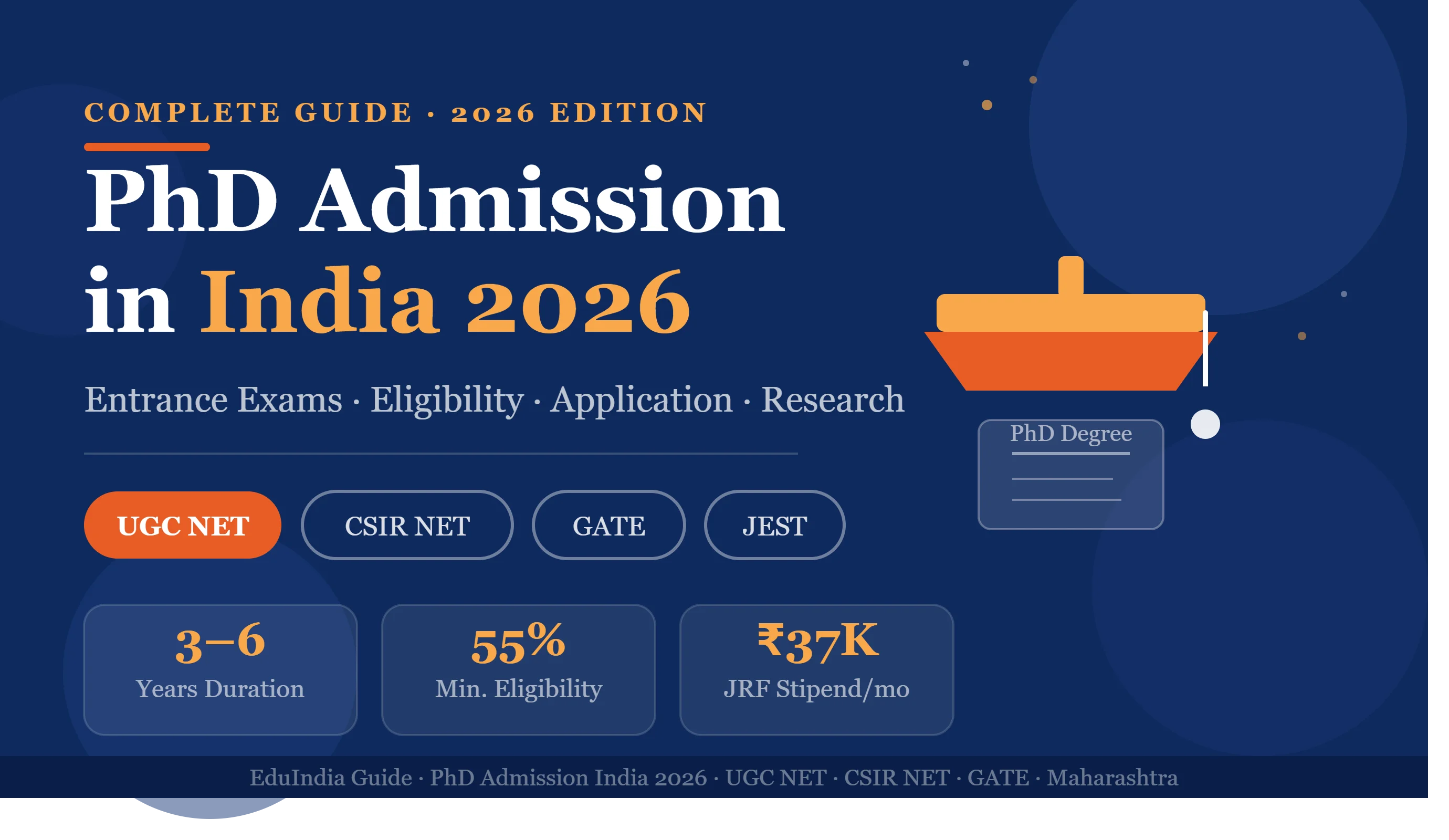
Overview of PhD Admissions in India 2026Pursuing a PhD in India is one of the most intellectually rewarding journeys a graduate can undertake. In 2026, the landscape of PhD admission in India has become more structured, competitive, and opportunity-rich than ever before. Whether you are targeting central universities, IITs, IIMs, IISc, or state universities including those in Maharashtra, knowing the full picture is essential before you apply.India admits doctoral candidates through a mix of national entrance exams, institutional tests, and fellowship pathways. The key national exams include the UGC NET, CSIR NET, and GATE — each designed for specific academic disciplines. This guide covers every major dimension of the PhD admission process: eligibility, entrance exams, application forms, syllabus, and what it truly takes to secure a spot in a top Indian research institution in 2026.At a Glance:Minimum Eligibility: Master's degree with 55% marks (50% for reserved categories)Key Entrance Exams: UGC NET, CSIR NET, GATE, and university-specific testsDuration: Minimum 3 years, typically 4–5 years, maximum 6–8 yearsApplication Season: Most universities open PhD application forms between February and August 2026What is the Eligibility for PhD in India?Quick Answer: To be eligible for PhD admission in India in 2026, you must hold a Master's degree (or equivalent) with at least 55% marks (50% for SC/ST/OBC-NCL/PwD/EWS candidates) in a relevant discipline from a recognised university. Alternatively, a 4-year undergraduate honours degree with a minimum CGPA of 7.5/10 is now accepted by many central universities under the National Education Policy (NEP) 2020 framework.Detailed Eligibility CriteriaEducational Qualification:Master's degree in a relevant subject from a UGC-recognised university with a minimum of 55% aggregate marks.Reserved Category: SC/ST/OBC (Non-Creamy Layer)/PwD candidates require only 50% marks at the Master's level.NEP 2020 Route:Candidates holding a 4-year Bachelor's degree with Research (FYUGP) with 75% or 7.5 CGPA are now eligible for direct PhD at several central universities.Appearing Candidates: Students in the final year of their Master's degree may apply provisionally, subject to meeting criteria upon result declaration.Age Limit: No fixed upper age limit for PhD in India. JRF fellowships, however, have an upper age limit (usually 28–31 years).GATE/NET Requirement: Varies by institution. Some require a valid national-level score; others conduct their own entrance exam.Important Note: Always verify the eligibility conditions on the specific university's official notification, as conditions for PhD admission in Maharashtra 2026 or other state universities may differ slightly from central university norms.Overview of PhD Entrance Exams in India 2026Cracking the right entrance exam is the gateway to PhD admission in India. In 2026, there are several pathways available — ranging from national fellowships to institutional tests.1. UGC NET for PhD AdmissionThe University Grants Commission National Eligibility Test (UGC NET) is the most widely recognised qualification for PhD admission across humanities, social sciences, commerce, management, education, and computer science. Clearing UGC NET — especially with a JRF (Junior Research Fellowship) rank — opens doors at almost all central and state universities in India.Conducting Body: National Testing Agency (NTA)Mode: Computer-Based Test (CBT)Frequency: Twice a year (June and December cycles)Subjects: 83+ subjects across arts, commerce, law, education, and sciencesValidity: JRF is valid for 2 years; NET qualification has no expiry for admission purposesStipend (JRF): ₹37,000/month for the first 2 years, ₹42,000/month subsequently2. CSIR NET for PhD AdmissionThe CSIR-UGC NET is the premier exam for PhD admission in science disciplines — covering Life Sciences, Chemical Sciences, Mathematical Sciences, Physical Sciences, and Earth Sciences.Conducting Body: CSIR (Council of Scientific and Industrial Research) with NTAMode: Computer-Based TestFrequency: Twice a year (June and December)JRF Stipend: ₹37,000/month (enhanced after 2 years)Best For: Science graduates targeting research institutes, IITs, IISc, and CSIR laboratories3. GATE for PhD AdmissionThe Graduate Aptitude Test in Engineering (GATE) is mandatory for PhD admission in engineering, technology, and applied sciences at IITs, NITs, and several central universities.Conducting Body: IITs on a rotational basis (with IISc)Mode: Computer-Based TestFrequency: Once a year (typically February)Validity: 3 yearsHTRA Stipend: ₹37,000–42,000/month for PhD scholars at centrally funded institutes4. Other PhD Entrance Exams 2026JEST: Joint Entrance Screening Test for Physics and Theoretical Computer Science (IISc, TIFR, etc.)TIFR GS: Tata Institute of Fundamental Research Graduate School AdmissionsUniversity-Specific Exams: Delhi University, BHU, Osmania, Hyderabad University, and state universities conduct their own PhD entrance exams.Maharashtra State PhD Entrance Test (PET): Universities like SPPU (Savitribai Phule Pune University), Mumbai University, and Nagpur University conduct their own PhD entrance tests for PhD admission in Maharashtra 2026.UGC NET vs GATE for PhD Admission — Which is Better?Quick Answer: The answer depends entirely on your discipline. UGC NET is better for humanities, social sciences, commerce, law, and education, while GATE is the right choice for engineering, technology, and applied sciences. If you need a funded fellowship and are in a science subject, CSIR NET is ideal. Both NET and GATE offer monthly stipends to PhD scholars at nationally funded institutions. Comparison FactorUGC NET / CSIR NETGATESuitable DisciplinesHumanities, Social Sciences, Commerce, Sciences (CSIR NET)Engineering, Technology, Architecture, SciencesConducting BodyNTA / CSIRIITs + IIScFellowship AvailableYes — JRF ₹37,000–42,000/monthYes — HTRA ₹37,000–42,000/month at IITs/NITsValidityJRF: 2 years; NET: Lifetime3 yearsAccepted ByCentral Universities, State Universities, Deemed UniversitiesIITs, NITs, IISc, Central Universities (technical)Additional BenefitAssistant Professor eligibility (UGC NET)PSU recruitment, MTech admissionFrequencyTwice a yearOnce a year (February)Expert Tip: If you are from a science background with options in both, consider attempting CSIR NET for JRF fellowship and GATE for IIT/NIT admission simultaneously — there is no restriction on appearing for both.PhD Without NET in India — Is It Possible?Quick Answer: Yes, PhD without NET in India is possible. Many prestigious institutions — including IITs (using GATE scores), IISc, TIFR, JNCASR, and numerous state universities — accept candidates through their own institutional entrance exams, interviews, or research aptitude tests. However, UGC regulations require that PhD admission must include some form of qualifying entrance test, which can be the institution's own exam.Routes to PhD Without UGC NETIIT PhD (via GATE): GATE score + written test + interviewIISc Bangalore: GATE/JEST/CSIR NET or IISc own testTIFR:Own GS (Graduate School) entrance examJNCASR: Own entrance test in sciencePrivate Deemed Universities: Many conduct their own PhD entrance examsState University PhD Entrance Test:Maharashtra (SPPU PET, Mumbai University PhD test), Karnataka, Tamil Nadu, etc.Without JRF/NET, you may not be eligible for a UGC fellowship but may still receive institutional fellowships or external funding from ICSSR, DST, DBT, and other government bodies.How to Apply for PhD in India After Master's — Step-by-StepThe PhD application form 2026 process varies by institution but typically follows a standardised flow. Here is a practical step-by-step roadmap.Step 1 — Identify Your Research Area and Target Institutions
Before applying, be clear about your research interest and identify 3–5 institutions that have active faculty and funding in your area. Check the institution's PhD notification for 2026 on their official website.Step 2 — Clear the Relevant Entrance Exam
Qualify for UGC NET, CSIR NET, GATE, or the institution's own entrance test. JRF rank is preferred for funded positions. Keep your scorecard and admit card safely.Step 3 — Fill the PhD Application Form 2026
Visit the official admission portal of your target university between February and August 2026. Fill in academic details, upload documents (degree certificates, marksheets, NET/GATE scorecard, photo, ID), and pay the application fee.Step 4 — Write Your Research Proposal
Most PhD programmes in India require a Research Proposal of 1,000–3,000 words. This is a critical document. See the research proposal section below for detailed guidelines.Step 5 — Appear for the Written Test / Interview
Many institutions conduct a second-stage written test and/or personal interview to assess research aptitude, subject knowledge, and proposal quality. Prepare thoroughly using the subject's PhD entrance exam syllabus in India.Step 6 — Admission and Enrolment
After merit list publication, selected candidates must confirm admission, pay fees, and enrol within the stipulated time. A supervisor (guide) is usually allotted within the first semester.PhD Research Proposal India — Guidelines for 2026A strong PhD research proposal is often the deciding factor in competitive PhD admissions in India. It communicates your intellectual vision, methodological awareness, and readiness for independent research.Components of a PhD Research ProposalTitle: Clear, specific, and reflecting the scope of your research. Avoid vague or overly broad titles.Abstract / Executive Summary:150–300 words summarising the research problem, objective, and methodology.Introduction and Background:Contextualise the research problem. Why does this research matter now? What gap does it address?Literature Review: Demonstrate familiarity with existing work. Cite key papers, identify the gap your study will fill.Research Objectives: 3–5 clearly stated, measurable objectives derived from the problem statement.Research Methodology: Explain your methods — qualitative, quantitative, or mixed. Include data sources, sample design, tools, and analysis techniques.Expected Outcomes and Significance:What original contribution will your research make? Who will benefit?Timeline: A realistic semester-wise research plan (usually 3–5 years).References / Bibliography: Use standard citation format (APA, MLA, or Chicago as required by the institution).Pro Tip: Contact potential supervisors before submitting your application. A faculty member who has pre-read your proposal and agrees to guide you significantly improves your selection chances — especially at IITs, IISc, and NIT systems.PhD Entrance Exam Syllabus India 2026UGC NET Syllabus (General)Paper 1 (General):Teaching Aptitude, Research Aptitude, Reading Comprehension, Logical Reasoning, Data Interpretation, ICT, Higher Education System, Policies and AdministrationPaper 2 (Subject-Specific): Varies by subject. Full syllabus available on the NTA UGC NET website.CSIR NET Syllabus (Sciences)Life Sciences: Molecules and their Interaction, Cellular Organisation, Fundamental Processes, Cell Communication, Developmental Biology, System Physiology, Inheritance Biology, Diversity of Life Forms, Ecological Principles, Evolution and Behaviour, Applied Biology, Methods in BiologyPhysical Sciences: Mathematical Methods, Classical Mechanics, Electromagnetic Theory, Quantum Mechanics, Thermodynamics and Statistical Physics, Electronics and Experimental MethodsChemical Sciences: Inorganic, Organic, Physical Chemistry, Interdisciplinary TopicsMathematical Sciences: Analysis, Linear Algebra, Abstract Algebra, Topology, Statistics, Numerical AnalysisEarth, Atmospheric, Ocean and Planetary SciencesGATE SyllabusGATE covers 29 engineering and science papers. Each paper has a core technical syllabus (70% weightage) and General Aptitude (15%) and Engineering Mathematics (15%). Refer to the official GATE 2026 information brochure for detailed subject-wise syllabi.Always download the official syllabi from ugcnet.nta.ac.in and the IIT GATE website. Third-party sources may be outdated or inaccurate for the 2026 cycle.Part-Time vs Full-Time PhD in India — Pros and ConsChoosing between a part-time and full-time PhD in India is a significant life decision. Both modes are recognised by UGC, but they come with very different trade-offs.Full-Time PhDPros:Faster completion (3–5 years)Eligible for JRF/SRF fellowship stipendFull access to lab, library, and facilitiesDeeper immersion in researchStronger publication record typicallyCons:Income depends on fellowship (can be limited)High personal and financial pressureRelocation often requiredLimited professional network buildingPart-Time PhDPros:Maintain employment and incomeApply real-world experience to researchNo need to relocateFlexibility in research scheduleCons:Longer duration (up to 8 years maximum)Usually not eligible for JRF stipendRisk of work-research conflictLess peer interaction and supervision timeFewer universities offer itWho Should Choose Which? Choose full-time PhD if you are fresh from your Master's, eligible for a fellowship, and want to build a career in academia or advanced research. Choose part-time PhD if you are an industry professional seeking a doctorate to advance your career, move into teaching, or conduct applied research without sacrificing your income.How Long Does a PhD Take in India?Quick Answer: A PhD in India takes a minimum of 3 years and a maximum of 6 years for full-time candidates. Part-time PhD candidates have up to 8 years to complete their doctorate. The average completion time for most disciplines is 4 to 5 years. Extensions beyond 6 years require specific approval from the university's Academic Council.Under UGC regulations, the typical PhD timeline in India looks like this:Year 1: Coursework (mandatory under UGC norms — minimum 1 semester), literature review, research proposal finalisationYear 2–3:Data collection, field/lab work, primary researchYear 3–4:Data analysis, chapter writing, supervisor reviewsYear 4–5:Draft thesis submission, pre-submission seminar, external evaluationYear 5–6: Viva Voce (oral defence), revisions, final award of degreeWhat Are the Best Subjects for PhD in India in 2026?High-demand PhD subjects in India in 2026 include:Artificial Intelligence and Machine Learning (high demand and funding)Biotechnology (high demand and funding)Data Science (high demand and funding)Environmental Science (high demand and funding)Pharmaceutical SciencesMaterials ScienceManagement / Business AdministrationLaw (LLD/PhD)PsychologyMathematicsEducationPublic HealthIn 2026, interdisciplinary PhD programmes — such as AI + Healthcare, or Law + Technology (RegTech) — are seeing growing interest and funding from both government agencies like DST and SERB, and private sector research partnerships.PhD Admission in Maharashtra 2026Maharashtra is home to some of India's most prestigious research institutions. PhD admission in Maharashtra 2026 is offered through both state-level universities and centrally funded institutions spread across Mumbai, Pune, Nagpur, Aurangabad, and Nashik.Top Institutions for PhD in Maharashtra 2026IIT Bombay (Mumbai): All STEM disciplines. Requires GATE/CSIR NET. One of India's premier PhD research destinations.Savitribai Phule Pune University (SPPU): Wide range of subjects. Conducts its own PhD entrance exam (PET). Applications typically open March–May.University of Mumbai: Strong in Humanities, Sciences, Law, and Management PhD programmes. Own entrance exam.TIFR Mumbai: Theoretical sciences, Mathematics, Biological Sciences. Very competitive national-level entrance test.Rashtrasant Tukadoji Maharaj Nagpur University: Diverse PhD programmes across faculties. Own entrance exam.Dr. Babasaheb Ambedkar Marathwada University (BAMU), Aurangabad: Social Sciences, Law, Science PhD programmes.IGIDR Mumbai: Economics, Finance, and Development Studies PhD.ICT Mumbai:Pharmaceutical and Chemical research PhD.Maharashtra PhD Entrance ProcessMost Maharashtra state universities follow the State Common Entrance Test Cell format or conduct their own PhD Entrance Test (PET). Key steps for PhD admission in Maharashtra 2026:Check the university notification (usually February–June 2026)Fill the PhD application form on the university's official portalAppear for the PhD entrance exam / PETAttend the personal interview / research proposal presentationMerit list declaration and enrolmentMaharashtra-Specific Note: Several Maharashtra universities accept UGC NET/JRF holders as exempt from the university's own PET exam. Always verify this exemption clause in the current year's official notification before registering for the entrance test.
PhD Admission in India 2026: Complete Guide to Entrance Exams, Eligibility & Application