Sign up with Google
 Sign in with Zoho

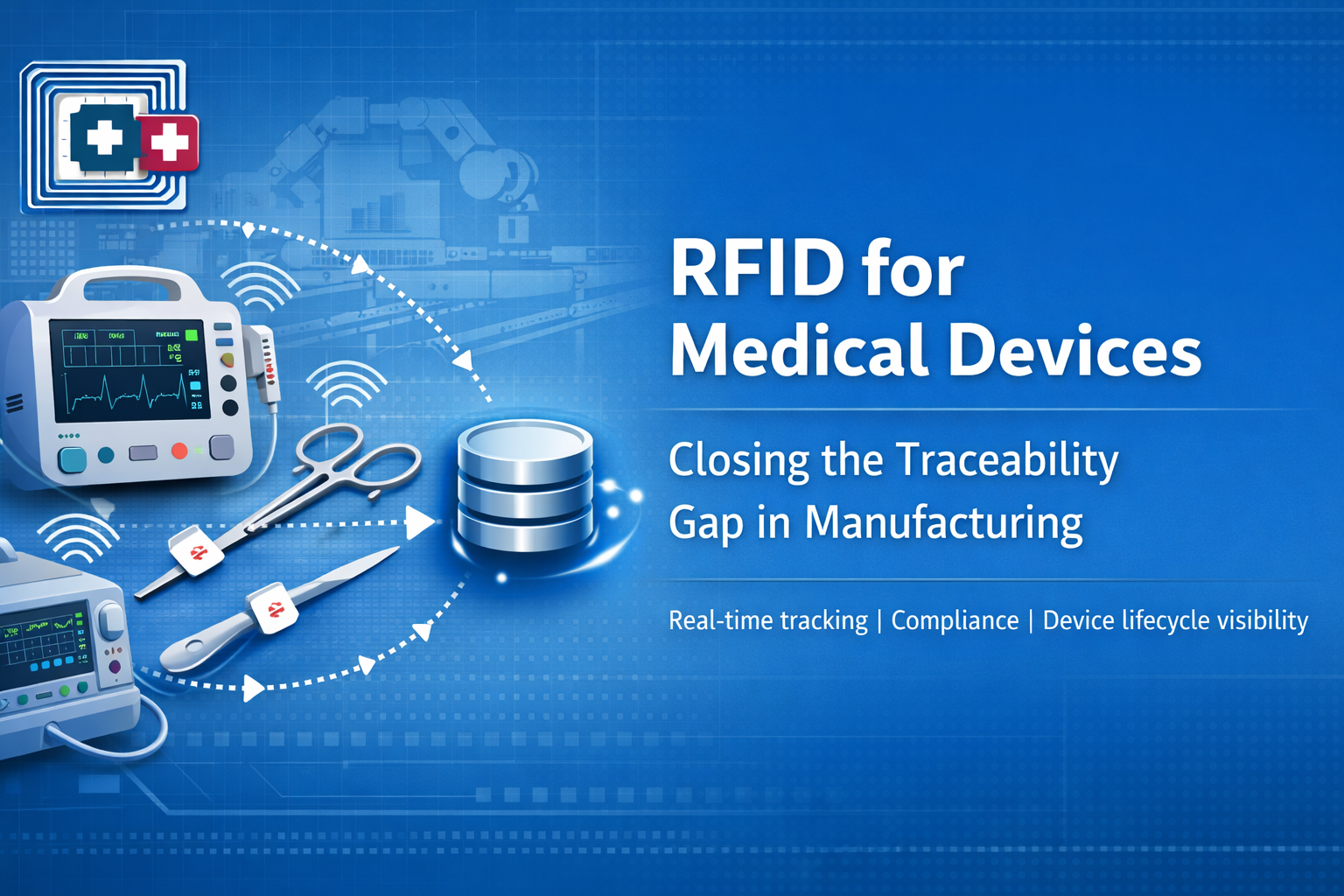
Think about what goes into a pacemaker before it reaches a patient. Dozens of components sourced from multiple suppliers. Assembly across several workstations. Multiple operators, specialized tools, mandatory quality checkpoints. By the time the device ships, it carries the full weight of that process with it — and somewhere in a regulatory filing, every detail of that process is supposed to be documented and verifiable.
That documentation isn't optional. The US FDA's Unique Device Identifier regulations and the EU Medical Device Regulation both require manufacturers to maintain complete, accurate records for every device that leaves the facility. Auditors can ask for them. Recall situations demand them fast. And yet, for many manufacturers, producing that record still involves pulling data from spreadsheets, paper logs, and operator notes — none of which stay synchronized in real time.
This is the gap RFID closes.
The Traceability Problem Most Manufacturers Know Too Well
Barcode scanning has been the workhorse of production-floor data capture for years, and it works reasonably well in controlled conditions. The catch is that it demands line-of-sight contact with every item at every stage. Operators have to physically stop, locate the barcode, orient the scanner, and log the event. On a busy production floor, that requirement creates predictable gaps. Items get moved without being logged. Workstations get skipped during a rush. The record that emerges looks complete on paper but doesn't always reflect what actually happened.
For most industries, a gap in the production record is an inconvenience. In medical device manufacturing, it's a regulatory exposure and, more importantly, a patient safety risk.
RFID for medical devices works differently. Tags attached to devices, components, tools, and even operator badges communicate wirelessly with readers mounted at fixed points throughout the facility. Nothing needs to be manually scanned. As an item moves through a workstation, the system logs it — time-stamped, automatic, no operator action required.
From Raw Material to Finished Device
Traceability in medical device manufacturing doesn't start at the assembly line. It starts the moment raw materials come through the receiving dock.
When components arrive from a supplier, they're tagged and entered into the tracking system with their batch and lot identifiers. From that point, every downstream use of those components is tied back to that original record. If a batch is later found to be defective — weeks or months after the devices containing it have shipped — the system can identify precisely which finished products were affected, without a manual audit through warehouses full of paper.
On the production line itself, work-in-progress tracking tends to be where manual systems fall apart fastest. Capturing start and stop times at each workstation requires an operator to scan at the beginning and end of every stage. In practice, that rarely happens consistently. RFID readers at each station capture arrivals and departures automatically, giving the system a continuous, unbroken record of where each device has been and for how long. If a device spends twice as long at a particular workstation as it should, or skips a mandatory quality check, the system flags it in real time rather than after the fact.
Tools, Operators, and Why They Both Matter
Medical device manufacturing is precise work, and it depends on tools staying calibrated and within their designated use parameters. A torque wrench used past its calibration date, or a specialized fixture moved to a workstation it wasn't assigned to, can affect every device touched during that window. Manual systems can track this in theory — in practice, tracking tool locations and calibration status across a full production shift requires discipline that's difficult to maintain consistently.
RFID-tagged tools report their location in real-time. The system knows if a tool has been moved where it shouldn't be, and it knows when a calibration or maintenance interval is approaching. Alerts go out before a problem occurs rather than after devices have already been manufactured.
Operator tracking works along the same lines. Every person working on the production line carries an RFID badge. The system records who worked on each device at each stage — which matters both for quality investigations and for FDA audit trails that require operator identification in the production record.
What Happens to the Device History Record?
The FDA requires manufacturers to maintain a Device History Record for each device. The DHR has to capture raw material information, manufacturing dates, tool usage, operator identities, quality check results, and unique device identifiers — among other things. Manually filling this in later creates a significant administrative burden, and records assembled from memory or partial logs are harder to defend under scrutiny.
When RFID handles data capture throughout production, the DHR fills itself. By the time a device reaches the end of the line, its record is already complete. What used to take hours of documentation work becomes a report the system generates on demand.
Recalls: Speed Is Everything
Product recalls in this industry are genuinely serious events. When a defect is identified in a batch of devices already in circulation, the manufacturer needs to locate affected units quickly — across distribution centers, hospital systems, and in some cases, patients already using the devices.
The speed of that response depends entirely on the quality of the traceability record. A system that can answer the question 'which devices incorporated components from this specific supplier lot?' in minutes rather than days changes the scope of a recall significantly. Fewer devices need to be pulled from circulation. The manufacturer can provide regulators with precise information quickly. And the risk to patients is addressed faster.
That outcome isn't possible with a system that relies on paper-based records or manually reconciled spreadsheets. It requires data that was captured in real-time, automatically, and reliably throughout the production process.
Integration with the Broader Manufacturing Stack
Traceability data is most useful when it is integrated with other systems. RFID systems that connect to ERP platforms allow real-time production data to inform material procurement, work order management, and inventory planning. When a batch of components is consumed in production, the inventory record updates automatically. When a production stage is completed, work order status reflects it without a separate manual entry.
This kind of integration also supports audit readiness. Instead of pulling data from multiple disconnected systems and reconciling it before an inspection, manufacturers have a single, unified record that covers everything from incoming materials to outgoing finished devices.
What RFID delivers in medical device manufacturing?
- Automatic data capture at every production stage — no manual scanning required
- Batch and lot-level traceability for all raw materials from the moment they arrive
- Real-time WIP visibility, including detection of skipped quality steps or extended dwell times
- Tool location and calibration management with proactive maintenance alerts
- Operator-level production records tied to each device for complete audit trails
- Automatic Device History Record population — documentation happens during production, not after
- Faster, more targeted recall response using precise batch and production data
- ERP integration for unified visibility across inventory, production, and compliance
RFID doesn't replace the discipline required in medical device manufacturing. What it does is remove the reliance on manual effort for tasks that manual effort reliably gets wrong — not because operators are careless, but because the volume and pace of production makes consistent manual data capture an unrealistic expectation. Accurate traceability, under those conditions, needs to be a function of the system rather than a function of individual attention.