Sign up with Google
 Sign in with Zoho
Hiring a Google Ads agency is supposed to make advertising easier.
You hand the account to someone who understands the platform, they manage the campaigns, and you focus on running your business.
But after a few months, a question often starts creeping in: Is my Google Ads agency actually doing a good job?
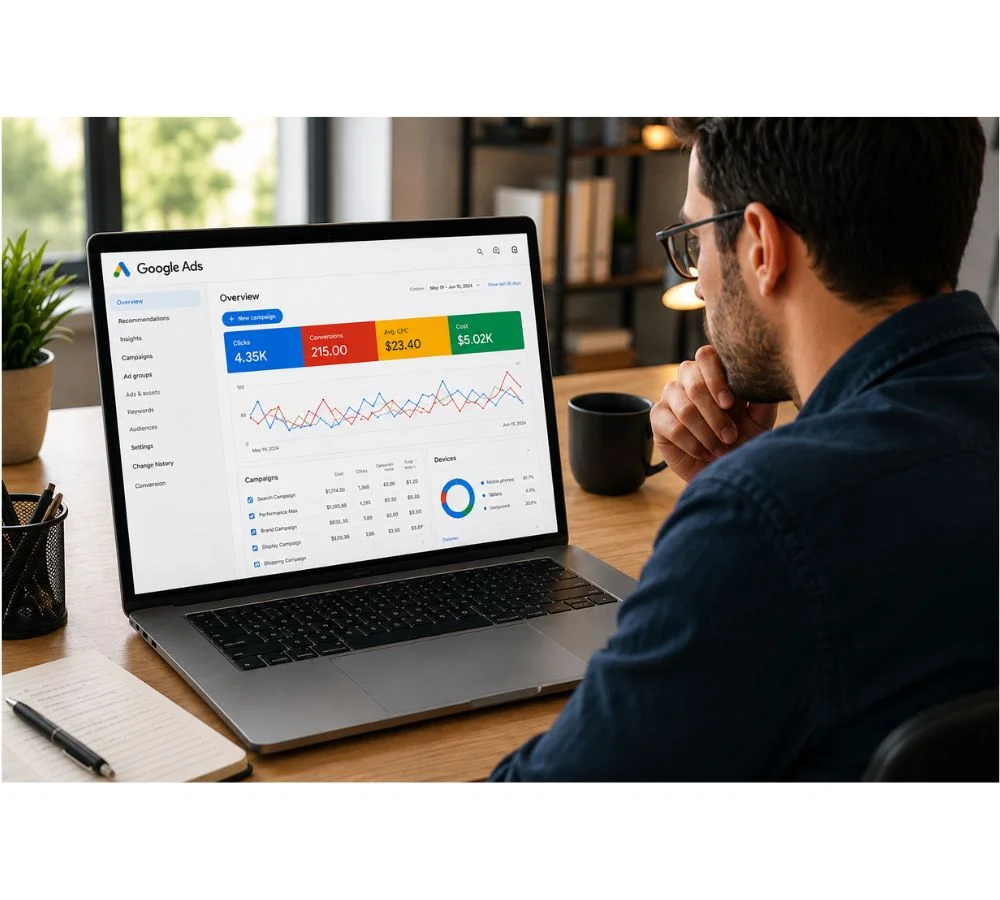
The problem is that Google Ads can look complicated from the outside. An agency can send you a report filled with impressions, clicks, CTR, conversions and graphs - and you can still have no idea whether your advertising is actually improving.
I've worked with Google Ads accounts for more than five years and audited over 100 accounts. When I review an account managed by another agency, I don't judge it by how impressive the monthly report looks.
I look at what is actually happening inside the account.
Here are eight things I would check.
1. Are You Getting Business Results, Not Just Clicks?
Start with the simplest question: Is Google Ads generating something valuable for your business?
For a local service company, that might mean qualified calls, booked appointments or quote requests. For an e-commerce business, it might mean purchases, revenue and profitable ROAS.
Clicks and impressions are useful diagnostic metrics, but they aren't the final objective.
Imagine an agency reports: “Traffic increased 35% this month.” Sounds good. But what happened to sales?
If clicks increased 35% while qualified leads stayed flat, I'm going to want to know why.
A good agency should be comfortable discussing business outcomes, not just advertising activity.
2. Do They Know Which Searches Are Spending Your Money?
This is one of my favorite places to look during an audit.
Your keywords and the searches people actually type into Google aren't always the same thing.
Suppose you're a plumbing company targeting a broad plumbing-related keyword. Your ads could potentially attract searches related to plumbing jobs, DIY plumbing, plumbing courses or cheap plumbing supplies.
Those clicks may technically be related to plumbing, but they're probably not customers.
Your agency should regularly review search terms, exclude irrelevant traffic where appropriate and identify valuable new search themes.
If nobody has touched the search terms for months, I'd want an explanation.
3. Is Conversion Tracking Actually Correct?
This is a big one.
I've seen accounts where the reported performance looked fantastic until I checked what Google was counting as a conversion.
Sometimes multiple tracking systems are counting the same action. Sometimes an insignificant action is set as a primary conversion. Sometimes calls aren't tracked properly. And sometimes the conversion tracking has stopped working altogether.
If Google Ads reports 100 conversions, you should be able to answer: What exactly were those 100 conversions?
A form? A purchase? A phone call? An appointment? A page view?
If neither you nor the agency can answer that clearly, don't make major budget decisions based on the conversion column yet.
4. Are They Checking Lead Quality?
This matters particularly for service businesses.
Let's say your agency reduced your cost per lead from $100 to $60. That's a 40% improvement. Great, right? Maybe.
Now ask your sales team.
If the $100 leads regularly became customers while the new $60 leads are spam, irrelevant enquiries or people who never answer, performance hasn't really improved.
This is why I like connecting advertising data with what happens after the lead.
Google Ads shouldn't be optimized simply to produce the cheapest possible form submission. It should ultimately help produce customers.
5. Can They Explain Where Your Budget Is Going?
You shouldn't need to understand every Google Ads setting. But you should understand where your money is being spent.
If you're spending $10,000 per month, your agency should be able to explain which campaigns receive most of the budget, which campaigns produce the best results, where money is being wasted, what changed this month and what they are testing next.
You don't need a 50-page report. In fact, I often prefer the opposite.
A useful report should make the important things easier to understand, not hide them behind marketing terminology.
6. Are They Constantly Changing Things Without a Reason?
An active agency isn't necessarily a good agency.
Google Ads needs optimization, but making changes simply to show that work was performed can hurt performance.
Imagine a campaign starts improving. Then someone changes the bidding strategy. Three days later they restructure the campaign. Then they change the budget. Then new ads are introduced.
Now performance drops. Which change caused it? Nobody knows.
A good Google Ads manager should be able to explain why an important change was made and what they expect it to accomplish.
Sometimes the correct decision is to leave a campaign alone long enough to gather meaningful data.
7. Do You Own Your Google Ads Account?
This is something I'd check before hiring an agency, not after leaving one.
Your business should retain appropriate ownership and access to its advertising assets and data.
If you decide to change providers, years of campaign history shouldn't disappear with the agency.
The same principle applies to important measurement and business assets surrounding the account.
You are paying to build that history. Make sure you can keep it.
8. Does Your Agency Have a Plan Beyond “Spend More”?
Increasing budget can make sense when a campaign is producing profitable customers and there's additional demand available.
But increasing budget shouldn't be the answer to every performance problem.
If leads are poor quality, increasing budget can simply buy more poor-quality leads. If search terms are irrelevant, you can spend more money on irrelevant searches. If conversion tracking is broken, scaling gives the bidding system more money while feeding it bad information.
Before increasing budget, I'd want to know: What's currently working? What's limiting growth? Where will the additional money go? What result are we expecting from it?
“Google recommends increasing your budget” isn't enough on its own.
How Do You Choose the Right Partner for Paid Search Campaigns?
This is one of the questions business owners should ask before handing over an advertising account.
I wouldn't choose a Google Ads partner based only on certifications, presentation slides or promises about ROAS.
Ask them to explain how they approach your actual business.
How will you measure a qualified lead? How often will search terms be reviewed? Who will actually manage my account? How will you decide when to increase the budget? How will you report what changed? Will I retain ownership of my account?
A good answer should make sense even if you aren't a Google Ads expert.
If every answer requires complicated terminology, that's not necessarily expertise. Sometimes it's just complexity.
A Simple Way to Evaluate Your Agency
You don't need to become a Google Ads specialist to hold an agency accountable.
Start with four questions: Where did our money go? What business results did it produce? What did you change and why? What are you doing next?
If your agency can answer those questions clearly and the business results support the answers, that's a good sign.
If you're consistently receiving reports but still can't tell whether Google Ads is actually helping your business, it may be worth getting a second opinion.
Because good Google Ads management shouldn't make the account harder for the business owner to understand. It should make the decisions clearer.
Author Bio
Gurdeep Singh is the founder of Adzlance and has more than five years of experience managing paid media and auditing Google Ads accounts. He works across Google Ads, Meta Ads, conversion tracking and performance-focused advertising strategy.