Sign up with Google
 Sign in with Zoho

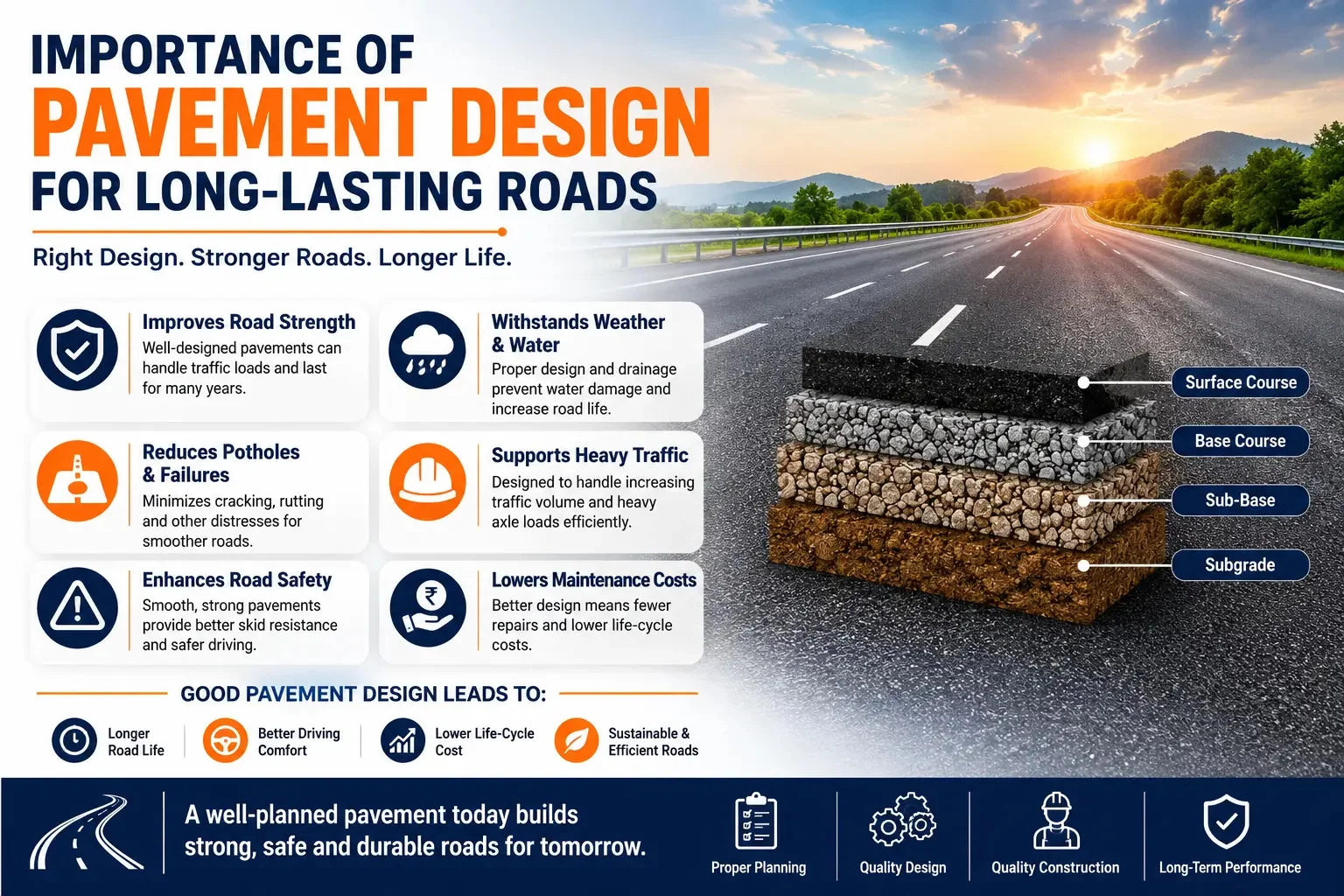
A properly designed pavement helps a road remain strong, safe, comfortable, and economical throughout its service life. On the other hand, poor design can result in potholes, cracks, rutting, uneven surfaces, water damage, and frequent maintenance. These problems not only increase repair costs but can also affect road safety and traffic movement.
Read Full Blog - https://sunconengineers.com/importance-of-pavement-design-for-long-lasting-roads/
1. Improves the Long-Term Strength of Roads
One of the main reasons pavement design is important is that it determines how well a road can carry traffic over time.
Every vehicle travelling on a road applies a load to the pavement. Heavy trucks and commercial vehicles can place particularly high stresses on pavement layers. If the pavement structure is not designed according to expected traffic conditions, the road may deteriorate much faster than planned.
Good pavement design for roads considers factors such as traffic volume, axle loads, soil conditions, climate, drainage, and the expected service life of the road. This allows engineers to select suitable pavement layers and thicknesses.
A strong pavement structure distributes vehicle loads effectively and reduces excessive stress on the underlying soil. This helps the road maintain its strength even under repeated traffic loading.
2. Reduces Potholes and Surface Failures
Potholes are one of the most common problems found on poorly maintained roads. They can develop because of several factors, including weak pavement layers, water infiltration, inadequate drainage, repeated traffic loading, and unsuitable materials.
Proper pavement engineering helps reduce these risks from the beginning.
When pavement layers are properly designed and constructed, they can withstand expected traffic and environmental conditions more effectively. Correct material selection, adequate thickness, proper compaction, and good drainage all contribute to a stronger road pavement.
This does not mean a well-designed road will never require maintenance. Every road eventually needs maintenance. However, good design can significantly reduce premature failures and help maintenance activities remain manageable.
3. Helps Roads Handle Heavy Traffic
Modern roads often carry significantly more traffic than they did in the past. Highways, industrial roads, urban corridors, and logistics routes may experience continuous movement of heavy vehicles.
This makes highway pavement design particularly important.
Engineers need to estimate present and future traffic before finalizing pavement requirements. A road designed only for today's traffic may struggle if vehicle numbers increase significantly over the years.
Traffic analysis helps engineers understand the expected number of vehicles and the impact of heavy axle loads. Based on this information, suitable pavement materials, layer thicknesses, and structural requirements can be selected.
A well-planned pavement can therefore support traffic growth while reducing the risk of early structural damage.
4. Provides Better Resistance to Weather Conditions
Roads are exposed to changing weather throughout their service life. Heavy rainfall, high temperatures, moisture, and temperature variations can all affect pavement performance.
Water is particularly damaging when it enters pavement layers and remains trapped inside the structure. Moisture can weaken supporting layers and subgrade soil, eventually leading to cracks, potholes, settlement, and other failures.
This is why drainage should be considered alongside pavement design.
Effective road design should ensure that rainwater can move away from the pavement quickly. Proper slopes, drainage systems, shoulders, and pavement layers can help minimize water-related damage.
In regions that experience heavy rainfall, climate conditions should be carefully considered during road pavement design methods and construction planning.
5. Supports Better Road Safety
Road condition has a direct relationship with road safety.
Cracked surfaces, potholes, uneven pavement, rutting, and settlement can make driving uncomfortable and potentially dangerous. They may cause vehicles to lose stability, especially at higher speeds or during wet conditions.
A properly designed pavement provides a smoother and more stable driving surface. Good pavement performance also helps maintain road geometry and reduces unexpected surface defects.
Therefore, pavement design is not only an engineering or cost consideration. It is also an important part of creating safer transportation infrastructure.
6. Helps Select the Right Pavement Type
Different roads have different requirements. There is no single pavement structure that is suitable for every project.
Depending on traffic, soil, climate, construction conditions, budget, and expected service life, engineers may consider different pavement solutions.
For example, flexible pavement design is commonly used for many roads and highways because of its adaptability and construction flexibility. Asphalt-based pavement systems can be designed with multiple layers to distribute traffic loads.
On the other hand, rigid pavement design uses concrete pavement and can be suitable for locations where high durability and heavy-load performance are required.
The selection should be based on engineering evaluation rather than simply choosing the cheapest initial option.



.webp)