Sign up with Google
 Sign in with Zoho

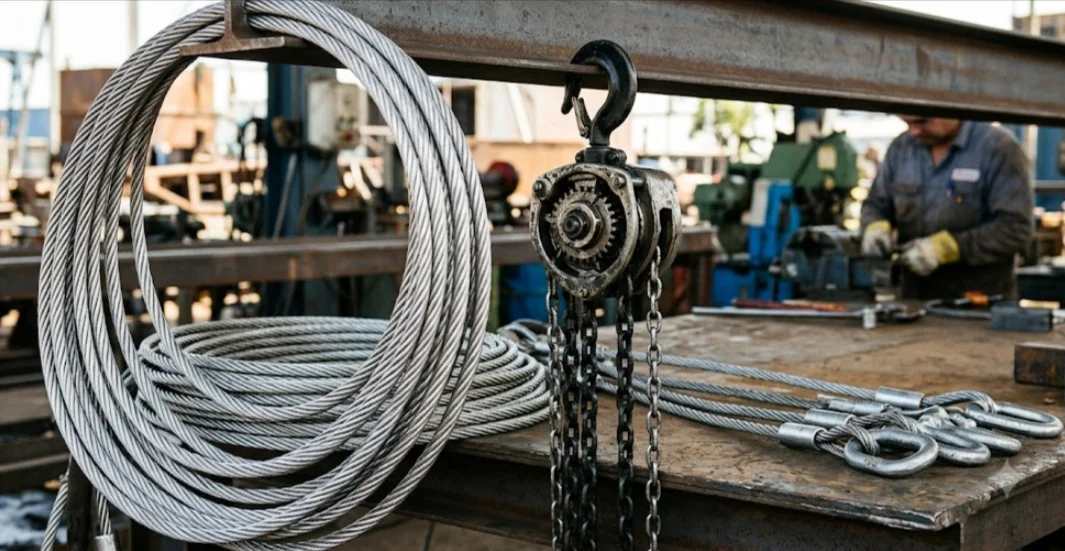
When dealing with multi-ton loads, harsh marine environments or high-stakes construction sites, there’s no place for guesswork. Safety, load sharing and material durability are the non-negotiables that determine whether a project moves forward smoothly or comes to a sudden, expensive halt.
Among the many rigging and lifting equipment, two workhorses stand a head and shoulders above the rest. These are stainless steel wire ropes and chain blocks.
Whether you’re securing balustrades on a coastal balcony or lifting heavy machinery in a workshop, knowing how to properly pair these tools is key to maximum operational efficiency and peace of mind.
Stainless Steel Wire Ropes: The Corrosion-Resistant Powerhouse
Wire ropes are the central nervous system of modern lifting, tensioning and rigging systems. All wire ropes are not created equal. Regular galvanised steel is good for basic indoor operations, but harsh outdoor environments like marine ports, chemical processing plants and architectural applications require something much stronger.
What Makes Stainless Steel So Different?
Excellent corrosion resistance:
Molybdenum added to grade 316 stainless steel greatly improves its resistance to salt water, harsh chemicals and industrial atmospheres.
Excellent Strength-to-Weight Ratio:
Constructed with tightly braided strands (such as 1x19, 7x7 or 7x19 construction), these ropes offer superior tensile strength without any additional weight.
Aesthetic & Structural Flexibility Stainless Steel wire ropes are not just for heavy lifting but also have a wide range of applications in structural architecture, shade sail tensioning & modern balustrades as they maintain a sleek, clean finish over decades.
The choice of wire rope strand configuration is very important: a 1×19 construction is stiff and is good for straight tensioning, while a 7×19 rope offers maximum flexibility for running over pulleys and sheaves.
Heavy Lifting, Made Easy: The Manual Chain Block
Chain blocks (also called manual chain hoists) provide the controlled mechanical advantage needed to lift massive static loads vertically, while wire ropes are responsible for the reach, tension and flexible pulling power.
A chain block uses a simple system of internal gears, usually a planetary gear system, to multiply small manual pulling forces on a hand chain into enormous lifting force on a load chain.
Advantages of Chain Blocks
No electricity required – ideal for remote job sites, field maintenance or temporary installations where power sources are unavailable.
Compact Portability: Easily transported, rigged to a gantry beam or moved between workstations.
Precision Control: With mechanical brake systems, operators can lift, hold and lower heavy equipment down to the millimetre.
Maximum Efficiency of Chain Blocks with Wire Ropes
Chain blocks and stainless steel wire ropes are often a match made in heaven for real-life rigging setups.
For example, in a marine hoist or in overhead cranes operating in a humid environment, main winch line is a stainless steel wire rope and a high tonnage chain block is used for local lift to move components into position.
Pro Tip: Keep the Working Load Limit (WLL) the same for all components in your rigging set up. A system is only as strong as its weakest shackle, hook or wire link.
In terms of sourcing heavy duty hardware that meets the most rigors safety standards, there’s nothing like working with established industry suppliers. The industry professionals look to specialists like Kebles Trading for reliable, certified lifting and rigging hardware built tough for the Australian conditions. You’ll get high-grade, compliant solutions from us.
Safety Checklist for All Lifts 4 Rules
Before attempting any lift it is important to run through a standard safety checklist:
Check for Fraying: Along the entire length of the wire rope where it works, inspect it for broken wires, bird-caging or severe kinking.
Check brake function: Check the automatic load brake on the chain block under a light load before lifting at full capacity.
Overloading is not allowed. Do not exceed the stamped Working Load Limit on the chain block or wire rope assembly.
Correct Storage: Keep chain blocks and wire ropes off the ground in a dry, ventilated place to avoid unnecessary wear and contamination.
Conclusions
For a quality rigging gear, it's not just doing the job; it's protecting your team, your gear and your schedule.
Discover how to harness the unique qualities of stainless steel wire ropes and chain blocks to build safer, more efficient lifting systems capable of withstanding the toughest conditions.
Read more informative blogs - https://guestcountry.com/home