Sign up with Google
 Sign in with Zoho

Hello there! Interested in launching your DoorDash clone? Then you already know the online food delivery market is heading toward $1.51 trillion in global revenue by 2026. DoorDash has positioned itself firmly at the center of it. A 60%+ domestic market share in the US and more than 56 million active users monthly tell you how far that platform has come since its early days of restaurant partnerships and independent contractors.
While the numbers have told you the growth, what they don't show is where the gaps are: Regional markets, niche delivery models, and customer segments that don't fit the mass-market approach are where new platforms actually have room to grow.
So, how can you launch your DoorDash clone app quickly without spending a year or more building everything from scratch?
Why Building from Scratch Isn't Every Founder's First Choice Anymore
It may seem like a good idea to build a platform like DoorDash from scratch. You have total control of the product and can form each screen just the way you want.
In fact, this freedom has a high price tag.
An online delivery marketplace isn't just one application. It's several products in harmony. Customers require an easy-to-use ordering process. Each restaurant should have its own dashboard for menus and orders. Route management, earnings tracking, and navigation are required for delivery partners.
Above that is an admin panel that takes care of payments, commissions, support, analytics, and platform management.
All those moving parts can easily make a development process last longer than a year by the time they are all put together.
For many startups, the bigger risk isn't the development cost. It's taking months to develop software, only to find that the trend has passed and people no longer need what you built.
It's better to start early with a DoorDash clone app than to build long.
What is a DoorDash Clone, Anyway?
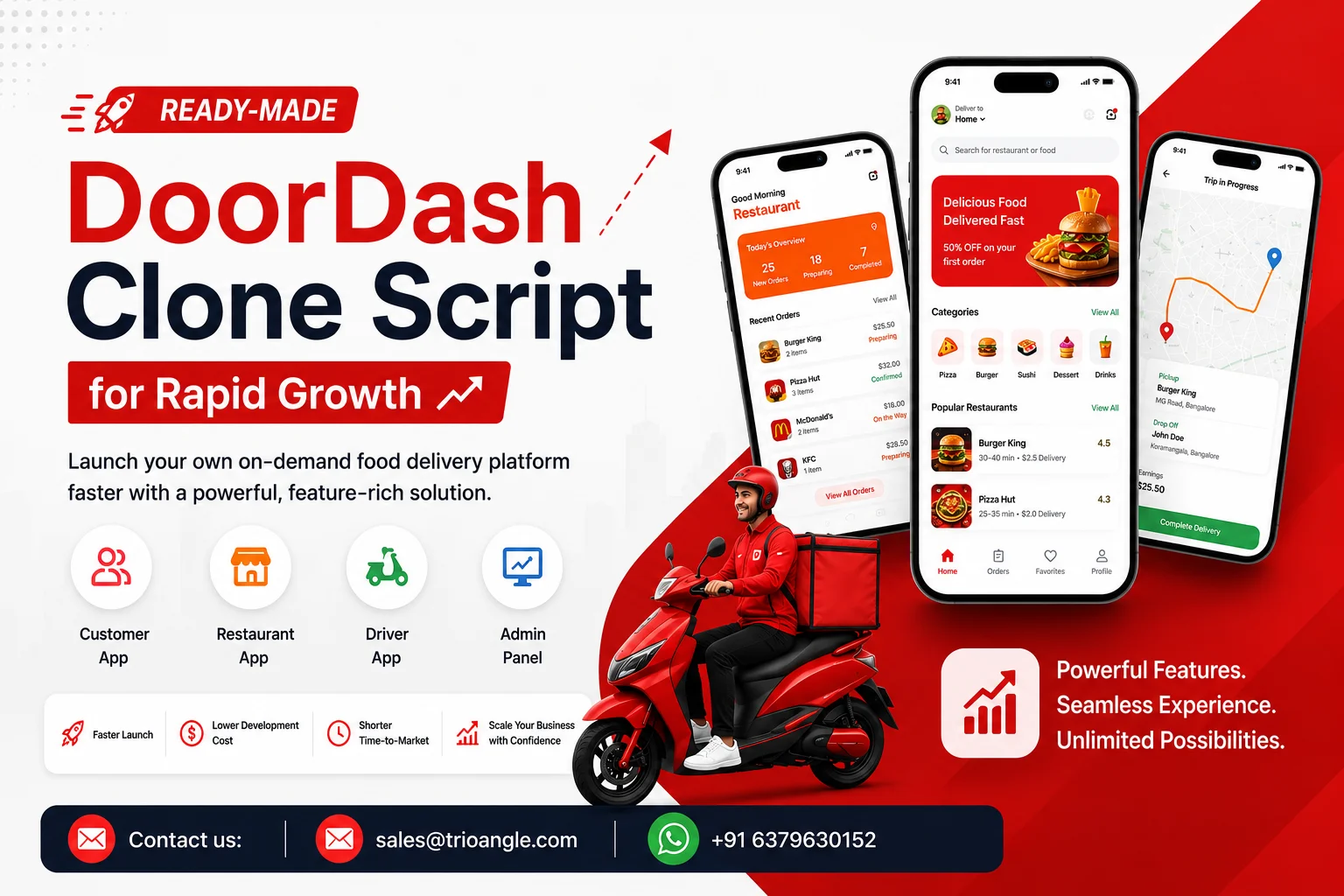
A DoorDash clone is the core infrastructure you need to operate an online delivery platform like DoorDash. It follows the same business model and workflow. So, you can concentrate on branding, local operations, and customer acquisition, rather than rebuilding common functionality.
A typical DoorDash clone app includes four separate interfaces:
- Customer App
- Restaurant dashboard
- Delivery partner app
- Admin panel
They all have their own specific functions, and they all play a part in ensuring that orders are processed smoothly.
Customer Panel
People don't often consider the technology behind clicking the “Order Now” button; they just want it to do its job the way it was intended.
This means it should be quick, familiar, and predictable from the time they open the application to the time their food arrives.
Core customer features of a DoorDash clone app:
- Find and discover restaurants
- Filters by category and cuisine
- Real-time order tracking
- Secure online payments
- Estimated delivery times
- Order history
- Ratings and reviews
- Push notifications
Notice that none of these features are particularly revolutionary.
That's because when people order dinner, they don't want to get novelty. They're looking for reliability.
Dozens of advanced features they will never use are less important than a smooth checkout and accurate delivery estimate.
Restaurant Panel
Restaurants have different priorities. They aren't focused on the interface; what they really need are tools. Tools that assist them in managing orders effectively during the busiest service times.
A restaurant portal should provide the following:
- Manage menus
- Update pricing
- Pause unavailable items
- Take or cancel orders
- Track incoming deliveries
- Monitor sales
- Access performance reports
A great restaurant panel helps streamline daily operations without adding extra friction, especially during peak hours.
One of the top reasons restaurants stay in a marketplace after signing up is this.
Delivery Partner App
Delivery partners are in the middle of restaurants and customers.
When their experience becomes frustrating, delivery times get longer, and customer satisfaction decreases.
A good delivery app will have the following features:
- Order requests
- Route optimization
- GPS navigation
- Earnings dashboard
- Delivery history
- Status updates
- Proof of delivery
A lot of founders tend to be very customer-centric and neglect the drivers.
In reality, it can be one of the most competitive differentiators that a marketplace can possess: having reliable delivery partners.
Admin Panel
When restaurants see one side of the platform, customers see another, and delivery partners see theirs, the admin sees it all.
The centralized dashboard offers a clear view of the platform operations, giving you complete control over the business.
Typical capabilities include:
- Restaurant approvals
- Driver verification
- Commission management
- Promotions
- Payment reports
- Customer support
- Platform analytics
- User management
If you don't have good administration tools, it's not easy to expand beyond a few restaurants.
Why a DoorDash Clone Script is a Better Idea than Building from Scratch
A DoorDash clone script is a pre-built software solution that comes integrated with all the frontend and backend architecture you need to launch your food delivery platform.
Now, this is usually the point where founders start comparing features.
- Is there live tracking on the platform?
- Do restaurants have the capacity to operate several branches?
- Is there an adequate variety of payment methods?
Those questions are important, but they're not the ones that make your project successful.
The first decision really comes down to time.
If you're looking to prove a market, get restaurants and begin transactions, it may not be the best use of your time to spend the next 15 months constructing infrastructure from scratch.
With the clone script, you are not rebuilding the groundwork for a food delivery platform; you're building on software that already knows how customers order, how restaurants get orders, how drivers deliver orders, and how money flows through the platform.
And no, a DoorDash clone script isn't some half-baked product promising a quick launch as a gimmick. It's simply a ready-made solution that offers businesses the advantage of time.
What Should You Customize Instead of Rebuilding Your DoorDash Clone?
The first mistake many founders make is assuming every part of a DoorDash clone script has to be unique. It usually doesn’t.
Customers should be familiar with the food delivery process. They shouldn't have to figure out the checkout process every time they install a new app.
Don't redesign all the marketplace functions, but concentrate on the ones that make your business unique.
That could include:
- A special attraction like healthy meals, local restaurants, or corporate catering
- Optimal delivery zones for smaller cities
- Repeat ordering loyalty programs
- Other payment options that are available locally but not on larger platforms
- Better restaurant onboarding
- Faster customer support
Those are competitive advantages.
Changing the location of the "Place Order" button in the script is not.
Top delivery companies don't always come out on top just because their software stands out. They thrive because their operational excellence sets them apart.
Conclusion
Building a food delivery platform like DoorDash no longer requires starting with a blank page.
A DoorDash clone offers a practical way to launch your own on-demand delivery business without having to spend months developing pre-existing systems. More importantly, it lets you concentrate on the areas of the business that really generate long-term value: restaurants, delivery partners, and a customer experience they can trust.
All you need is a reliable DoorDash clone script, a niche worth serving, and the willingness to get your first version out there. The platform doesn't have to be perfect on day one. It just has to start.