Sign up with Google
 Sign in with Zoho

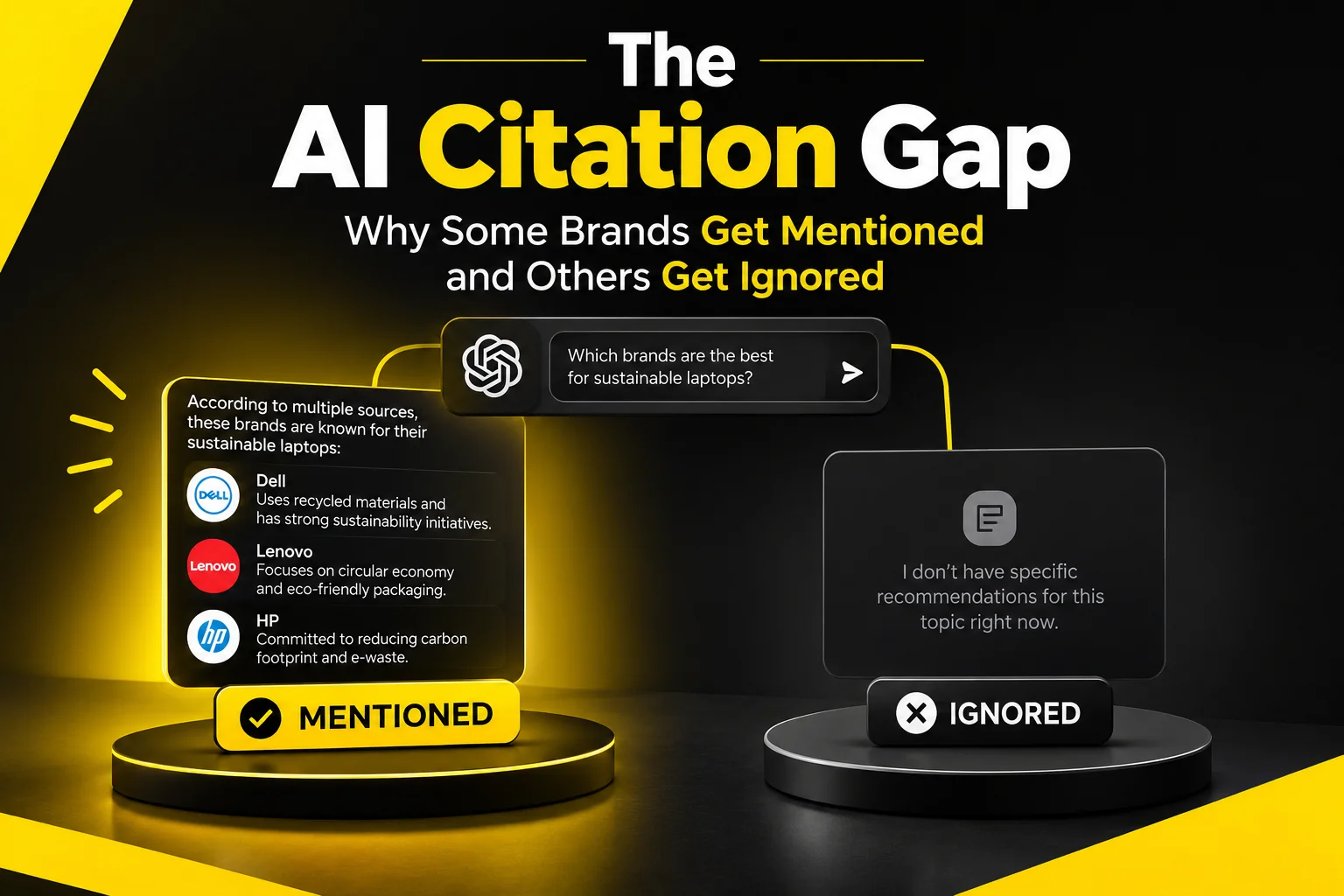
Ask ChatGPT, Perplexity, or Google's AI Overviews to recommend a tool, service, or expert in almost any industry, and you'll notice something interesting: the same handful of brands keep showing up, while equally competent competitors are nowhere to be found. This phenomenon has a name the AI citation gap and it's quietly becoming one of the most important visibility battles in digital marketing.
What Is the AI Citation Gap?
The AI citation gap refers to the growing disparity between brands that get referenced, quoted, or recommended by generative AI systems and those that don't, regardless of actual product quality or market share. Unlike traditional SEO, where ranking factors are relatively well understood, AI citation depends on a different, less transparent set of signals how large language models perceive authority, trust, and topical relevance based on the data they were trained on and the sources they retrieve in real time.
In other words, being good at what you do is no longer enough. You also have to be legible to AI systems.
Why Some Brands Get Cited
1. Structured, well-organized content AI models favor content that's easy to parse and extract facts from. Clear headings, definitions, FAQs, and concise explanations make it easier for a model to lift accurate information about your brand and present it confidently.
2. Strong third-party mentions Citations rarely happen in a vacuum. If your brand is referenced across review sites, industry publications, forums like Reddit, and comparison articles, AI systems are more likely to treat you as a credible, verifiable entity worth mentioning.
3. Topical authority over time Brands that consistently publish in-depth, expert-level content on a specific niche build what's often called "topical authority." AI models are trained to associate certain names with certain subjects much like how search engines learned to trust domain expertise over generic content.
4. Personal branding and thought leadership: Individual experts and founders who write and speak publicly about their field often get cited more than faceless corporate entities. A good example is how independent voices building niche expertise, like the work showcased at anshulrana.in can, carve out AI visibility precisely because the content is specific, consistent, and tied to a recognizable personal brand rather than generic marketing copy.
5. Clean technical foundations Sites that are crawlable, fast, and free of structural issues give AI retrieval systems fewer reasons to skip them. If a model's retrieval layer can't access or parse your content properly, it simply won't be considered as a source.
Why Other Brands Get Ignored
- Thin or promotional content: AI models are trained to avoid amplifying sales language. If your content reads like an ad rather than an explanation, it's less likely to be cited.
- Inconsistent information across the web: Conflicting facts about your brand (different pricing, outdated details, mismatched descriptions) make AI systems less confident about citing you accurately.
- No independent validation: If nobody outside your own website talks about you, AI has little external evidence to draw from.
- Poor semantic clarity: Vague positioning or jargon-heavy messaging makes it harder for AI to categorize what you actually do.
- Absence from AI-crawled sources: Many models rely heavily on sources like Wikipedia, Reddit, YouTube transcripts, and major publications. If you're invisible in those ecosystems, you're often invisible to AI too.
How to Close the Gap
- Write for extraction, not just persuasion. Use clear definitions, bullet points, and direct answers to common questions.
- Build a genuine presence beyond your own website. Guest content, community discussions, and expert interviews all feed the data AI models draw from.
- Establish a consistent narrative. Make sure your brand's description, offerings, and positioning are the same everywhere they appear online.
- Invest in personal or founder branding. As seen with niche experts like the content strategy behind anshulrana.in, a well-defined personal voice often earns AI trust faster than a generic corporate one.
- Monitor how AI describes you. Regularly test prompts across different AI tools to see whether you're being mentioned accurately — or mentioned at all.
The Bigger Picture
The AI citation gap is essentially a new layer of digital visibility, sitting on top of traditional SEO. Brands that adapt early by structuring their content for machine readability, building authentic third-party credibility, and maintaining consistent, expert-driven messaging are the ones most likely to be quoted, recommended, and trusted by AI systems in the years ahead.
As AI-driven discovery becomes a bigger part of how people find products, services, and expertise, closing this gap won't be optional. It will be a core part of any serious digital strategy.