Sign up with Google
 Sign in with Zoho
An Enterprise Resource Planning (ERP) system plays an important role in managing business operations, from financial transactions and inventory to procurement and reporting. However, as organisations expand, their operational requirements become more complex. A system that once supported everyday activities may gradually struggle to keep pace with increasing workloads, new business processes and changing demands.
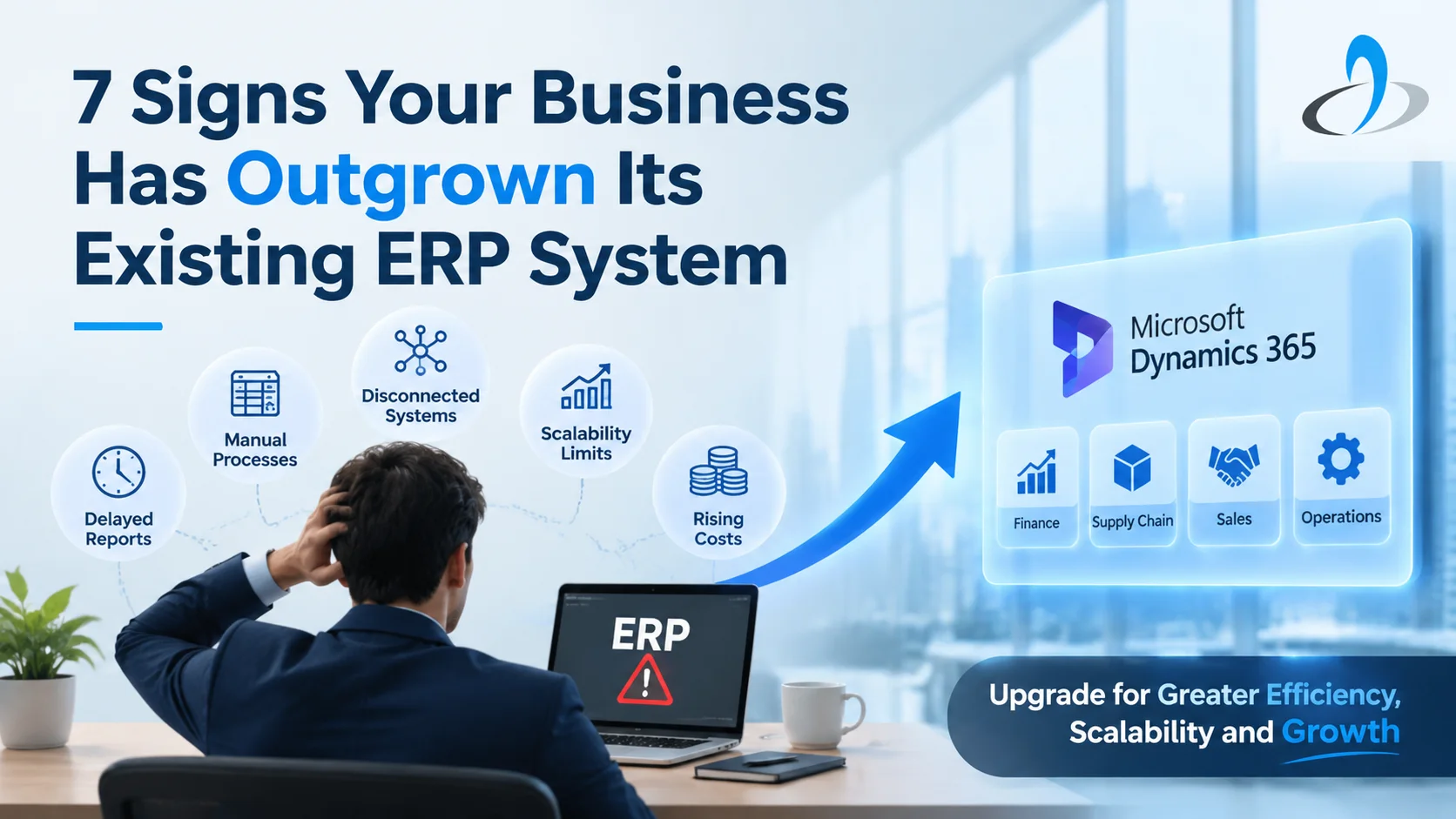
Recognising when your business has outgrown its ERP system is essential to maintaining operational efficiency and supporting future growth. Frequent manual work, disconnected applications, delayed reporting and limited scalability are some indicators that your existing solution may no longer meet your requirements.
Modern ERP platforms such as Microsoft Dynamics 365 offer integrated capabilities to help businesses manage evolving operational needs. Here are seven signs that indicate it may be time to reassess your ERP system.
1. Increasing Dependence on Manual Processes
If employees regularly use spreadsheets, emails and separate applications to complete tasks that should be automated, your ERP system may have limitations. Manual data entry, invoice processing, purchase order management and reconciliation increase administrative workloads and create opportunities for errors.
As transaction volumes grow, these workarounds become harder to maintain. Businesses need an ERP solution that connects essential workflows and reduces repetitive activities. Dynamics 365 BC ERP, for example, brings finance, purchasing, sales and inventory processes together within one business management platform.
2. Limited Visibility into Business Performance
Making informed decisions requires access to accurate and timely information. If managers depend on manually prepared reports or wait for different departments to consolidate data, the existing ERP may not provide sufficient business visibility.
An effective ERP system should help decision-makers monitor financial performance, inventory levels, operational costs and business activities. Solutions such as Dynamics 365 Business Central provide financial reporting, analysis views and business insights that help organisations understand their performance.
3. Difficulty Scaling Business Operations
Business growth often introduces additional locations, employees, customers, suppliers and transactions. An ERP system designed around smaller operational requirements may struggle to accommodate this expansion.
If adding new business units or supporting complex workflows requires extensive customization, your system may lack the flexibility needed for future growth.
Businesses should evaluate ERP platforms that can support their operational scale. Dynamics 365 BC supports the needs of small and medium-sized organisations, while Dynamics 365 F&SCM addresses more complex enterprise finance and supply chain requirements.
4. Disconnected Applications Across Departments
When finance, sales, procurement, inventory and operations use separate applications, information becomes fragmented. Employees may need to enter the same information into multiple systems, increasing the possibility of inconsistencies.
A connected ERP environment helps departments work with shared business information. Microsoft Dynamics 365 supports integration across business applications and other Microsoft technologies, helping organisations establish more connected workflows.
5. Delayed Reporting and Decision-Making
If generating financial statements, inventory reports or operational summaries takes several days, your ERP system may not be providing the information needed at the right time.
Growing businesses require timely insights to identify trends, monitor performance and respond to operational changes. Modern ERP capabilities can improve access to business data and support more informed decisions.
6. Increasing Maintenance and Customization Costs
An ageing ERP system may require frequent maintenance, additional customizations and specialist support. Over time, these expenses can become difficult to justify, particularly when the system still fails to meet changing business requirements.
Businesses should assess the total cost of ownership, including licensing, infrastructure, maintenance, integrations and upgrades. Sometimes, upgrading or replacing the existing platform can provide better long-term value than continuously modifying an unsuitable system.
7. Limited Support for Automation and Emerging Technologies
Business technology continues to evolve, with artificial intelligence, predictive analytics and workflow automation becoming increasingly relevant to enterprise operations.
If your existing ERP cannot integrate with modern tools or support the automation your business needs, it may restrict opportunities for improvement.
Platforms such as Dynamics 365 are incorporating Microsoft Copilot and AI capabilities to assist with business processes, information analysis and productivity. The availability of specific capabilities depends on the application, configuration and licensing.
When Should You Consider Moving to a New ERP System?
Experiencing one of these challenges does not automatically mean your ERP system needs replacing. However, when several limitations begin affecting productivity, reporting accuracy, customer service or operational costs, it is worth evaluating your existing platform.
Start by reviewing your current workflows, identifying recurring inefficiencies and assessing your future business requirements. Consider whether an upgrade, additional integration or complete ERP migration would address these challenges.
Choosing the Right ERP Solution for Your Business
The right ERP platform depends on the size, complexity and operational requirements of your organisation.
- Dynamics 365 Business Central: Suitable for small and medium-sized businesses looking to connect financial management, sales, purchasing, inventory and other core operations.
- Dynamics 365 Finance & Supply Chain Management: Designed for organisations with more complex financial, manufacturing, procurement, inventory and supply chain management requirements.
Working with an experienced Dynamics 365 implementation partner can help businesses assess their existing systems, plan data migration, configure workflows and align the new ERP environment with their operational needs. The right implementation approach should prioritise business requirements rather than unnecessary customization.
Conclusion
An ERP system should support business growth, not become an obstacle to it. Increasing manual workloads, disconnected applications, limited reporting and rising maintenance costs are signs that your existing platform may no longer be suitable.
Evaluating modern ERP solutions such as Dynamics 365 can help organisations identify opportunities to improve efficiency, connect departments and prepare for future operational demands. The important step is to understand your current limitations and choose a solution that aligns with your long-term business goals.