Sign up with Google
 Sign in with Zoho

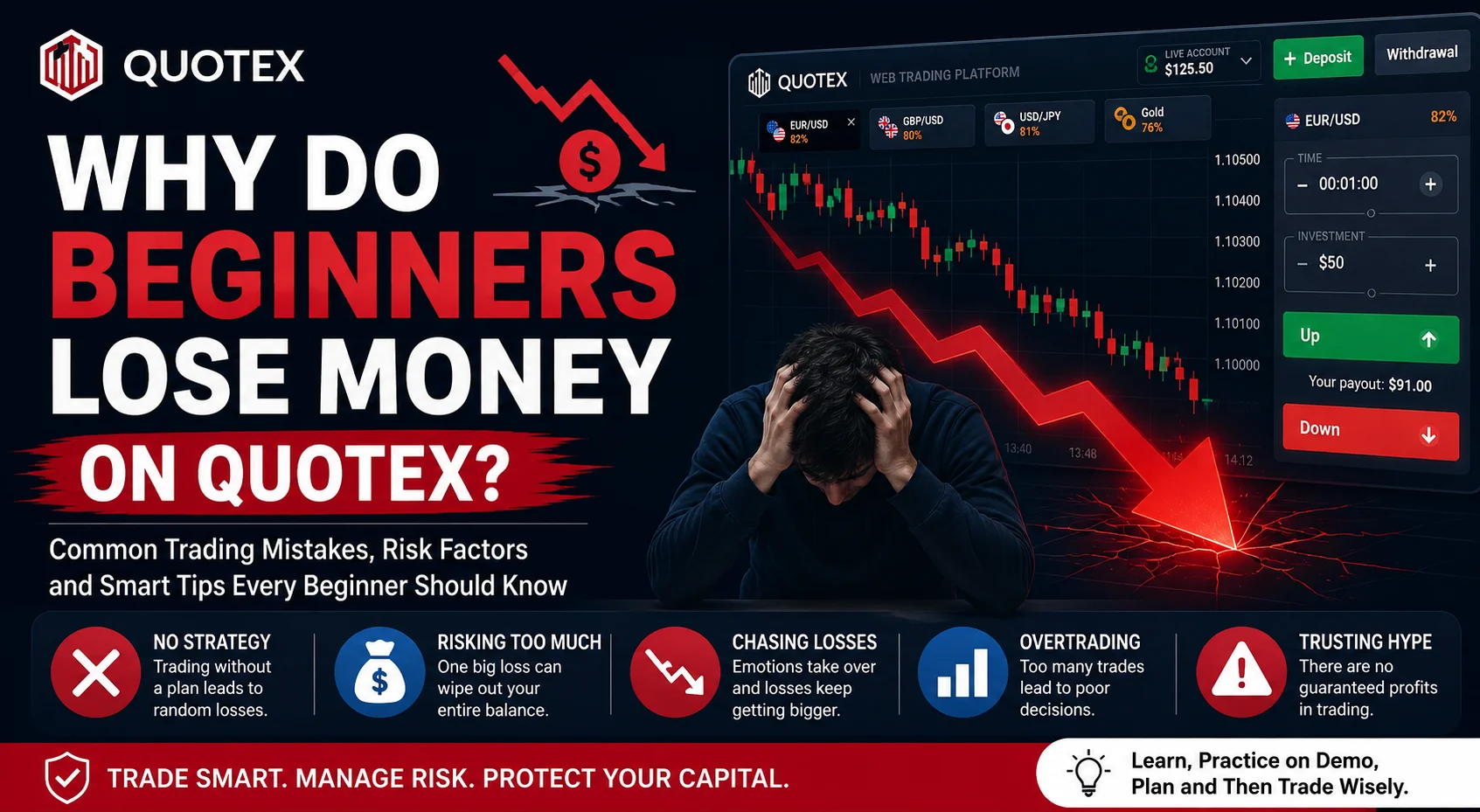
Many beginners lose money on Quotex because they start trading without understanding the risks, use weak strategies and make decisions based on emotions. Fixed-time trades depend on whether an asset’s price finishes above or below a particular level when the selected period expires. The trader may receive a predetermined payout for a correct prediction or lose the amount committed to an unsuccessful trade.
No strategy, indicator or signal can guarantee consistent profits. Beginners should understand the product carefully and confirm whether the platform and its services are permitted in their country before depositing money.
1. Trading Without Enough Practice
Some beginners move directly to real-money trading without first learning how charts, indicators, trade durations and order placement work.
A demo account allows users to practise with virtual funds without immediately risking real money. Quotex’s educational material recommends that beginners use demo trading to understand the basic process before considering real-money activity.
However, successful demo results do not guarantee success with actual funds. Emotional pressure is usually stronger when real money is involved.
2. Risking Too Much on One Trade
Beginners often use a large portion of their balance on a single position because they want faster returns. One unsuccessful prediction can then cause a significant loss.
Risking too much also makes emotional decision-making more likely. Quotex’s own educational content identifies excessive risk, loss chasing and trading without a plan as common reasons beginners lose their deposits quickly.
Traders should decide their maximum acceptable loss before placing any trade and avoid using money needed for bills, education or other essential expenses.
3. Chasing Previous Losses
After an unsuccessful trade, a beginner may immediately increase the next trade amount to recover the money. This is commonly called revenge trading.
The decision is usually driven by frustration rather than analysis. A second loss may then encourage an even larger position, creating a damaging cycle.
Quotex offers a risk-management feature that can be used to establish daily trading or loss limits. Such controls cannot prevent every loss, but they may help traders follow their plans and reduce emotionally driven activity.
4. Trading Without a Clear Strategy
Randomly predicting whether a price will move up or down is not a reliable trading method.
A basic strategy should define:
- Which assets will be analysed
- What chart timeframe will be used
- Which indicators or price patterns are required
- How the expiry time will be selected
- How much can be risked
- When trading should stop
Beginners should test one simple method over many demo trades instead of changing strategies after every unsuccessful result.
5. Depending Completely on Indicators
Indicators such as RSI, MACD, Moving Averages and Bollinger Bands can help analyse momentum, trends and volatility. However, they are based mainly on previous price data and can provide delayed or misleading signals.
An overbought RSI reading does not guarantee that the price will fall. Similarly, a moving-average crossover does not guarantee that a new trend will continue.
Indicators should support analysis rather than replace independent judgement.
6. Using Very Short Expiry Times
Short expiry periods may appear attractive because results are produced quickly. However, prices can fluctuate unpredictably over a few seconds or minutes.
Normal market noise, sudden volatility and minor timing differences may affect the outcome. Fast trades can also encourage overtrading because beginners may place several positions without properly reviewing the market.
7. Trusting Guaranteed-Profit Claims
Beginners may follow social media groups, signal sellers or influencers who advertise guaranteed profits, high accuracy or risk-free systems.
The CFTC and SEC have warned about fraudulent schemes involving online binary-options platforms, including withdrawal problems, account-credit issues, identity theft and manipulated trading software.
Users should research any platform independently, verify its legal status and avoid giving account access or personal information to unknown individuals.
Conclusion
Beginners commonly lose money on Quotex because they trade too early, risk large amounts, chase losses, depend on weak signals and ignore risk management.
Using a demo account, following a written plan and setting strict limits may support more disciplined decisions, but they cannot eliminate financial risk. Fixed-time trading remains an all-or-nothing activity that can result in losing the full amount committed to a position.