Sign up with Google
 Sign in with Zoho

Digital communication has changed the way businesses present information, interact with customers, and manage workplace communication. Across the UAE, organizations are increasingly replacing static posters and traditional noticeboards with professional display technologies that can deliver dynamic, timely, and engaging content.
From corporate offices and retail stores to hotels, educational institutions, healthcare facilities, and showrooms, digital signage has become a practical tool for improving communication and customer experience. Choosing the right technology, however, requires more than selecting a large screen. Businesses need to consider display quality, connectivity, installation, content management, viewing conditions, and long-term support.

What Makes Digital Signage Valuable for UAE Businesses?
Digital signage uses electronic displays to communicate information such as advertisements, announcements, menus, schedules, promotional messages, presentations, directions, and corporate communications.
One of its biggest advantages is flexibility. Printed signage has to be physically replaced whenever information changes. Digital displays allow organizations to update content electronically, making it easier to respond to promotions, events, seasonal campaigns, operational changes, and internal communication requirements.
In a fast-moving commercial environment such as Dubai, this flexibility can be particularly useful. Businesses can adapt their visual communication without redesigning and reprinting materials every time a message changes.
Digital Signage Solutions Maxhub and Huawei
Businesses evaluating professional display technology may consider digital signage solutions Maxhub and Huawei according to their operational requirements.
The ideal solution depends on where the display will be installed and how it will be used. A reception screen may primarily communicate branding and visitor information, while a meeting-room display may need interactive functionality, wireless presentation, video conferencing, and collaboration features.
Before purchasing equipment, organizations should identify the intended application, screen size, viewing distance, brightness requirements, connectivity options, mounting location, and content management needs.
This application-first approach helps businesses avoid purchasing technology that looks impressive on paper but does not perform efficiently in the intended environment.
Applications Across Different Industries
Digital signage is versatile because the same technology can serve different purposes depending on the organization.
Corporate Offices
Businesses can use displays in reception areas, meeting rooms, employee spaces, and training facilities.
Corporate screens may show visitor information, company announcements, meeting schedules, performance dashboards, presentations, or internal communications. Interactive displays can also support brainstorming, document annotation, and team collaboration.
Retail and Showrooms
Retailers need to attract attention while communicating product information clearly.
Digital displays can promote products, highlight offers, communicate pricing, demonstrate features, or strengthen brand messaging. Content can be updated quickly, allowing retailers to adapt campaigns according to customer demand.
Hospitality
Hotels, restaurants, conference centers, and other hospitality businesses can use digital displays to communicate event schedules, restaurant information, directions, promotional offers, and guest announcements.
A professionally designed display network can also create a consistent visual experience across different areas of a property.
Education and Training
Interactive display technology is increasingly useful in classrooms, training rooms, and educational facilities.
Teachers and trainers can use interactive screens for presentations, multimedia lessons, annotations, demonstrations, and collaborative activities. In these environments, ease of use and connectivity are particularly important.
Comparing Interactive and Conventional Displays
Not every digital signage project requires an interactive screen.
Conventional digital signage is primarily designed for viewing. It is suitable when the objective is to present information, advertisements, announcements, or visual content to an audience.
Interactive displays are designed for direct user engagement. Users can interact with content, annotate information, navigate presentations, and collaborate with other participants.
Organizations considering BenQ interactive display solutions in UAE or Samsung interactive display solutions in UAE should therefore begin by defining how the screen will be used.
For example, a retail advertisement may require a standard commercial display, while a training room may benefit significantly from an interactive display.
Why Display Specifications Matter
Selecting a professional display involves several technical considerations.
Screen size is important, but it is only one factor. Businesses should also evaluate resolution, brightness, contrast, viewing angle, operating environment, connectivity, mounting requirements, and expected operating hours.
A screen installed near a bright window may require different specifications from one installed in a controlled meeting room.
Similarly, a large conference room may require a larger display or multiple screens to ensure that participants can comfortably view content from different seating positions.
Proper planning at the beginning of a project can reduce future installation and operational problems.
The Role of Connectivity
Digital signage is increasingly connected to wider IT infrastructure.
Displays may communicate with media players, computers, wireless networks, content management systems, cloud platforms, and meeting-room equipment. Reliable network connectivity is therefore an important part of the overall solution.
Businesses should also consider how content will be updated. A single screen in a small office may be managed locally, while organizations with multiple branches may require centralized management.
A scalable architecture allows businesses to add displays later without redesigning the entire system.
Digital Signage and Modern Workplace Technology
Digital signage should not always be viewed as a standalone product.
Modern workplaces often require displays alongside desktop computers, networking equipment, access control systems, cloud services, and IT support.
Organizations searching for a Dell desktop supplier in UAE or Lenovo desktop supplier in UAE, for example, may have broader requirements involving employee workstations and workplace technology.
Businesses with limited desk space may also consider solutions from a Dell all in one PCs supplier in UAE when designing modern office environments.
Integrating these technologies properly can create a more efficient and consistent workplace infrastructure.
Choosing Samsung and Other Professional Display Technologies
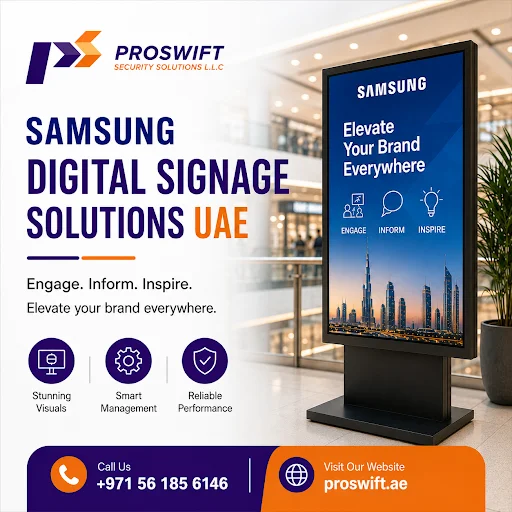
Samsung is another brand frequently considered by businesses searching for Samsung digital signage solutions UAE.
Different manufacturers and product ranges offer different capabilities. Rather than choosing a product solely because of its brand recognition, businesses should compare the technology against their actual requirements.
Important questions include:
- What is the display's intended purpose?
- How many hours will it operate each day?
- What type of content will be displayed?
- Does the environment require high brightness?
- Is touch interaction necessary?
- What connectivity options are required?
- How will content be managed?
- Can the system scale to additional locations?
- What installation and maintenance support is available?
These questions help procurement teams make decisions based on business value rather than specifications alone.
Installation Is Part of the Solution
Professional installation can have a significant effect on the performance and appearance of a digital signage system.
The installation team should consider screen positioning, wall structure, mounting hardware, cable routing, electrical access, network connectivity, ventilation, security, and maintenance access.
For organizations operating several displays, installation planning becomes even more important because consistency across locations can affect both usability and brand presentation.
Post-installation configuration and testing should also verify connectivity, content playback, screen orientation, resolution, and management access.
Supporting the Wider IT Environment
Digital signage often works alongside other business technologies. Reliable IT infrastructure can therefore contribute to a smoother deployment.
Organizations may require IT maintenance, Microsoft productivity services, networking, access control, or other technology support alongside their display systems.
For example, companies requiring ongoing infrastructure assistance may explore IT AMC services in Dubai to support their broader technology environment.
Organizations using Microsoft workplace tools can also evaluate Microsoft Office 365 as part of their productivity infrastructure.
For network connectivity, professional switching infrastructure such as Cisco switches in UAE may be relevant to larger digital signage deployments where multiple devices need reliable network communication.
What Businesses Should Look for in a Technology Partner
Choosing the right technology partner can be as important as choosing the display manufacturer.
Businesses should look for a provider that understands both the hardware and the operating environment. A good technology partner should be able to discuss application requirements, installation conditions, connectivity, scalability, maintenance, and future expansion.
The provider should also be prepared to recommend alternatives when a different technology better suits the project.
This consultative approach is particularly valuable for organizations managing multiple technology requirements at the same time.
Future Outlook for Digital Signage in the UAE
Digital signage is likely to remain an important part of business communication as organizations place greater emphasis on customer experience, workplace collaboration, and real-time information.
The technology is also becoming increasingly connected with network infrastructure, cloud platforms, interactive collaboration tools, and centralized content management.
For UAE businesses, the opportunity is not simply to install more screens. The greater value comes from using displays strategically.
A well-planned system can improve communication, strengthen visual presentation, support collaboration, and make information easier to access.
Whether a business is evaluating Maxhub and Huawei solutions, Samsung professional displays, BenQ interactive technology, or other commercial display platforms, the best investment is one that aligns technology with a clearly defined business purpose.
As workplaces and customer-facing environments continue to evolve, professional digital signage can become an important component of a connected and technology-driven business strategy in the UAE.
Phone: +971 56 185 6146
Website: https://proswift.ae
Product Page: https://proswift.ae/products/digital-signage-solutions-maxhub-and-huawei/
Social media Links–
https://www.facebook.com/proswiftsecuritysolutions
https://www.instagram.com/proswiftsecuritysolutions
https://www.youtube.com/@proswiftsecuritysolutions
https://www.pinterest.com/proswiftsecuritysolutions
https://www.linkedin.com/company/proswift-security-solutions
https://x.com/ProswiftUAE