Sign up with Google
 Sign in with Zoho

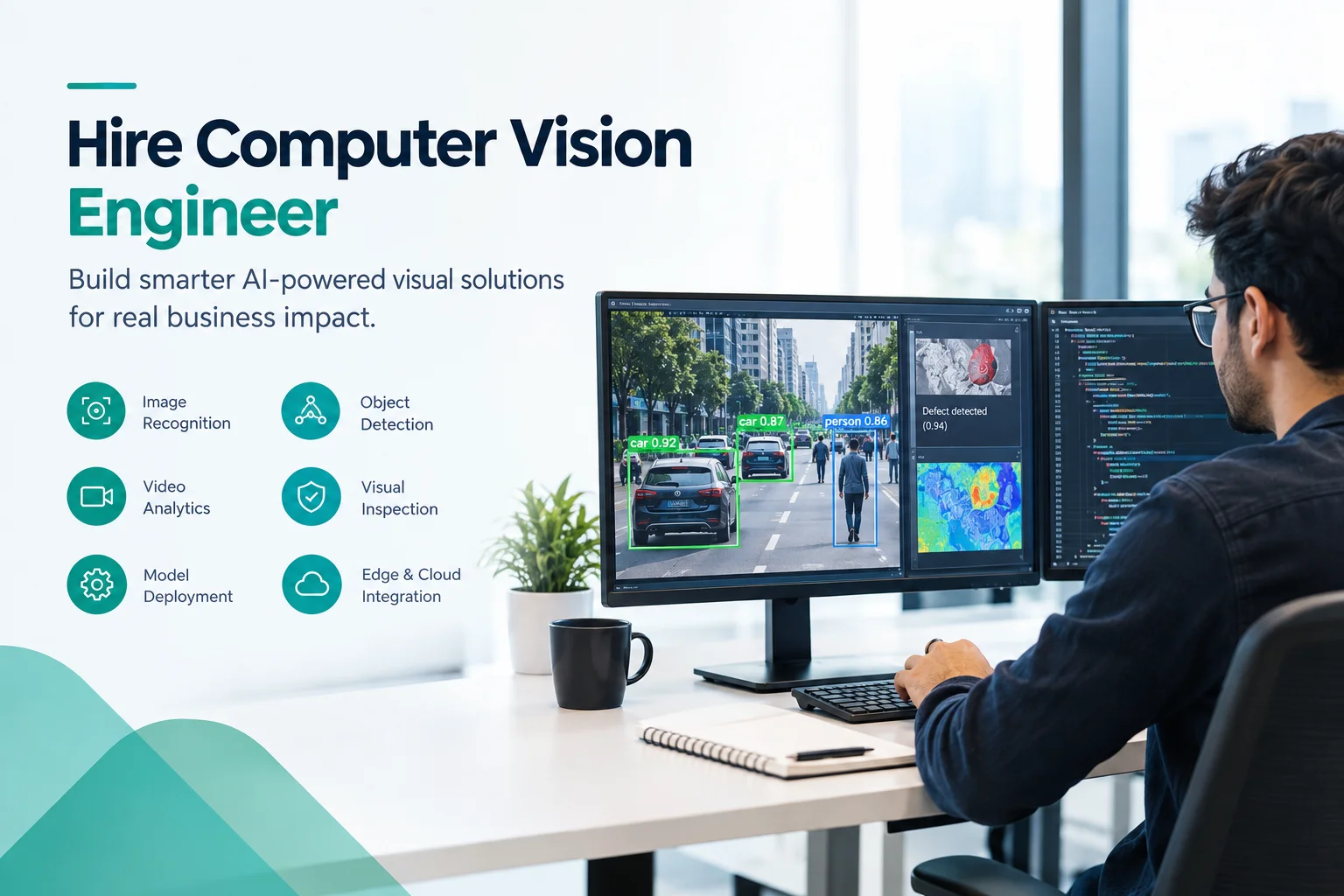
Computer vision has moved from experimental AI projects to practical product development. Retailers use it for inventory monitoring, manufacturers use it for quality inspection, and healthcare technology companies use visual models to support image analysis. As these applications become more demanding, businesses increasingly need specialists who can turn visual data into reliable product features. Knowing when to Hire Computer Vision Engineer can therefore influence development speed, accuracy and long-term scalability.
Why Computer Vision Matters for Modern Products
Computer vision enables software to interpret images, video and other visual information. However, building a useful system involves much more than training a model. Teams need to consider data quality, model selection, inference speed, integration, security and ongoing monitoring.
For example, a manufacturing product may need to identify defects from thousands of images each day. A model with strong laboratory accuracy may still fail commercially if it produces too many false positives or cannot process images quickly enough.
Industry research continues to show strong investment in AI. Stanford's AI Index has reported substantial growth in organisational AI adoption, while computer vision remains an important area across manufacturing, healthcare, retail, logistics and autonomous systems.
What a Computer Vision Engineer Brings
A skilled engineer connects machine learning with real product requirements. Their responsibilities can include:
- Image classification and object detection
- Image segmentation and visual tracking
- Optical character recognition
- Video analytics
- Facial and biometric applications where appropriate
- Dataset preparation and annotation strategies
- Model optimisation and deployment
- Computer vision API and application integration
- Edge AI and real-time inference
When companies Hire Computer Vision Engineer talent, decision makers should look beyond familiarity with frameworks. The important question is whether the engineer can translate a business problem into measurable technical requirements.
Computer Vision Engineer vs General AI Developer
A general AI developer may be able to build machine learning applications across several domains. A computer vision specialist typically brings deeper experience with visual datasets, image preprocessing, detection architectures, augmentation, video pipelines and model evaluation.
This distinction becomes important when visual accuracy directly affects product performance. For a basic AI-enabled application, a broader machine learning profile may be sufficient. For real-time inspection, autonomous navigation or sophisticated image analysis, specialist knowledge can reduce experimentation and development risk.
How We Have Supported Product Development
At Acrosstek, our approach to computer vision development focuses on the complete product lifecycle rather than treating the AI model as an isolated component. In projects involving intelligent software solutions, teams have worked on data preparation, model development, API integration and performance optimisation.
For example, when a product team needs automated visual inspection, the development process can begin by defining acceptable detection accuracy and false-positive rates. The model is then tested against representative production data rather than relying only on benchmark datasets. This approach helps stakeholders understand whether an AI feature can deliver practical value before expanding its scope.
Choosing the Right Computer Vision Architecture
The technology decision should match the product requirement. Cloud-based inference can simplify infrastructure management and support centralised processing. Edge deployment can be more suitable when applications require low latency, offline operation or reduced data transfer.
Decision makers should compare:
- Accuracy requirements
- Processing speed
- Infrastructure costs
- Data privacy
- Model maintenance
- Integration complexity
- Expected scale
The best architecture is therefore not necessarily the most advanced one. It is the approach that meets the product's measurable requirements without creating unnecessary complexity.
What to Look For When Hiring
Before you Hire Computer Vision Engineer, assess practical experience alongside technical knowledge. Useful indicators include experience with Python, OpenCV, PyTorch or TensorFlow, computer vision algorithms, cloud or edge deployment, and production model monitoring.
Ask candidates to explain how they would handle poor-quality data, changing environments and model drift. These situations often reveal more about real-world engineering ability than theoretical questions.
The Future of Computer Vision Development
Computer vision is increasingly combining with generative AI, multimodal models, robotics and edge computing. This creates opportunities for products that can understand not only what appears in an image but also the surrounding context.
For decision makers, the priority should be building reliable visual intelligence that supports a measurable business objective. The right engineering expertise can help transform computer vision from a promising prototype into a scalable product capability.