Sign up with Google
 Sign in with Zoho
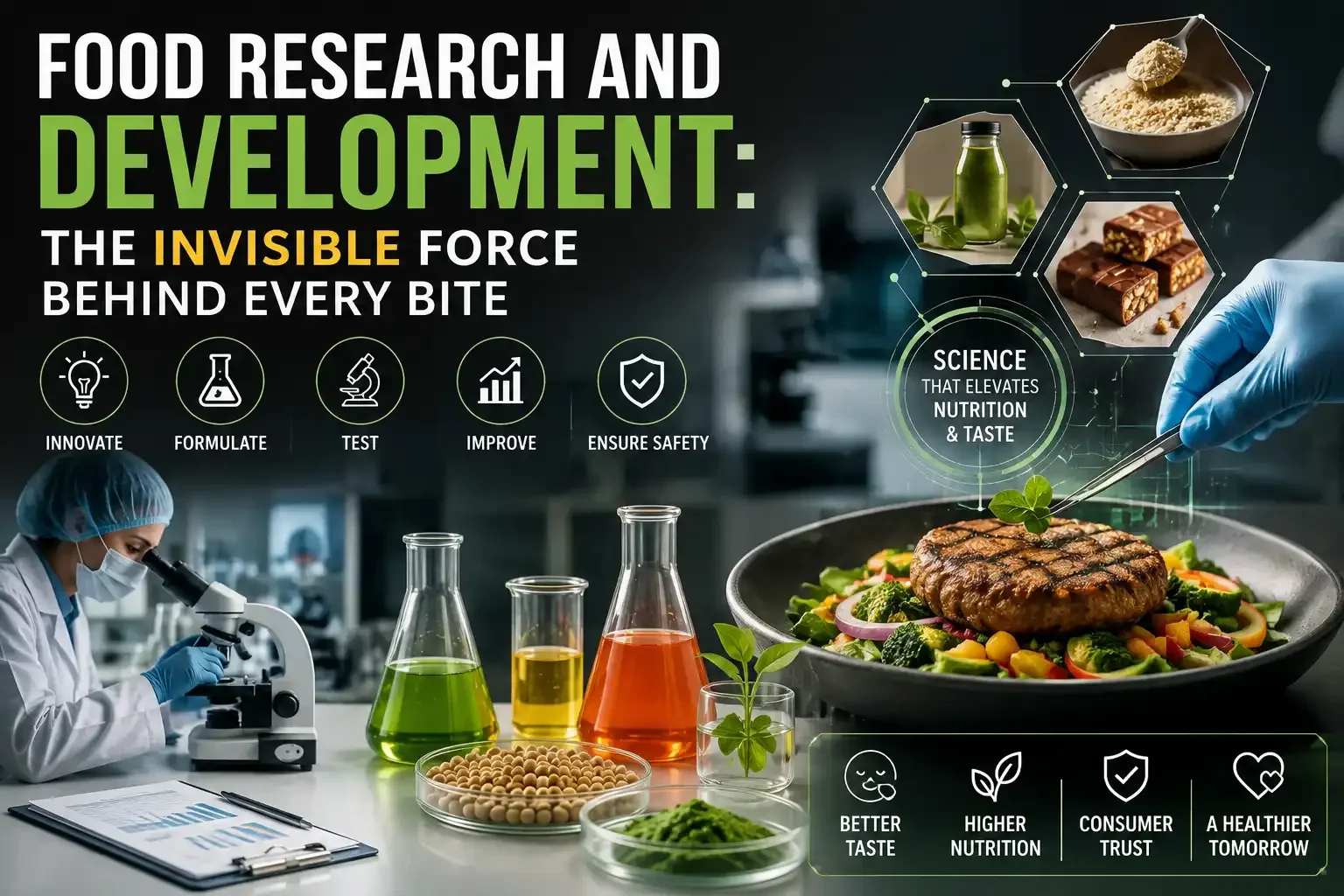
The food industry is constantly evolving as consumers look for products that offer better taste, improved nutrition, convenience, quality, and safety. From functional beverages and protein-rich snacks to plant-based alternatives and nutraceutical products, businesses are exploring new ways to meet changing consumer expectations. However, transforming an innovative food idea into a commercially successful product requires much more than an attractive concept. It involves scientific research, technical expertise, product testing, and a well-planned development process.
This is where food research and development (R&D) becomes essential. It helps food businesses create new products, improve existing formulations, maintain consistent quality, and prepare products for large-scale manufacturing.
What Is Food Research and Development?
Food research and development is a systematic process of studying ingredients, developing formulations, conducting experiments, and improving food products to achieve specific quality and performance standards.
It combines food science, nutrition, food chemistry, microbiology, sensory evaluation, and processing technology. The objective is to develop products that meet consumer expectations while remaining safe, stable, cost-effective, and suitable for commercial production.
For example, a startup planning to launch a sugar-free energy drink must consider several factors, including sweetener selection, acidity, flavour balance, ingredient compatibility, shelf life, and regulatory requirements. Food R&D helps bring these elements together through scientific formulation and practical testing.
Why Is Food R&D Important for Modern Food Businesses?
Food R&D plays an important role in helping businesses remain competitive in a rapidly changing marketplace.
1. Encourages Product Innovation
Consumer preferences continue to change, creating opportunities for innovative products. Research and development allow businesses to experiment with new ingredients, flavours, textures, and nutritional profiles. Companies can explore categories such as functional foods, high-protein snacks, plant-based products, fortified beverages, and sugar-free alternatives.
2. Improves Product Quality and Consistency
A product may taste excellent during its initial preparation but perform differently during commercial manufacturing. R&D helps identify formulation variations and establish standardised recipes. This supports consistent taste, texture, appearance, and nutritional composition across production batches.
3. Supports Food Safety and Stability
Food safety is a critical consideration throughout product development. R&D helps assess ingredient compatibility, microbial risks, processing conditions, packaging suitability, and storage behaviour. Appropriate laboratory testing and shelf-life studies help businesses understand how products perform under different storage conditions.
4. Controls Manufacturing Costs
Ingredient selection and formulation directly influence production economics. Research teams evaluate alternative ingredients, processing methods, and manufacturing requirements to develop commercially practical products without compromising essential quality attributes.
5. Helps Meet Regulatory Requirements
Food businesses must consider applicable food safety and labelling regulations before launching products. R&D works alongside regulatory specialists to support ingredient assessment, nutritional information, product specifications, and compliance-related documentation.
The Major Stages of Food Product Research and Development
Developing a food product involves multiple stages. Each step helps reduce technical uncertainties before commercial manufacturing begins.
1. Market Research and Concept Development
The process starts with understanding the target audience, market demand, competing products, and consumer expectations. Businesses identify the product category, intended benefits, preferred flavours, price positioning, and potential points of differentiation.
A clearly defined concept provides direction for the technical development process.
2. Ingredient Research and Selection
Selecting suitable ingredients is one of the most important parts of formulation. Developers evaluate ingredients based on their functional properties, nutritional contribution, availability, cost, compatibility, and regulatory suitability.
For example, a plant-based beverage may require suitable proteins, stabilisers, emulsifiers, and flavouring components to achieve the desired consistency and sensory profile.
3. Recipe Formulation and Prototype Development
Once ingredients are selected, the development team creates initial formulations and prepares laboratory-scale prototypes. Different ingredient combinations and processing conditions are tested to achieve the desired taste, texture, colour, and functionality.
Multiple formulation trials may be necessary before identifying a suitable prototype.
4. Sensory and Quality Evaluation
Sensory testing helps determine how consumers may experience the product. Attributes such as aroma, flavour, mouthfeel, appearance, sweetness, and aftertaste are evaluated.
Technical parameters such as pH, moisture content, viscosity, acidity, and other relevant quality indicators may also be assessed depending on the product category.
5. Shelf-Life and Stability Testing
A commercially viable food product must maintain acceptable quality throughout its intended storage period. Shelf-life studies help evaluate changes in flavour, texture, colour, nutritional characteristics, and microbiological quality.
Packaging materials, storage temperatures, processing conditions, and formulation composition can all influence product stability.
6. Pilot Batches and Commercial Scale-Up
A successful laboratory formulation must be adapted to manufacturing equipment and larger production volumes. Pilot-scale trials help identify challenges involving mixing, heating, cooling, filling, processing time, and ingredient dispersion.
Scale-up trials help establish practical production parameters and reduce the risk of inconsistencies during commercial manufacturing.
Emerging Trends Influencing Food Research and Development
The food innovation landscape is expanding as businesses respond to changing lifestyles and growing interest in specialised nutrition.
Functional Foods and Beverages: Products containing probiotics, prebiotics, vitamins, minerals, botanical extracts, and other functional ingredients are receiving attention. Their development requires careful ingredient compatibility and stability evaluation.
Plant-Based Innovation: Demand for dairy alternatives and plant-based foods has encouraged research into plant proteins, natural stabilisers, flavour improvement, and texture development.
Sugar Reduction: Brands are exploring alternative sweetening systems to reduce added sugar while maintaining acceptable taste and mouthfeel.
High-Protein Products: Protein-enriched snacks, beverages, powders, and convenient meal products require formulation strategies that address solubility, texture, flavour, and processing stability.
Clean-Label Formulations: Businesses are increasingly interested in ingredient transparency and simplified ingredient lists. This creates opportunities for research into suitable natural ingredients and functional alternatives.
Common Challenges in Food Product Development
Despite the opportunities, developing a commercially successful food product involves several technical challenges.
Ingredient interactions can affect flavour, colour, texture, and stability. A formulation that performs well in laboratory conditions may behave differently during industrial processing. Maintaining shelf life without negatively affecting sensory quality can also be difficult.
Other challenges include raw material price fluctuations, packaging compatibility, regulatory compliance, manufacturing limitations, and achieving the right balance between product quality and production cost.
These challenges highlight the importance of structured R&D, systematic trials, technical documentation, and appropriate quality testing.
How Professional Food R&D Support Helps Businesses
Working with experienced food development professionals can help startups, established brands, and manufacturers approach product innovation more systematically.
Professional support may include ingredient research, customised recipe formulation, prototype development, sensory evaluation, stability assessment, nutritional analysis coordination, regulatory guidance, packaging recommendations, and manufacturing scale-up.
Companies such as FoodSure support food businesses in developing and refining product concepts across different food and beverage categories. Businesses looking for a deeper understanding of the technical process can explore Food Research and Development to learn more about product innovation, formulation, and development.
The right technical approach helps businesses make informed decisions before investing in commercial production.
Conclusion
Food research and development is a fundamental part of building innovative, safe, consistent, and commercially viable food products. It connects consumer demand with food science, ingredient technology, formulation expertise, and manufacturing requirements.
Whether a business wants to introduce a functional beverage, develop a protein-rich snack, improve an existing recipe, or explore plant-based alternatives, a structured R&D process can help turn an initial idea into a product ready for the marketplace.
As consumer expectations and food technologies continue to evolve, investing in research and development will remain an important strategy for long-term growth, product differentiation, and competitiveness in the food industry.