Sign up with Google
 Sign in with Zoho

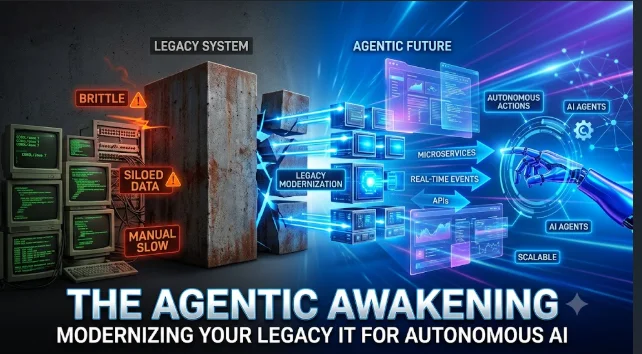
Computing is entering a significant new phase. Instead of relying only on software that responds to individual instructions, organizations are beginning to use systems that can interpret objectives, make decisions, and carry out tasks with limited human direction.For the past decade, much of the enterprise technology conversation has focused on Generative AI. These systems can write, summarize, create images, and communicate in remarkably natural ways. However, they are still largely reactive. They wait for a prompt, generate a response, and stop.Agentic AI takes the next step. It does not only produce text or code; it can also plan and execute actions.
An agent can break a complex problem into smaller tasks, use software tools, evaluate the results, and adjust its approach when something goes wrong. Its goal is not simply to answer a question, but to complete an objective.Consider a marketing campaign. A generative model might draft a personalized email. An AI agent could go further by selecting the target audience from a CRM system, reviewing previous engagement, writing the message, scheduling the campaign, monitoring its performance, and adjusting the follow-up strategy. The agent would still operate within defined permissions and business rules, but it could manage the workflow without requiring a person to approve every routine step.This is the direction of the agentic enterprise.
Yet many organizations are finding that their existing technology environments are not prepared for it. Legacy systems often lack the interfaces, data access, flexibility, and real-time capabilities that autonomous agents need. As a result, modernization is no longer only a cost-reduction exercise or a cloud migration project. It is becoming a basic requirement for organizations that want to use AI effectively.
The Architectural Problem: Why Legacy Systems Limit Autonomous AI
To understand the connection between Agentic AI and modernization, it helps to compare how the two operate.Many legacy environments were designed around predictable, tightly controlled processes. They often rely on monolithic applications, on-premises infrastructure, batch processing, and highly coupled code. In a monolithic system, business rules, user interfaces, and data access may all be embedded in one large application.
Changing a single function can require extensive testing and a full application deployment.That design can be reliable for stable, routine operations, but it is difficult for an AI agent to navigate. Agents work best when they can access individual capabilities as discrete tools. They need clear, programmatic ways to check inventory, update a customer record, issue a refund, or change an order.
A large legacy modernization application may offer none of these capabilities through accessible interfaces.Instead, the system may have been built for human users working through screens or for rigid integrations such as scheduled flat-file transfers. Those methods are poorly suited to agents that need to make several decisions and call multiple services in sequence. An agent may be technically capable of solving a business problem but unable to interact with the systems required to implement the solution.
Data access creates another challenge. Important business information is often spread across proprietary databases, undocumented schemas, and separate applications. Extracting a basic insight may require custom queries or manual reconciliation. This is especially limiting for an agent that needs current information to make decisions.For example, an agent responsible for improving supply chain routes cannot work effectively with inventory data that is updated only once a day.
It needs timely information about stock levels, shipping delays, supplier capacity, weather conditions, and other relevant events. Without that context, the agent may have the reasoning ability to recommend an action but lack the information and system access needed to act safely.The issue is not that every legacy system must be replaced immediately. In many cases, organizations can modernize gradually by exposing selected capabilities through APIs, separating critical services, improving data pipelines, and adding controls around older applications. The central goal is to make business functions accessible, understandable, and usable by both people and software.
The API Imperative: Turning Business Capabilities into Usable Tools
A modern architecture gives AI agents the tools they need to interact with an organization’s systems. APIs, or application programming interfaces, are central to this approach.An API defines how one application can request information or perform an action in another application. When legacy capabilities are separated into services and exposed through secure, well-documented APIs, they become easier for both traditional software and AI agents to use.Suppose a customer reports that a shipment is missing.
An agent handling the case might need to complete several steps:
1.Check the shipment status through a logistics service.
2.Review inventory to determine whether a replacement is available.
3.Examine the customer’s account and service history.
4.Apply the appropriate compensation policy.
5.Issue a refund or arrange a replacement shipment.
6.Update the customer record and communicate the resolution.
In a modernized environment, each of these capabilities can be made available through a separate service. The agent can then decide which tools to use, call them in the right sequence, and respond based on the results.This does not mean that the agent should have unrestricted access to every system. Secure authentication, authorization rules, transaction limits, approval workflows, and audit logs remain essential.
Modernization should make systems more accessible to authorized software while also making their boundaries clearer.The result is a more programmable enterprise. Instead of keeping business capabilities hidden inside large applications, the organization makes those capabilities available as controlled, reusable functions. This creates the technical foundation for automated workflows that can adapt to changing circumstances rather than following one fixed script.
Data Fluidity: Giving Agents Current and Relevant Context
APIs provide the means for an agent to act, but reliable data provides the context for deciding what to do.Traditional systems often treat data as a record of past activity. Relational databases and data warehouses are commonly optimized for transaction processing, scheduled reporting, or end-of-month analysis. Those functions remain important, but they are not sufficient for autonomous systems that need to respond to events as they occur.
An agent adjusting a supply chain route may need to consider a shipment delay, a change in inventory, a weather warning, a supplier update, and a customer priority at the same time. A daily batch report cannot provide that information quickly enough.Modernization addresses this problem through event-driven architecture and real-time data pipelines. Technologies such as Apache Kafka and cloud-based streaming services allow business events to be captured and shared as they happen. A sale, website interaction, shipment update, machine reading, or service incident can become an event that other systems are able to process.This approach helps an organization build a more connected data environment.
It also supports the use of data lakes, modern analytics platforms, vector databases, and Retrieval-Augmented Generation, commonly known as RAG.RAG allows an AI system to retrieve relevant information from a collection of documents before generating a response. In an enterprise, those documents might include contracts, operating procedures, product manuals, emails, and historical support cases. Vector databases help locate relevant material by meaning rather than by exact keyword matches.Older infrastructure was generally not designed to index millions of unstructured documents and retrieve relevant passages in milliseconds.
A modernized data layer makes that possible at scale, while also allowing organizations to apply access controls, retention policies, and monitoring.Together, real-time events and searchable business knowledge give an agent a more complete view of the organization. The agent can observe current conditions, retrieve relevant history, and record the results of its actions. Without these capabilities, an autonomous system is forced to operate with incomplete or outdated information, which increases the risk of poor decisions and unintended actions.
Self-Healing Systems: Applying Agents to IT Operations
The value of modernization extends beyond customer service and business process automation. It also changes how an organization can manage its own technology environment.Legacy IT operations often depend on manual work. Administrators patch systems, provision servers, inspect monitoring dashboards, investigate incidents, and respond to failures one at a time.
These environments can also depend heavily on informal knowledge held by a small number of experienced employees.That model becomes difficult to sustain as systems grow more complex and business expectations for speed increase. Modern architectures provide a more programmable alternative through practices such as Infrastructure as Code, container orchestration, automated testing, and continuous delivery pipelines.Once infrastructure exposes reliable interfaces and produces high-quality telemetry, AI agents can assist with operational work.
An agent could monitor service health, identify unusual patterns, examine logs, compare the problem with previous incidents, and recommend or carry out an approved remediation step.Possible actions might include adding server capacity, rolling back a faulty deployment, restarting a failed service, or rerouting traffic. High-risk changes should remain subject to approval, while lower-risk and reversible actions can be automated under clearly defined policies.Agents may also help optimize cloud resources by identifying unused capacity, shifting workloads, or recommending changes based on cost, performance, energy use, or regional requirements.
These tasks require strong controls because an incorrect decision can affect availability, security, or customer data.The broader benefit is a more efficient relationship between people and infrastructure. Agents can handle repetitive monitoring and first-level diagnosis, while engineers focus on architecture, reliability, security, and long-term improvements. The objective is not to remove human responsibility, but to reduce routine operational work and give technical teams better information when they need to make important decisions.
Building Agentic AI into the Modernized Core
Modern infrastructure alone does not create a successful Agentic AI program. Organizations also need a deliberate architecture for managing agents, their permissions, and their decisions.AI should not be treated as a separate chatbot attached to the side of the business. In many cases, it needs to be integrated into the workflows where decisions and actions already take place.
This requires an orchestration layer between the organization’s core services, data platforms, and user interfaces.An orchestration layer can manage several responsibilities. It can route tasks to specialized agents, enforce permissions, maintain context, apply business rules, record activity, and coordinate interactions with APIs. It can also define which tasks require human approval and which tasks can be completed automatically.
A useful design approach is the Human-in-the-Loop model. Under this arrangement, an agent can analyze a situation, create a plan, and prepare the required API calls, but a person must approve the final action when the consequences are significant. Examples include authorizing a large payment, changing a critical database schema, or modifying an important security policy.As the system becomes more reliable, some lower-risk processes can move toward a Human-on-the-Loop model.
The agent can act independently within approved boundaries while human operators monitor performance and intervene when necessary. Escalation may be triggered when the agent has low confidence, encounters an unfamiliar situation, or proposes an action outside its normal operating range.Observability is particularly important because AI systems are probabilistic. They may take different paths to solve similar problems, and the reasoning behind a decision may not be obvious from the final result alone.
Organizations therefore need detailed records of the information an agent retrieved, the tools it used, the actions it proposed, and the responses it received.Distributed tracing, structured logging, evaluation systems, and AI-specific telemetry can help teams understand agent behavior. Sensitive information should be protected, and internal reasoning should not be treated as a substitute for a clear audit trail.
What matters operationally is that the organization can determine what information influenced a decision, which policies applied, and what actions were taken.With these controls in place, Agentic AI can become a managed capability rather than an unpredictable add-on. The system remains flexible enough to handle changing situations while operating within boundaries defined by the organization.
Conclusion: The Strategic Cost of Holding on to Legacy Systems
As Agentic AI develops, the competitive difference between organizations will depend less on who owns the most data or capital and more on who can put autonomous intelligence to work safely and consistently.This shift is already beginning in areas such as software development, customer service, financial analysis, and logistics. Organizations that postpone modernization and treat it only as deferred maintenance may find it increasingly difficult to take part in these improvements.A highly coupled, batch-oriented environment will not necessarily make Agentic AI impossible, but it will limit what the technology can do. Automation will remain concentrated in simple scripts and workflows that require frequent human intervention.
By contrast, organizations with modular systems, accessible APIs, real-time data, and strong governance will be in a better position to automate more complex processes.That advantage could appear in several forms: faster supply chain decisions, more responsive customer service, more efficient IT operations, and shorter product development cycles. The impact will depend on the quality of the organization’s data, the reliability of its systems, and the controls surrounding its AI agents.Legacy technology is therefore more than a financial or maintenance burden. When it prevents an organization from accessing its own data or connecting its own capabilities, it becomes a constraint on speed and decision-making.Modernization is difficult. It requires investment, careful sequencing, technical expertise, and attention to security and business continuity. It does not require every system to be replaced at once.
A practical strategy can begin with the processes where better APIs, fresher data, or faster automation would create the most value.The central point is straightforward: autonomous AI needs a modern foundation. Without accessible systems, reliable data, and appropriate controls, the promise of Agentic AI will remain limited by the technology underneath it. With that foundation in place, organizations can use AI not only to generate content, but also to coordinate work, respond to events, and help execute business goals responsibly.