Sign up with Google
 Sign in with Zoho

When a Jaw Problem Is More Than It Looks Like
An overbite. A chin that seems to jut forward or fall back a bit too much. Trouble chewing on one side without really knowing why. A facial profile that just doesn't sit quite right, even if you can't put your finger on it. Most patients notice these things long before anyone tells them there's an actual skeletal cause behind them. And that's really the point — what looks like a cosmetic quirk is often a specific, measurable jaw discrepancy, and finding it takes more than a mirror or a quick look in the dental chair. That's where the cephalometric X-ray comes in.
So What Exactly Is a CEPH X-Ray?
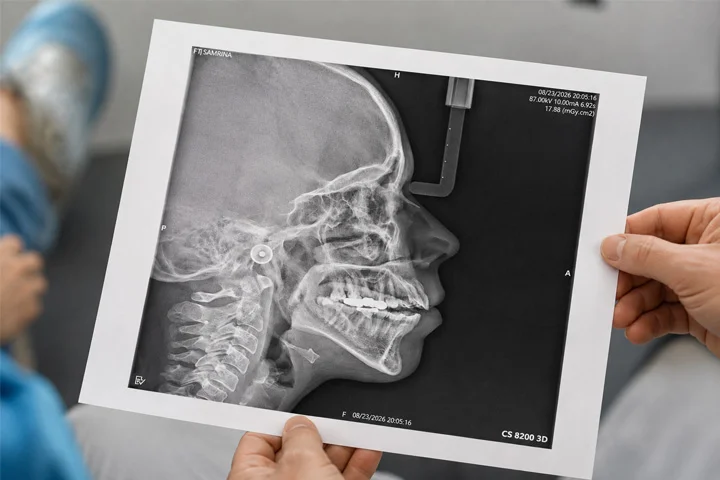
A CEPH X-ray is a side-profile image of the skull, taken from a fixed distance and a fixed angle every single time. That consistency is the whole point — because the image is reproducible, an orthodontist can mark specific points on the skull and jaw and measure the angles and distances between them. This is called cephalometric analysis, and it basically turns "your jaw looks a little off" into an actual number that can be compared, tracked, and planned around.
What This Analysis Actually Tells the Orthodontist
How the two jaws relate to each other. This is probably the biggest one. Cephalometric analysis shows whether your upper and lower jaw are reasonably balanced, or whether one is sitting too far forward or too far back relative to the other. And this matters a lot, because the treatment for "my lower jaw is a bit behind" looks nothing like the treatment for "my teeth are just crowded."
Whether the growth pattern is more vertical than it should be. Not every jaw issue is a front-to-back problem. Some patients have what's called an open bite, where the back teeth touch but the front teeth never quite meet. Others have a deep bite, where the top front teeth overlap the bottom ones more than they should. Both of these come from vertical growth patterns that show up clearly once measured.
How the face looks as a whole, not just the teeth. Because a CEPH X-ray also captures the soft tissue outline — lips, nose, chin — it gives orthodontists a sense of how any planned tooth or jaw movement will affect the overall facial profile, not just whether the teeth line up.
Where a child's jaw is actually headed. In kids and teens who are still growing, this kind of imaging can flag a growth pattern before it turns into a bigger problem, which opens the door to catching it early with growth guidance rather than waiting and dealing with something more complicated later.
Whether the problem is even about the teeth at all. This one surprises a lot of patients. Someone might come in thinking their front teeth "stick out too much," and the CEPH shows that it's not really the teeth — it's a lower jaw sitting further back than it should be. Same visible symptom, completely different cause, completely different treatment.
The Usual Suspects: Common Abnormalities a CEPH Picks Up
A few patterns come up again and again in cephalometric analysis. A Class II pattern usually shows a lower jaw that's set back, or an upper jaw that's a bit more prominent than normal, giving that classic overbite look. A Class III pattern is more or less the opposite — the lower jaw sits ahead of the upper one, which can look like an underbite. Then there's the open bite we mentioned, plus signs that hint at facial asymmetry (usually confirmed alongside other exams, since a side-profile image alone can't tell the whole asymmetry story), and increasingly, orthodontists are also using this imaging to get a rough sense of airway space, since jaw structure and breathing during sleep turn out to be more connected than people used to think.
Why Getting the Diagnosis Right Actually Matters
Here's the thing — if you treat the wrong problem, you don't really fix anything. Put braces on teeth that look crooked because of an underlying skeletal issue, and you might get some improvement, but there's a real chance it relapses once treatment ends, because the actual cause (the jaw relationship) was never addressed. Cephalometric X-rays give orthodontists and oral surgeons something to work from that isn't just a visual guess, which is exactly why it's hard to plan serious treatment without one.
Where Treatment Goes From There
Once the abnormality is actually identified, the path forward usually falls into one of a few buckets:
- Growth modification for kids and teens who still have growing left to do — appliances that nudge jaw development in a better direction while there's still time
- Orthodontics alone, for cases where braces or aligners can realistically handle it
- A combined orthodontic-surgical approach for adults with a skeletal discrepancy significant enough that braces on their own won't cut it
Which bucket a patient falls into really comes down to age, severity, and what the cephalometric measurements actually show.
It Rarely Works Alone
A CEPH X-ray is almost never the only scan involved. Most orthodontic workups also include an OPG X-ray, which checks general dental health and rules out things like impacted teeth that could complicate the plan. And for cases heading toward jaw surgery, a 3D CBCT scan often gets added too, since it fills in the three-dimensional detail that a flat CEPH image simply can't show on its own.
What Actually Happens During the Scan
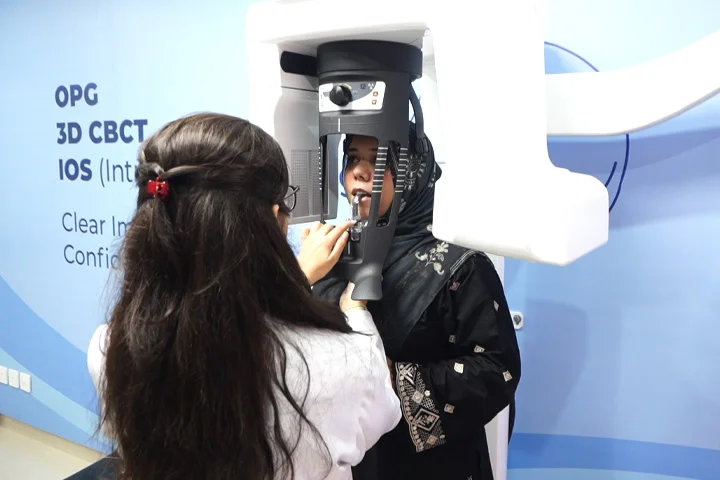
Nothing complicated, honestly. You stand with your head held in a fixed positioner so the angle stays consistent, the machine captures the image in a few seconds, and someone marks the relevant landmarks afterward to run the measurements. Start to finish, it's a few minutes, and the radiation dose involved is minimal.
One Roof, Fewer Headaches
Because jaw issues often need more than one type of imaging to sort out properly, it helps to go somewhere that can do CEPH, OPG, and CBCT scans without sending you elsewhere — and ideally somewhere that also handles broader diagnostics like CT Coronary Angiography, in case cardiac clearance is needed before a surgical case. Less running around, faster answers.
Final Thoughts
Jaw problems are rarely as simple as they look in the mirror, and treating them properly starts with actually knowing what's causing them. A cephalometric X-ray gives orthodontists and surgeons something concrete to work with — real measurements instead of a visual guess — so the treatment plan ends up targeting the actual cause of the problem, not just the symptom sitting on the surface.