Sign up with Google
 Sign in with Zoho

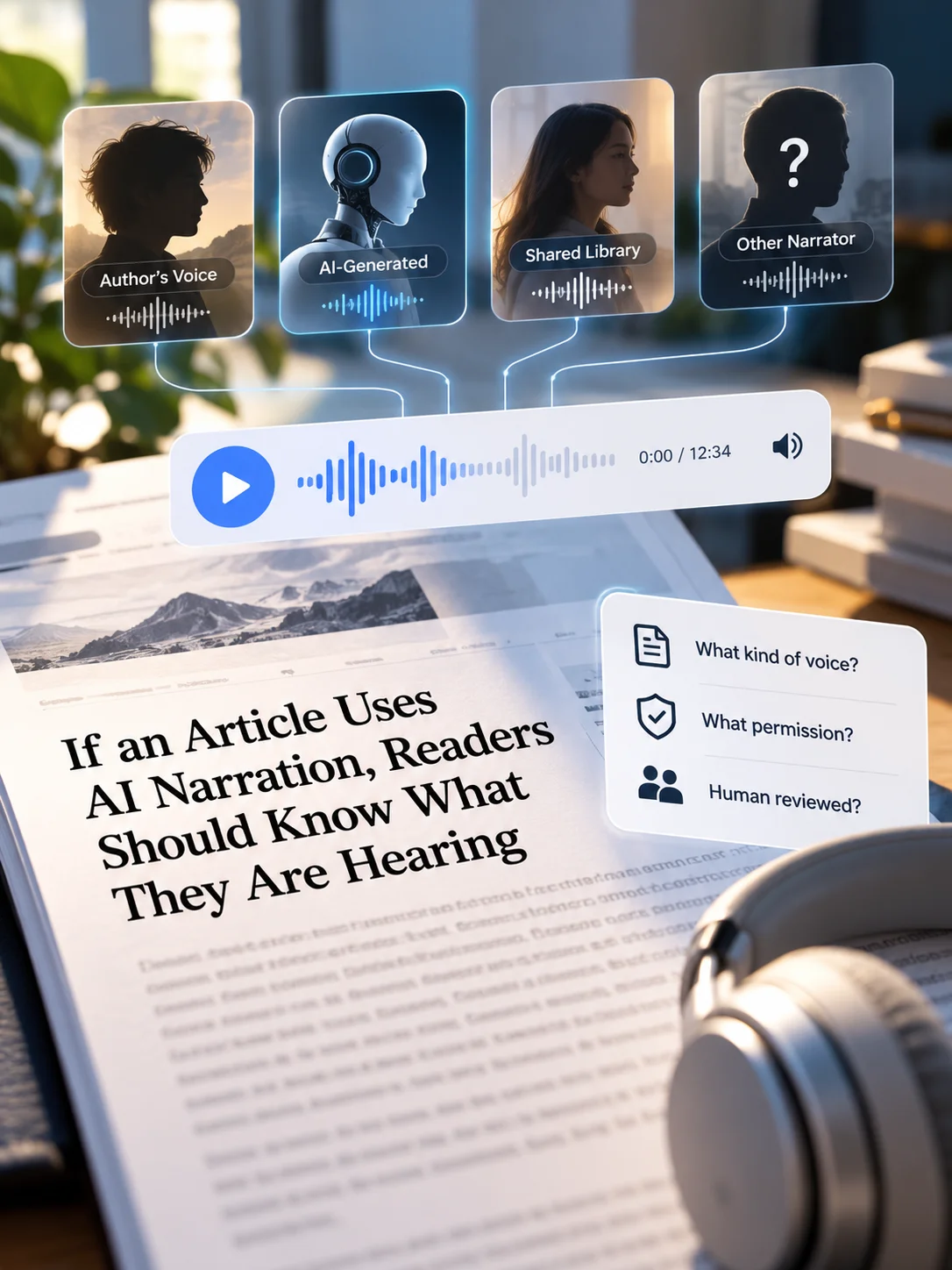
An audio player beneath an article seems straightforward: press play and listen. But when a voice reads a personal essay or opinion piece, it can sound as though the author is speaking directly to the listener.
That may not be true. The narration could be synthetic, selected from a shared library, or based on a real person’s recording. None of those choices is inherently deceptive. The problem is leaving readers to guess.
Audio changes how a piece is received. A byline identifies the writer, but narration adds pace, warmth, and personality. A first-person story may sound as if its author also recorded it, even when the author never went near a microphone. Readers do not need a technical explanation of speech synthesis. They do need enough context to know whether they are hearing the author, another narrator, or a generated voice.
A convincing voice can imply the wrong person
Narrator identity matters more in some writing than in others. In a short tutorial, listeners may care mainly about clear instructions. In a personal essay, the voice can seem tied to the author’s emotions, background, and identity.
Synthetic narration can still be useful. It offers another way to access an article when reading from a screen is inconvenient. Yet a natural-sounding voice may lead listeners to assume that it belongs to the writer or that a human narrator performed the piece.
A short credit can prevent that confusion. It does not need to interrupt the article or look like a warning. It only needs to say plainly what the audio is.
A useful audio credit answers three questions
A clear disclosure covers three parts of the process:
- what kind of voice the listener is hearing
- what permission or license allows that voice to be used
- whether someone reviewed the finished audio
Every statement should be based on facts the publisher has verified. If the voice is generic text-to-speech, say so. If it was cloned from a real person with permission, describe only the permission that can be confirmed. If the source or license is unclear, the voice is not ready for public use.
A basic credit could read:
> Audio version: synthetic narration. The article was written and edited by the author. The audio was checked against the final text before publication.
This is a template, not a statement every publisher can make. Each sentence should be used only when it is true.
For a licensed or consented voice, the credit may need to identify the arrangement more precisely. “Used with permission” says very little if nobody has checked what the permission covers, whether commercial use is included, or whether the voice may be used for this type of content.
The credit can remain short without becoming vague. “AI-generated narration” identifies the format. A source or licensing note explains why the voice may be used. A review note tells readers whether someone listened to the final recording. When a translation has not been independently checked, calling it an experimental version is more accurate than applying a vague “verified” label.
Previewing a voice is not permission to publish it
Testing and publishing are separate decisions. A creator may preview several voices while deciding whether audio suits an article, then reject all of them.
The FreeVoiceClone voice library is **free to try**, while the platform advertises support for **500+ languages** through its voice-generation tools. That range may help a writer explore narration styles or possible language versions before committing to production. It does not prove that every voice is cleared for every use, or that every language output has received human review.
Before publishing a community-contributed or cloned voice, the publisher still needs answers. Who provided it? What uses are permitted? Is it meant to resemble an identifiable person? Do the relevant terms cover this article, audience, and method of distribution?
Availability answers “Can I preview this?” Permission answers “May I publish this here?” They are not the same question.
Multilingual narration needs someone who can judge it
Clear pronunciation is only part of a multilingual audio edition. A sentence can be grammatically correct and still sound too formal, oddly paced, or unlike the original author. Names, dates, numbers, and references to local culture are common places for problems to hide.
The reviewer needs to understand both the language and the article’s context. Reading the translated script is not enough; spoken language introduces emphasis, timing, and pauses that are invisible on the page.
If a qualified review is unavailable, the description should not imply that the audio is a finished, verified translation. Calling it a test or experimental version gives readers a more accurate expectation.
Consider a hypothetical article containing the date “05/11” and an unfamiliar product name. Readers may interpret the date differently depending on local convention, while a synthetic voice may stress the product name in an unexpected way. A grammatical translation does not rule out either problem.
A sensible review would write the date unambiguously, add pronunciation guidance where needed, and begin with a short sample. Someone fluent in the target language would then listen in context and flag anything unnatural. The complete recording would still need another check before being described as publication-ready.
Human review should cover the final file
An early sample is not enough if the article changes later. The audio should follow the final edited text, including corrected names, updated figures, and revised wording.
Someone should listen from beginning to end and check the recording against the page. This can catch missing sentences, repeated lines, awkward pauses, and pronunciation errors that did not appear in a short preview. For another language, the reviewer also needs enough fluency to judge meaning and tone.
“Human reviewed” should describe an actual review, not the fact that a person clicked the generate button.
Keep the text and the credit close to the audio
Audio should add another way to access an article rather than hide the written version. Keeping the text available lets readers skim, quote, translate, or check a sentence they did not hear clearly. A transcript helps for the same reason, as do accurate captions.
The audio credit belongs near the player, where listeners can see it before or while pressing play. It may be brief, but it should not be buried in a general terms page.
Ordinary controls matter too: play, pause, duration, and a clear language label. A decorative interface is of little use if readers cannot tell who is speaking or whether anyone reviewed the narration.
Questions to answer before publishing
- Does the narration match the final edited article?
- Is the voice synthetic, cloned, or based on a shared recording?
- Has the intended use been checked against the relevant permission or license?
- Were names, numbers, dates, and unusual terms reviewed by listening?
- If the audio uses another language, did a qualified person review its meaning and tone?
- Can readers still access the text or a transcript?
- Is the narration labeled plainly beside the player?
The answers do not need to become a long disclaimer. They do need to exist.
The Final Judgment Belongs to the Author
AI narration can make an article easier to access without requiring a fresh recording session after every revision. The trouble begins when that convenience is presented as something it is not: the author’s own performance, a licensed voice when permission has not been checked, or a reviewed translation that no qualified listener has heard.
The boundary is fairly simple. Readers should be told what kind of narration they are hearing, and publishers should be able to support any claim they make about rights or review. The credit does not need to dominate the page. It needs to be visible and accurate.
If the provenance of a voice or the quality of a translated recording remains uncertain, that uncertainty should be resolved or stated before publication. Software may produce the audio, but the author still decides what reaches the listener. Clear labeling is part of that editorial responsibility.