Sign up with Google
 Sign in with Zoho

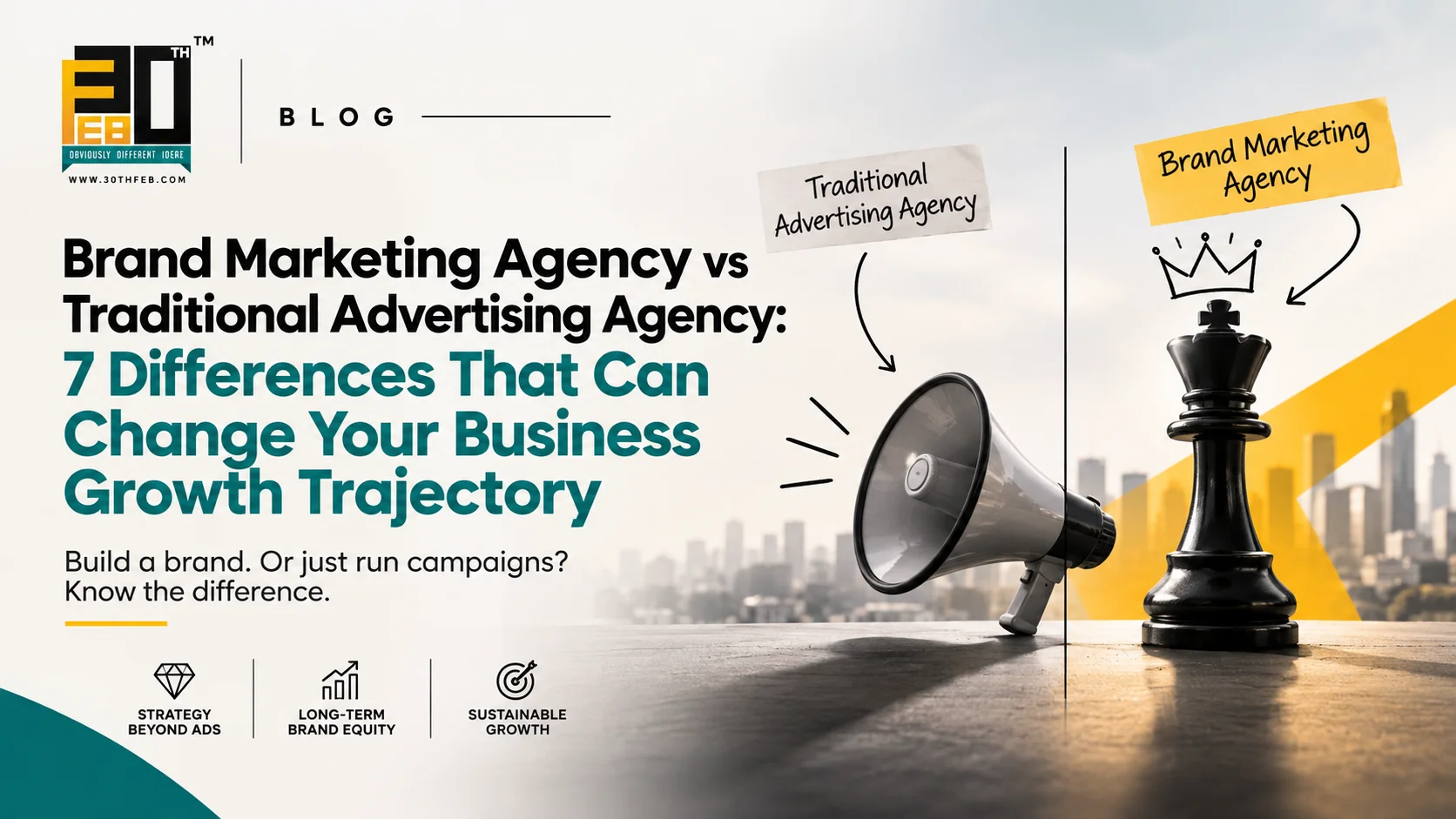
For businesses looking to scale, the real question isn't how loudly they communicate. It's whether they're communicating the right value to the right audience.
This is where the difference between a brand marketing agency and a traditional advertising agency becomes important.
While both contribute to business visibility, their strategic roles are different. One focuses on building the foundation that makes a business distinctive and valuable. The other typically focuses on promoting products, services and campaigns to reach audiences.
Understanding these differences can help founders, CMOs and growth-focused businesses make smarter investments.
1. Brand Strategy vs Campaign Execution
Traditional advertising agencies often focus on campaign concepts, media placements and promotional execution.
A brand marketing agency starts earlier.
It examines your market position, customer perception, competitive landscape and long-term business objectives before deciding how the brand should communicate.
The difference: Advertising asks, "How do we promote this?" Branding asks, "Why should customers choose us?"
2. Long-Term Brand Equity vs Short-Term Visibility
Advertising can generate immediate attention. However, attention without differentiation is difficult to sustain.
Strong branding builds recognition, credibility and preference over time.
Experienced brand consultants in India understand that brand equity is not simply about being remembered. It is about being remembered for something meaningful.
A useful framework:
Visibility → Recognition → Trust → Preference → Loyalty
Advertising can accelerate visibility, but a strategic brand foundation helps turn visibility into lasting business value.
3. Market Differentiation vs Promotional Messaging
Traditional advertising often highlights product benefits, offers and competitive advantages.
Brand marketing goes deeper by identifying what makes the business genuinely different.
For example, two technology companies may offer similar solutions. One competes on pricing, while the other owns a distinct position around reliability, innovation or industry expertise.
The product may be similar. The perceived value doesn't have to be.
This is where established branding firms in India can help businesses develop a distinctive market position rather than competing through repetitive promotional messages.
4. Business Alignment vs Channel-Based Marketing
A traditional advertising approach may prioritize campaign performance across platforms.
A strategic brand marketing approach connects communication across the entire business.
Consider these touchpoints:
- Website positioning
- Sales presentations
- Social media communication
- Customer experience
- Employer branding
- Product messaging
If every touchpoint tells a different story, the brand loses clarity.
The right brand consulting firms in India help establish a consistent strategic direction that connects marketing, sales and customer experience.
5. Audience Understanding vs Audience Reach
Reaching more people isn't always the answer.
Growth depends on reaching the people who understand your value, need your solution and have the potential to become profitable customers.
A brand marketing company studies customer motivations, buying behaviour, decision-making processes and category expectations.
Its objective is not simply to increase reach but to improve relevance.
Better audience fit often creates better marketing efficiency.
6. Integrated Growth vs Isolated Campaign Results
Advertising campaigns are frequently measured through impressions, clicks, engagement and conversions.
These metrics matter, but they don't tell the entire business story.
Strategic brand marketing considers how positioning, messaging, demand generation and customer retention work together.
A stronger measurement framework includes:
Brand Metrics: Awareness, recall and differentiation.
Marketing Metrics: Qualified leads, conversion rates and acquisition costs.
Business Metrics: Pipeline contribution, customer lifetime value and revenue growth.
The objective is to connect marketing performance with business performance.
7. Strategic Partnership vs Service-Based Engagement
Perhaps the biggest difference is the relationship itself.
A traditional advertising agency may be engaged to deliver specific campaigns or creative assets.
A strategic brand marketing partner works alongside leadership to understand business ambitions, identify growth opportunities and shape the brand's direction.
For founders and CMOs, this distinction matters.
The right partner should challenge assumptions, question outdated positioning and identify opportunities that may not be immediately obvious.
That is the value of working with experienced brand consultants rather than simply outsourcing creative execution.
Choosing the Right Partner for Your Next Growth Stage
Before choosing between agencies, ask yourself five questions:
- Do we need stronger market positioning or simply greater visibility?
- Is our brand differentiated from competitors?
- Are marketing and sales communicating consistently?
- Can customers clearly understand our value?
- Do we need campaign execution or long-term strategic direction?
Your answers will reveal where your business needs support.
The 30TH FEB Perspective: Don't Just Advertise. Build a Brand Worth Remembering.
Advertising can put your business in front of people. But a strong brand gives them a reason to pay attention, believe in your value and choose you over alternatives.
The strongest businesses understand that visibility and brand equity must work together.
At 30TH FEB, we believe growth begins with strategic clarity. From brand positioning and identity to marketing strategy and business alignment, the focus should always be on building brands that create meaningful differentiation.
Because the goal isn't simply to be seen more.
It's to become the brand your market remembers, trusts and chooses.