Sign up with Google
 Sign in with Zoho

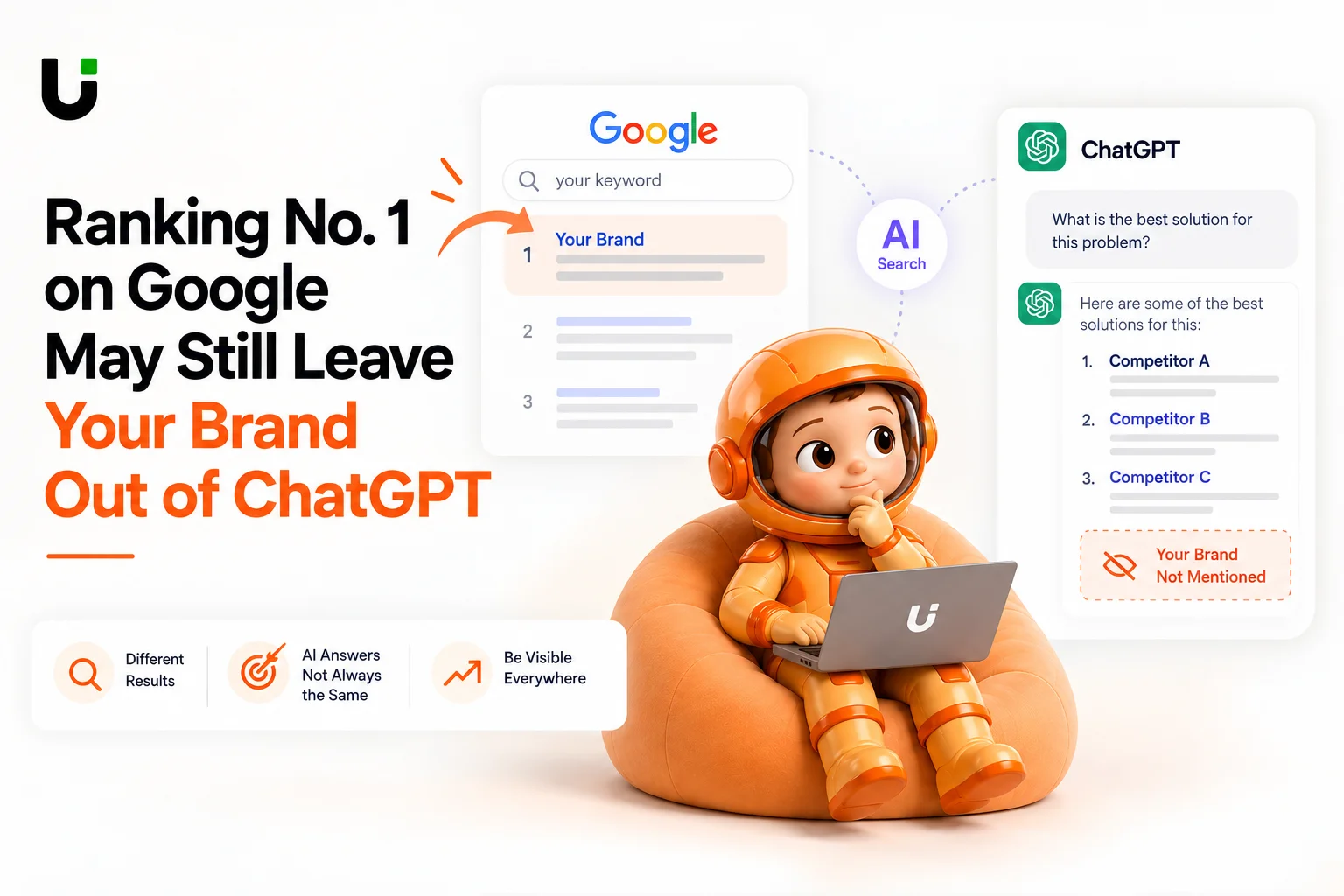
On one screen, the brand is number one.
On another, it does not exist.
The first screen shows Google. The company occupies the position every SEO team has spent years trying to win.
The second shows ChatGPT answering a buyer's question about the same product category. It recommends three companies. The Google leader is not one of them.
This is not necessarily a ranking failure. It is the result of two systems making two different decisions.
Google is deciding which pages should appear.
An AI platform is deciding what answer it should give.
That difference is beginning to create a blind spot for brands that have learned to measure visibility almost entirely through search rankings, impressions and clicks.
A company may still be easy to find. The more important question is whether it is being considered.
The journey no longer has to reach a website
A traditional search result leaves much of the work to the buyer. They open pages, read comparisons, return to the results and gradually build a shortlist.
AI can compress that entire journey into one conversation.
A buyer can describe their company, budget, team size and problem in a single prompt. The response may compare products, explain trade-offs and recommend a few brands before the buyer has visited any of their websites.
This changes the value of visibility.
In traditional search, appearing near the top gives a brand the opportunity to make its case.
In an AI-generated answer, the case may be made before the brand's own page is opened, or without that page being opened at all.
The sources shaping that answer may also extend beyond the company's website. Google says its AI features can use "query fan-out," issuing several related searches across different topics and sources before building a response (Google Search Central).
OpenAI explains that ChatGPT search uses third-party search providers and content from publishing partners to produce answers connected to web sources (OpenAI).
An AI recommendation can therefore be influenced by a much wider picture of the market: how a company describes itself, how other websites describe it, which problems it is associated with and how consistently it appears in credible category discussions.
The page ranking first on Google remains important. It is simply no longer the only signal in the room.
Two markets can now exist at the same time
This creates a strange situation for marketing teams.
A company can appear to lead its category in Google while a different set of competitors dominates AI answers.
One competitor may be repeatedly included in specialist articles. Another may appear across respected comparison pages. A third may have created content that answers the specific, conversational questions people bring to AI.
None of them necessarily needs to outrank the market leader for every major keyword.
They only need to become easier for AI systems to understand, support and include in the answer.
That is why the emerging divide cannot be explained by rankings alone.
Search visibility measures the position of a page.
AI visibility measures the presence of a brand within an answer.
The first is primarily about discovery. The second is increasingly connected to consideration.
WorksBuddy is investigating where the winners change
WorksBuddy is launching an ongoing research project called Google Winners vs AI Winners to examine how often the leaders of traditional search remain visible when the same buying decisions move into AI platforms.
The project will use non-branded, commercial questions based on the way people naturally evaluate products.
Instead of testing a broad term such as "accounting software," the analysis will examine questions such as:
"Which accounting platform is suitable for a growing company that needs invoicing, payment reminders and cash-flow visibility?"
The leading organic results on Google will then be compared with the brands named across ChatGPT, Gemini, Perplexity, Claude and Copilot.
Prompts will be repeated because AI-generated answers can change between runs. The research will also examine the sources cited, the consistency of recommendations and the share of voice each brand receives across the full prompt set.
The intention is not to produce another list of companies that are "winning AI."
It is to investigate where the two systems disagree.
Do the brands occupying Google's top positions also enter AI-generated shortlists?
Are smaller challengers gaining visibility inside AI answers despite weaker search rankings?
Which publications, directories and comparison pages influence those recommendations?
And when a leading brand disappears, is the missing signal on its website or somewhere else on the web?
Those questions matter because a conventional SEO report cannot answer them.
The answer will not be "SEO is dead"
AI visibility should not be treated as a replacement for search visibility.
Strong technical foundations, useful content and clear site structure remain essential. Google explicitly states that established SEO practices continue to apply to AI Overviews and AI Mode.
The change is that ranking well may now be the beginning of the work rather than the final proof of visibility.
Research into Generative Engine Optimization has already demonstrated that the way information is written and supported can influence its visibility within generative answers. A study accepted at KDD 2024 reported improvements of up to 40% under certain benchmark conditions, while also finding that the effect varied by domain (GEO research).
That variation is important. It suggests there is no universal checklist that can guarantee a mention.
Brands first need to understand the questions being asked, the competitors appearing and the sources shaping the response.
Sometimes the answer will be stronger content.
Sometimes it will be a clearer product page.
Sometimes it will be an expert article, a credible comparison or a relevant piece of editorial coverage.
The work may begin on the website, but it does not always end there.
The next report marketers will need
For years, a marketing team could point to a ranking report and say, with confidence, "We are visible."
That sentence now needs a second part.
Visible where?
Ranko, WorksBuddy's AI-visibility platform, is designed to help answer that question by tracking buyer prompts, measuring brand share of voice and identifying the sources used inside AI-generated answers.
The purpose is not to create another score for marketers to watch.
It is to show whether a brand's position in search matches its position in the answers buyers increasingly use to build their shortlists.
Google may still decide which page ranks first.
But ChatGPT, Gemini, Claude, Copilot and Perplexity are helping decide which brands enter the conversation.
The companies preparing for that shift are no longer asking only, "Where do we rank?"
They are beginning to ask, "When AI answers, who does it choose?"