Sign up with Google
 Sign in with Zoho

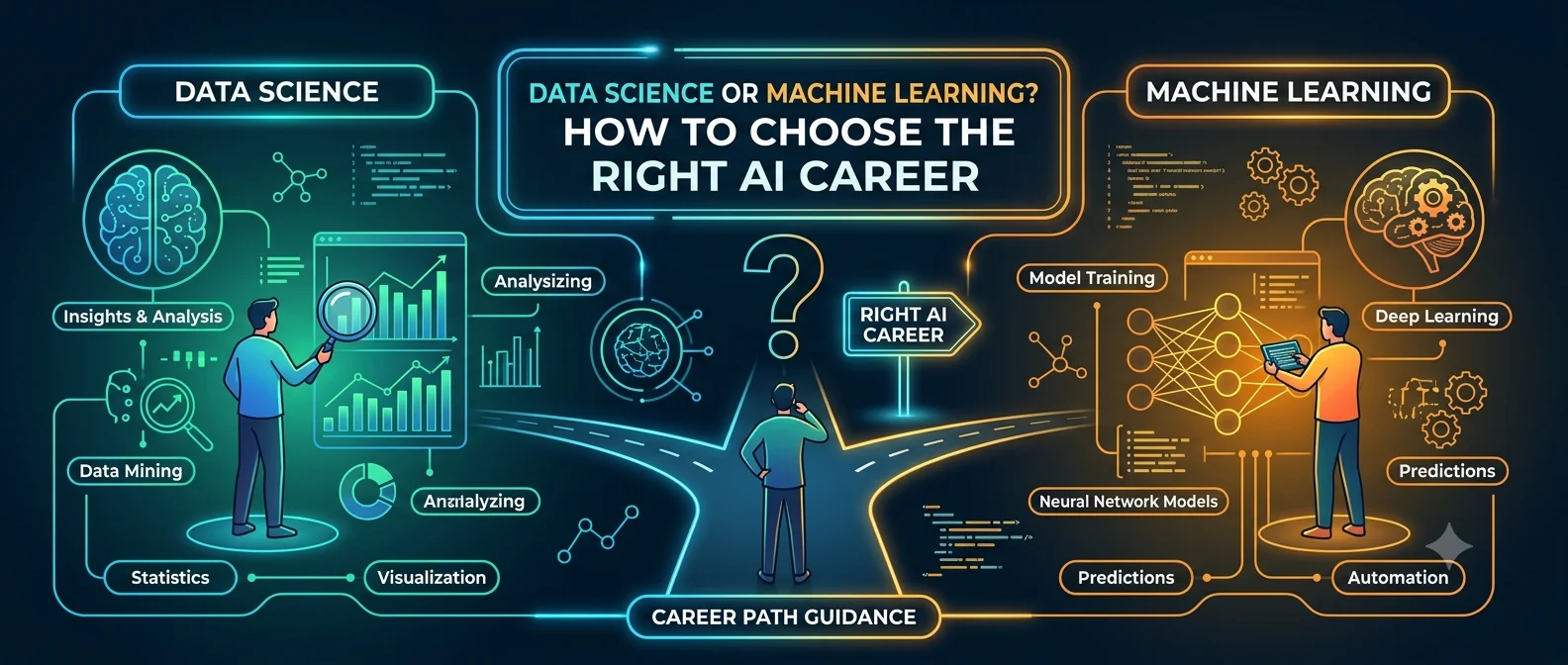
Data science and machine learning are often used interchangeably in casual conversation, which creates real confusion for professionals trying to plan an AI career path. While the two fields overlap significantly, they lead to genuinely different day-to-day work, require somewhat different skill emphases, and suit different professional strengths. This blog breaks down the practical differences between data science and machine learning careers to help you choose the right direction.
Understanding the Core Difference
Data science is a broad discipline focused on extracting insights from data to inform business decisions. It combines statistics, data analysis, visualisation, and — often, but not always — machine learning techniques, within a business-context, decision-support role. Machine learning is a more specialised, technical discipline focused specifically on building, training, and deploying predictive models and algorithms. A machine learning engineer's work centres on the technical mechanics of building AI systems, while a data scientist's work centres on generating insights and recommendations, of which machine learning models are often just one tool.
What Data Scientists Actually Do
- Analyse large, complex datasets to identify patterns and trends relevant to business questions
- Build and interpret statistical models to support decision-making
- Communicate findings to business stakeholders through visualisations and reports
- Sometimes build machine learning models, though often at a less deeply technical level than dedicated ML engineers
- Work closely with business teams to translate data insights into actionable recommendations
Typical skills: Statistics, data visualisation, SQL, Python or R, business communication, moderate machine learning knowledge.
What Machine Learning Engineers Actually Do
- Design, build, and train machine learning models for specific predictive or automation tasks
- Optimise model performance, accuracy, and computational efficiency
- Deploy models into production systems and maintain them over time
- Work closely with software engineering teams to integrate AI models into applications and platforms
- Focus heavily on the technical, algorithmic, and infrastructure aspects of AI systems
Typical skills: Strong programming (Python, sometimes additional languages), deep understanding of machine learning algorithms, software engineering practices, data pipeline and infrastructure knowledge.
Key Differences to Consider
- Business focus vs technical focus: Data science leans toward business insight and communication; machine learning leans toward technical system-building.
- Breadth vs depth: Data scientists typically work across a broader range of tools and techniques; machine learning engineers go deeper into the technical mechanics of specific algorithms and systems.
- Stakeholder interaction: Data scientists often interact directly with business stakeholders to present findings; machine learning engineers more often collaborate with technical teams (software engineers, data engineers).
- Career entry points: Data science can be more accessible to professionals from analytical or business backgrounds; machine learning generally requires stronger, more specialised technical and mathematical foundations from the outset.
Which Path Might Suit You Better
Consider data science if:
- You enjoy translating data into business insights and communicating findings to non-technical audiences.
- You have (or want to build) strong analytical and statistical skills without necessarily going deep into algorithm design.
- You're drawn to a role that blends technical analysis with business strategy.
Consider machine learning if:
- You enjoy deep technical problem-solving and building systems from the ground up.
- You have (or want to build) strong programming and mathematical foundations.
- You're drawn to the engineering side of AI — building, optimising, and deploying models rather than primarily interpreting their outputs for business audiences.
Salary and Career Trajectory Considerations
Both fields offer strong career prospects, though compensation and demand patterns can differ by industry and specific role seniority. Machine learning engineering roles, given their deeper technical specialisation, often command premium salaries, particularly in technology-focused companies building AI products. Data science roles offer strong compensation as well, often with a slightly broader range of industries and company types actively hiring, given the more universally applicable, business-facing nature of the skill set.
You Don't Have to Choose Permanently
Many professionals start in data science and later specialise more deeply into machine learning as their technical skills and interests develop, while others start with a machine learning focus and move toward more strategic, business-facing data science or analytics leadership roles over time. Your first certification or course doesn't have to lock you into a single, permanent career direction — it's a starting point that can evolve as you gain experience and clarity about what you enjoy most.
Getting Started on the Right Foot
Whichever direction appeals to you, choosing a certification or course specifically aligned with that path — rather than a generic "AI course" — will give you a more relevant, focused foundation. Look for programmes with clear curriculum breakdowns that explicitly indicate whether they lean toward data science's broader analytical scope or machine learning's deeper technical specialisation.
You can explore AI certification India programmes covering both data science and machine learning pathways, designed to help you build a strong foundation in the direction that best matches your interests and career goals.
Frequently Asked Questions
Is data science easier to learn than machine learning?
Data science generally has a lower technical entry barrier due to its broader, more business-oriented focus, though both fields require solid analytical skills to succeed.
Can I switch from data science to machine learning later?
Yes, many professionals build a data science foundation first and later specialise into machine learning as their technical skills develop.
Which pays more — data science or machine learning?
Machine learning engineering roles often command premium salaries due to deeper technical specialisation, though data science roles offer strong compensation across a wide range of industries.
Do I need a strong math background for machine learning?
Yes, machine learning generally requires a stronger foundation in statistics, linear algebra, and calculus compared to many data science roles, particularly for building and optimising models from scratch.