Sign up with Google
 Sign in with Zoho

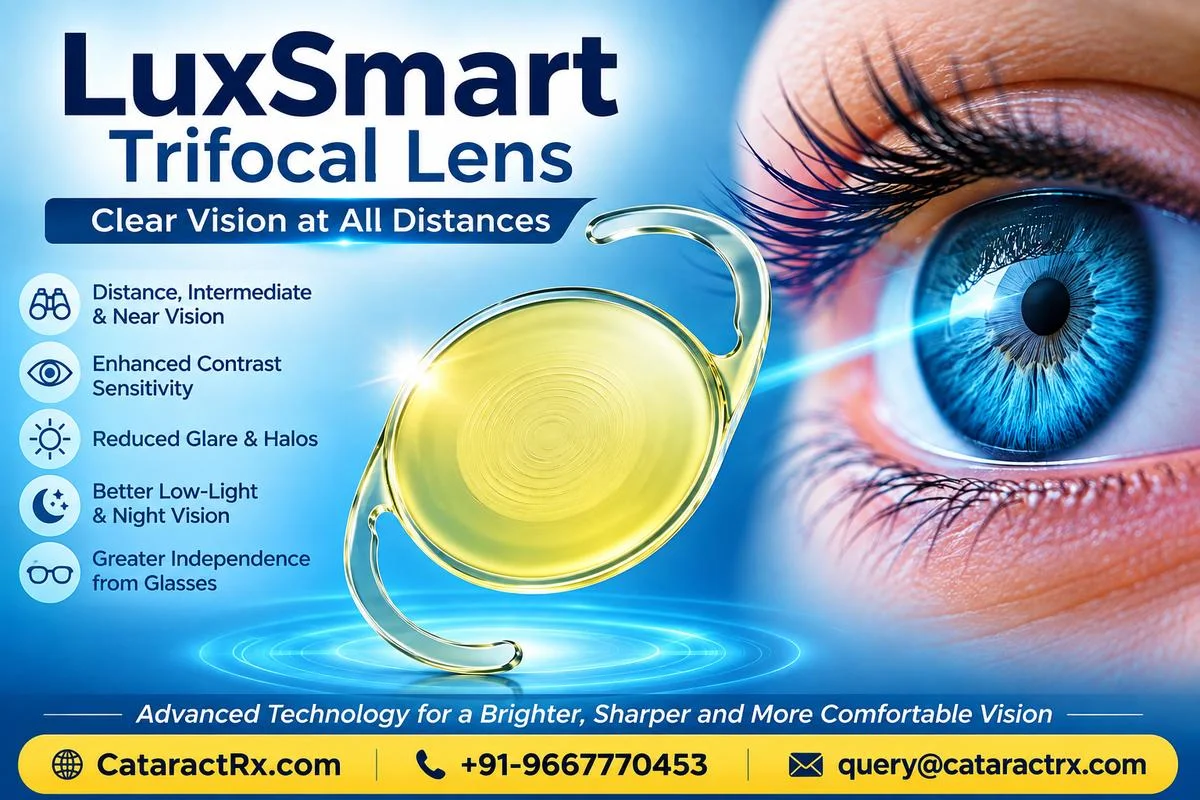
Choosing an intraocular lens after cataract diagnosis is no longer simply about restoring distance vision. Many patients want comfortable vision for computers, smartphones, conversations, shopping, cooking, and other everyday activities while also reducing their dependence on spectacles.
The luxsmart trifocal lens is often considered by patients looking for an advanced premium option that can provide a broader range of useful vision. However, the right IOL depends on eye health, lifestyle, visual expectations, and detailed pre-operative measurements.
What Makes LuxSmart Different From Standard IOLs?
LuxSmart™ is an advanced EDOF intraocular lens that extends the range of clear vision instead of focusing at a single distance, supporting distance, intermediate, and near vision after cataract surgery.It also features an aspheric design for more natural vision and is associated with improved contrast sensitivity and reduced glare and halos compared to some other premium IOLs. Key features include:
- Extended Depth of Focus technology for a wider range of functional vision
- Enhanced contrast sensitivity, particularly useful in challenging lighting
- Reduced glare and halos compared with some multifocal approaches
- Aspheric optical design for optimized visual quality
- Potentially less dependence on glasses for everyday activities
- Support for distance, intermediate, and useful near vision
These characteristics make the lens an interesting option for people who want more visual flexibility without choosing a traditional multifocal design solely for spectacle independence.
Can LuxSmart Improve Everyday Vision After Cataract Surgery?
For many cataract patients, the goal is not just to remove the cloudy lens but to regain clear, practical vision for daily life. The premium luxsmart lens is designed to extend depth of focus, helping support vision at multiple distances.This can be especially useful for active people who switch often between distance and intermediate tasks like using a laptop, driving, cooking, checking a phone, or reading labels.
The CataractRx page highlights several patient-oriented advantages:
- Improved visual quality: Enhanced clarity and contrast can support comfortable everyday vision.
- Intermediate vision: Extended focus may make computer and dashboard activities more convenient.
- Low-light performance: Better contrast sensitivity can be helpful when lighting conditions are less favorable.
- Lifestyle flexibility: Reduced dependence on corrective lenses may provide greater freedom during daily activities.
- Visual comfort: Reduced glare and halos are highlighted as an important advantage.
- Adaptation: Patients may require some time to adjust to their new visual experience following surgery.
Outcomes vary and depend on corneal and retinal health, eye measurements, existing conditions, and accurate IOL power calculation.
Is LuxSmart Better Than Other Trifocal Options?
The question of luxsmart vs other trifocal lenses should be based on individual visual needs rather than features alone, as different IOLs serve different priorities. LuxSmart uses EDOF technology, while Vivity uses non-diffractive X-Wave™ technology. Both aim to extend vision, with LuxSmart also focusing on maintaining contrast sensitivity and reducing glare and halos. A useful comparison should consider:
- Vision range: How much distance, intermediate, and near vision does the patient realistically need?
- Contrast sensitivity: Is comfortable vision in dim or low-light environments particularly important?
- Night-time activities: Patients who frequently drive or move around at night may prioritize visual comfort.
- Glare and halos: Different lens technologies can produce different visual phenomena.
- Spectacle expectations: Some patients prioritize maximum freedom from glasses, while others prefer balanced visual quality.
Rather than treating one lens as universally superior, an ophthalmologist should evaluate the patient's eyes and expectations before recommending a particular IOL.
How Is LuxSmart Implanted During Cataract Surgery?
LuxSmart implantation follows standard cataract surgery steps. Before surgery, the eye is carefully examined with measurements to choose the correct IOL power, along with a review of medical history and eye health.
The procedure is usually done under local anesthesia. The cloudy lens is removed through a small incision using phacoemulsification and replaced with the LuxSmart IOL, which then unfolds inside the eye. As with any advanced lens, some temporary effects like dryness, mild discomfort, glare, or halos may occur, and adaptation can take a few days or weeks. Because of this, proper consultation and eye evaluation are more important than choosing a lens based only on its name or technology.
What Should You Ask Before Choosing This IOL?
Before selecting an advanced IOL, patients should have a clear discussion with their cataract surgeon about their visual priorities. A comprehensive eye examination, corneal measurements, and medical-history review are important parts of the pre-operative assessment.
Consider asking:
- What vision range can I realistically expect after surgery?
- Do my eyes have any condition that could affect the result?
- How much will I still need glasses for reading or close work?
- Is my lifestyle suitable for an extended-depth-of-focus lens?
- How important is night vision and contrast sensitivity for me?
- Which IOL power calculation method will be used?
- What visual effects might I notice during the adaptation period?
- What alternatives should I consider before making my decision?
How Can You Choose the Right IOL for Your Vision Goals?
The ideal cataract lens should match your eyes and lifestyle, not just be labeled as premium. To check if LuxSmart is right for you, consult a cataract specialist for a full pre-operative evaluation.
For guidance, contact CataractRx.com at +91-9667770453 or [email protected]. A proper evaluation helps set realistic expectations and choose the most suitable IOL for your vision needs.
Frequently Asked Questions
1. What is LuxSmart IOL?
LuxSmart is an advanced intraocular lens that uses Extended Depth of Focus technology to provide a broader range of functional vision after cataract surgery.
2. Can LuxSmart reduce dependence on glasses?
It may reduce dependence on glasses for certain distance, intermediate, and near activities, although individual results vary and some patients may still require spectacles for specific tasks.
3. Is LuxSmart suitable for everyone?
No. Suitability depends on overall eye health, visual requirements, measurements, medical history, and the patient's expectations. A detailed ophthalmic evaluation is essential.
4. Can LuxSmart cause glare or halos?
Some patients may experience temporary glare or halos after surgery. The CataractRx page states that these visual disturbances are reduced compared with some other IOL approaches, but they cannot necessarily be eliminated in every patient.
5. How long does an IOL last?
IOLs are designed to remain in the eye for a lifetime under normal circumstances. The CataractRx page describes IOLs as being made from durable, biocompatible materials that generally do not require routine replacement.