Sign up with Google
 Sign in with Zoho

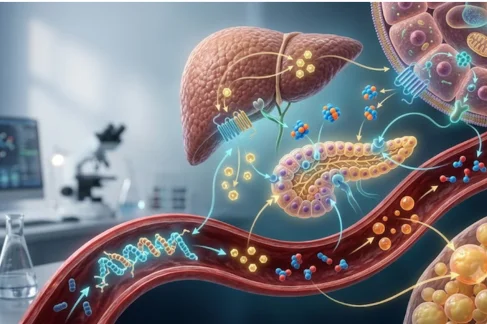
Your body's cells are all dependent on blood flow. It transports hormones, transports nutrients and oxygen, removes waste, and aids in temperature regulation. You never give it any thought when it functions well. When it doesn't, the consequences may be severe and take a while to manifest.
Most people first meet their circulation through numbers: a blood pressure reading, a cholesterol result, a resting heart rate on a watch. A Blood Test Analysis App with AI can help you read those numbers in one place and spot patterns over time. It helps to understand what the numbers represent first, so here is how circulation works and how to tell whether yours is in good shape.
What Is Blood Flow?
Blood flow through your heart and blood arteries is known as blood flow. It is expressed as a volume over time, as liters per minute. Your heart pumps around 5 liters per minute while you're at rest, or about 2,000 gallons each day.
The same blood travels repeatedly since your body can only contain 1.3 liters of blood. It takes roughly a minute to complete a circuit.
How Circulation Works
The heart is the pump
The heart has four chambers. The two upper chambers (atria) receive blood. The two lower chambers (ventricles) push it out. Valves between them keep blood moving in one direction. The heart beats about 100,000 times a day, often without any conscious effort from you.
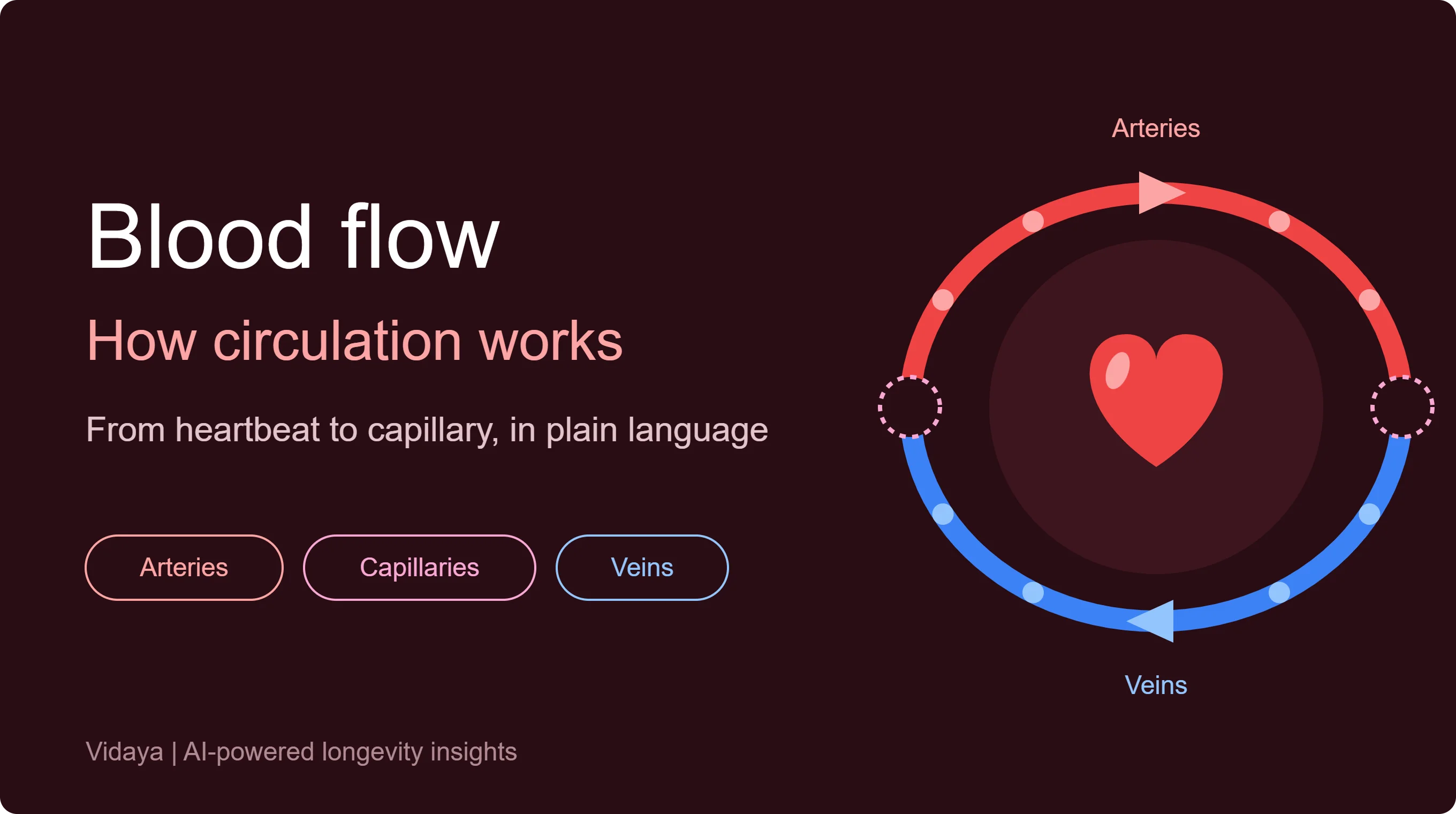
Arteries, capillaries, and veins
Each type of vessel has a different job:
- Arteries carry oxygen-rich blood away from the heart. Their muscular walls handle high pressure.
- Capillaries are tiny vessels with walls one cell thick. This is where oxygen and nutrients move into tissue and waste moves out.
- Veins return blood to the heart. They operate at low pressure and use one-way valves and the squeeze of your leg muscles to push blood upward.
Two loops, one system
Circulation runs in two connected loops:
- Pulmonary circulation: The right side of the heart sends blood to the lungs to pick up oxygen and release carbon dioxide.
- Systemic circulation: The left side sends oxygen-rich blood to the brain, muscles, organs, and skin, then collects it again on the way back.
What Controls Blood Flow
Your body adjusts circulation constantly. Four factors do most of the work:
- Blood pressure: The force pushing blood through vessels.
- Vessel diameter: Wider vessels allow more flow. Narrower ones restrict it.
- Resistance: Narrowing, stiffness, or plaque makes the heart work harder.
- Blood thickness: Dehydration or certain conditions make blood more viscous.
All of this is regulated by hormones and the neurological system. When you exercise, the flow to your digestive tract decreases and the veins in your working muscles widen. The opposite occurs after a large dinner. Because of this, modest exercise is acceptable after eating, but a strenuous workout may be taxing.
Why Healthy Circulation Matters
Good circulation supports nearly everything people care about when they track their health:
- Energy and exercise recovery: Muscles need steady oxygen and nutrient delivery.
- Brain function: The brain uses about 20% of your oxygen supply.
- Wound healing and immune response: Immune cells travel through blood.
- Heart and kidney health: Both are sensitive to long-term pressure and flow problems.
Cardiovascular disease remains the leading cause of death in the United States. Many of its drivers develop quietly over decades, which is why early measurement matters.
Common Circulation Problems
- Atherosclerosis: Plaque builds up in artery walls, narrowing them. It can lead to heart attack and stroke.
- High blood pressure: Often called a silent condition because it rarely causes symptoms. Nearly half of US adults meet the clinical definition.
- Peripheral artery disease (PAD): Narrowed arteries in the legs cause pain when walking, often relieved by rest.
- Blood clots: Deep vein thrombosis in the legs can be dangerous if a clot travels to the lungs.
- Raynaud’s phenomenon: Fingers and toes turn white or blue in the cold due to temporary vessel spasms.
- Microvascular damage: Diabetes can injure small vessels over time, affecting eyes, kidneys, and nerves.
Warning signs to take seriously
Contact a doctor if you notice:
- Leg pain or cramping when walking that eases with rest
- Swelling in one leg, especially with warmth or redness
- Cold, numb, or discolored hands or feet that don’t recover
- Slow-healing sores on the feet or legs
- Dizziness, unusual shortness of breath, or fatigue that is new for you
Call 911 for chest pain, sudden weakness on one side, trouble speaking, or sudden vision loss. Do not wait for a test result or an app notification.
How to Check Your Circulatory Health
No single test measures “blood flow” for the whole body. Instead, you combine several views.
Clinical tests
- Blood pressure: The most basic and important measure. Under 120/80 is considered normal. Readings at or above 130/80 are classified as elevated or high by current US guidelines.
- Ankle-brachial index (ABI): Compares blood pressure at the ankle and arm to screen for PAD.
- Doppler ultrasound: Uses sound waves to look at blood flow in specific vessels.
- Coronary artery calcium (CAC) scan: A CT scan that detects calcified plaque in heart arteries.
- Stress testing: Evaluates how the heart and vessels respond to exertion.
Blood biomarkers
Bloodwork does not measure flow directly. It measures the factors that damage vessels or raise risk:
- LDL cholesterol and ApoB: ApoB counts the particles that can lodge in artery walls and is often more informative than LDL alone.
- Lipoprotein(a): A largely inherited risk factor. Most people only need to test it once.
- Triglycerides and HDL: Part of the standard lipid picture.
- HbA1c and fasting glucose: Chronic high blood sugar harms vessel linings.
- hs-CRP: A marker of inflammation linked to cardiovascular risk.
- Homocysteine: Sometimes checked when family history or unusual risk factors exist.
Wearable data
Wearables provide ongoing context. An FDA-approved ECG capability on the Apple Watch can identify atrial fibrillation. Oura, Whoop, Garmin, and other companies have devices that monitor sleep, heart rate variability, and resting heart rate. These are not circulatory diagnostic instruments. They are helpful in identifying patterns, like an increase in resting heart rate over a period of weeks.
What It Costs
Prices vary by lab, location, and insurance, so treat these as rough US self-pay ranges and confirm before ordering:
- Standard lipid panel: about $20 to $100 through direct-to-consumer labs like Quest or Labcorp
- ApoB or Lp(a): about $30 to $100 each
- hs-CRP or HbA1c: about $15 to $60 each
- CAC scan: about $100 to $400 out of pocket
- Home blood pressure cuff: about $30 to $80
- Wearables: $200 to $400 upfront, sometimes plus a membership
- Subscription testing platforms: often a few hundred dollars per year
Insurance may cover tests when there are symptoms, a diagnosis, or strong family history. Preventive screening for blood pressure and cholesterol is commonly covered.
Putting the Data Together
The challenge isn’t a lack of data. It’s that the data lives in separate places: lab portals, wearable apps, a blood pressure log, a genetics report. Each shows a piece of the picture.
When applied properly, AI-assisted tools can be helpful in this situation. Bloodwork, wearable measurements, DNA data, and biological age tracking are all combined on platforms such as Vidaya to demonstrate the interdependence of markers. For instance, decreased sleep, a greater resting heart rate, and an increasing ApoB may all indicate the same thing. Seeing such pattern enables you to ask a doctor more insightful inquiries. It does not take the role of clinical care; rather, it enhances it.
Risks and Limits of Self-Tracking
- False reassurance: Normal numbers don’t rule out disease. Many people with early plaque have normal cholesterol.
- Anxiety: Checking daily can create stress without adding information.
- Device accuracy: Wrist-based blood pressure and some wearable metrics can be unreliable.
- Privacy: Health data is sensitive. Review how any app stores and shares it.
- Overinterpretation: Small shifts between tests are often normal variation.
Best Practices for Better Circulation
- Move daily. Regular aerobic exercise and strength training both support vessel health. Even walking helps.
- Know your numbers. Check blood pressure at home and get a baseline lipid and glucose panel.
- Don’t smoke. Tobacco damages vessel walls and raises clot risk.
- Eat for your arteries. Emphasize vegetables, fruit, legumes, whole grains, fish, and nuts. Limit ultra-processed food and excess sodium.
- Sleep well. Poor sleep is linked to higher blood pressure.
- Manage weight and blood sugar. Both affect vessel health directly.
- Retest on a schedule. Every six to twelve months works for most people.
- Involve your doctor. Share trends, not just single readings.
Conclusion
Blood flow is simple in concept and complex in practice. The heart pumps, vessels deliver, and dozens of factors adjust the system in real time. Most circulation problems develop slowly, which gives you time to catch them if you measure the right things. Combine home blood pressure, standard bloodwork, and wearable trends, then review them with a clinician. That is a practical way to protect your circulation for the long term.
FAQs
1. What is blood flow in simple terms?
It is the movement of blood through the heart and vessels, carrying oxygen and nutrients to tissue and removing waste.
2. How can I tell if I have poor circulation?
Common signs include cold or numb hands and feet, leg pain when walking, slow-healing sores, and swelling. These can have several causes, so a doctor should evaluate them.
3. Can a blood test measure blood flow?
Not directly. Blood tests measure risk factors that affect vessels, such as ApoB, glucose, and inflammation. Tests like ABI and ultrasound assess flow itself.
4. What improves blood flow naturally?
Regular exercise, not smoking, a heart-healthy diet, good sleep, and healthy weight are the best-supported steps.
5. When should I see a doctor about circulation?
See one for persistent leg pain, one-sided swelling, discolored extremities, or sores that won’t heal. Call 911 for chest pain or stroke symptoms.