Sign up with Google
 Sign in with Zoho

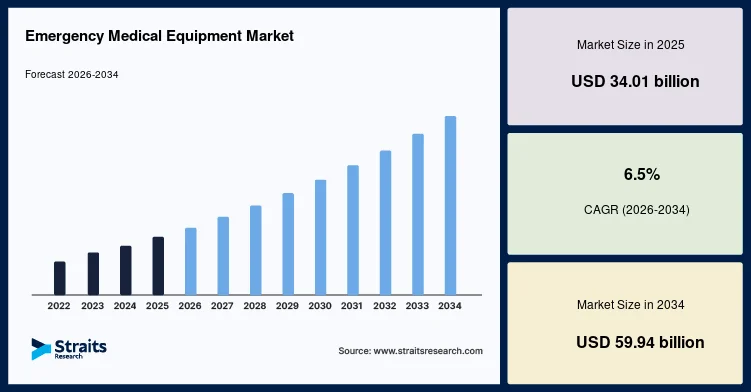
The global emergency medical equipment market is witnessing steady and robust expansion as healthcare systems worldwide increasingly prioritize rapid response capabilities and critical care readiness.
In 2025, the market size was valued at USD 34.01 billion, and it is projected to grow from USD 36.22 billion in 2026 to USD 59.94 billion by 2034, registering a CAGR of 6.5% during 2026–2034.
This growth reflects rising incidences of medical emergencies, expanding healthcare infrastructure, and continuous technological advancements in emergency care solutions.
Key Market Highlights
Regionally, North America remains the dominant market due to its highly advanced healthcare infrastructure, well-established emergency response systems, and strong adoption of innovative medical technologies. The presence of leading medical device manufacturers further strengthens its position in the global landscape.
In contrast, Asia-Pacific is expected to emerge as the fastest-growing region during the forecast period. Rapid healthcare modernization, increasing government investments in hospital infrastructure, and rising awareness about emergency medical care are key factors driving growth in countries such as India, China, and Southeast Asian nations.
Among product categories, emergency life-support equipment holds the largest market share. This includes ventilators, defibrillators, and advanced resuscitation systems, which are widely used in intensive care units and emergency departments. Meanwhile, portable diagnostic and monitoring devices are expected to register the fastest growth due to increasing demand for mobility, home healthcare services, and decentralized emergency care solutions.
Market Dynamics
The growth of the emergency medical equipment market is primarily driven by the rising number of road accidents, cardiovascular diseases, respiratory conditions, and trauma-related emergencies. These health challenges require immediate intervention, increasing the demand for advanced and reliable medical equipment.
Governments across various regions are investing heavily in strengthening emergency healthcare infrastructure. This includes upgrading ambulance services, equipping hospitals with advanced life-support systems, and improving emergency response times. Additionally, technological advancements such as AI-enabled patient monitoring systems, real-time data analytics, and portable life-support devices are significantly enhancing patient outcomes and operational efficiency.
However, the market also faces certain restraints. High equipment costs remain a significant barrier, especially in low- and middle-income countries. Furthermore, strict regulatory approval processes for medical devices can slow down product launches and innovation cycles.
Despite these challenges, several opportunities are emerging. The integration of telemedicine with emergency care systems is transforming how patients receive immediate treatment. Smart emergency response systems, mobile healthcare units, and compact diagnostic tools are opening new avenues for market expansion. The growing demand for decentralized healthcare services is also encouraging the development of portable and user-friendly emergency medical devices.
Unlock Full Report Insights and Strategic Analysis –https://straitsresearch.com/report/emergency-medical-equipment-market
Competitive Landscape
The market is highly competitive, with key players including Medtronic, Koninklijke Philips N.V., GE Healthcare, Stryker Corporation, Drägerwerk AG, ZOLL Medical Corporation, Mindray Medical International, Smiths Medical, Nihon Kohden Corporation, and Cardinal Health. These companies focus on innovation, strategic partnerships, and product development to strengthen their global presence.
Conclusion
Overall, the emergency medical equipment market is positioned for sustained growth, driven by rising healthcare needs, technological innovation, and increasing investments in emergency care infrastructure. As healthcare systems continue to evolve, demand for advanced, portable, and intelligent emergency medical solutions is expected to rise significantly across all major regions.