Sign up with Google
 Sign in with Zoho

Overview
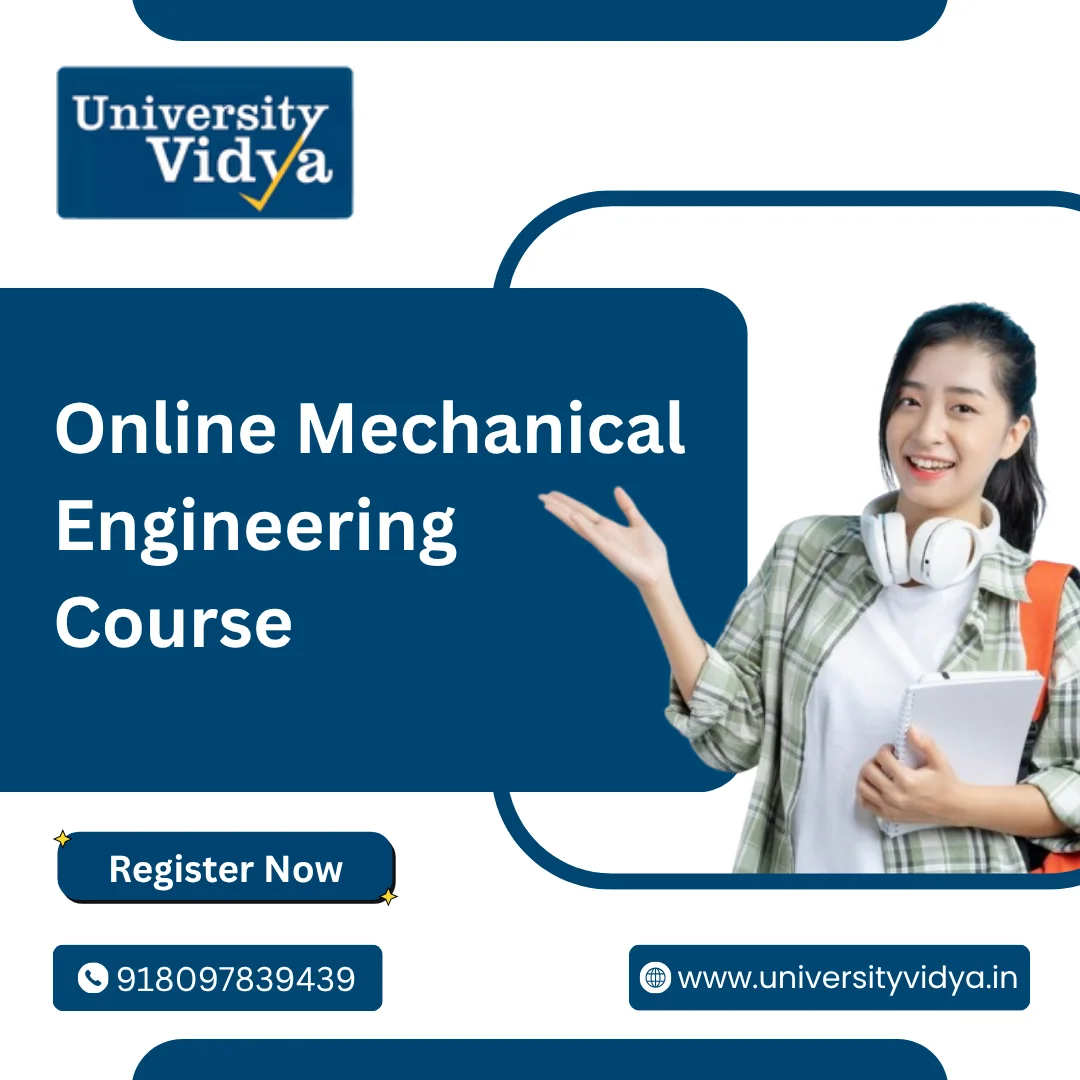
Mechanical engineering is one of the oldest and most versatile branches of engineering and it is now being delivered in one of the newest formats: fully online. Whether you are a fresh graduate, a diploma holder, or a working professional looking to upskill without taking time off, an online mechanical engineering course gives you access to industry-standard knowledge with the flexibility to learn on your own schedule.
This guide covers everything you need to know before hitting enroll, including the critical regulatory guidelines you must check to ensure your degree is legally valid.
What Does an Online Mechanical Engineering Course Actually Cover?
The curriculum of a modern online mechanical engineering course bridges the gap between traditional heavy machinery principles and modern digital design. Through Learning Management Systems (LMS), digital twin simulations, and weekend lab workshops, students cover a comprehensive syllabus.
Core Topics Covered:
- Engineering Mechanics: The foundational science of forces, motion, and structural dynamics.
- Thermodynamics: Understanding energy transfer, heat engines, and power cycles.
- Machine Design: Principles of designing safe and functional machine components under stress.
- Manufacturing Processes: Techniques ranging from traditional machining to advanced additive manufacturing (3D printing).
- Fluid Mechanics: Studying fluid behavior in pumps, turbines, and aerospace applications.
- CAD/CAM: Computer-Aided Design and Manufacturing using modern industrial software.
- Material Science: Understanding the physical and chemical properties of engineering materials.
Different Formats Available:
- Short Certificate Courses: Platforms like NPTEL or SWAYAM offer 4-to-12-week courses focusing on highly specific skills (like finite element analysis).
- Diploma Programs: Typically 1 to 2 years, focusing on operational maintenance and supervisory skills.
- B.Tech Online Degree: A 3-year lateral entry (for diploma holders) or a 4-year degree. Theoretical learning is managed online, while practical requirements are fulfilled via virtual lab simulations and weekend contact classes at designated centers.
Eligibility : Who Can Apply?
Technical education carries strict regulatory rules in India. Ensuring you meet the correct eligibility criteria is the first step toward a valid career path.
- Certificate Courses: Open enrollment. Generally, any 10th or 12th pass student, as well as current graduates, can apply to learn specific skills.
- Diploma Programs: Candidates must have completed their 10th-grade board examinations with Mathematics and Science.
- Online B.Tech: Candidates need a 10+2 passing certificate with Physics, Chemistry, and Mathematics (PCM).
- Lateral Entry B.Tech: This is the most popular route for working professionals. Candidates holding a 3-year Diploma in Engineering can secure direct admission into the second year (3rd semester).
Best Online Universities and Platforms in India
Finding an accredited and employer-respected platform is crucial. Here are some of the most recognized avenues in 2026:
- SWAYAM / NPTEL: Backed by the government and taught by IIT professors. These are free to audit and excellent for adding prestigious skill certifications to your resume.
- BITS Pilani (WILP): The gold standard for working professionals. Their Work Integrated Learning Program is highly respected by massive automotive and manufacturing corporations.
- Manipal Online & Amity Online: Offer comprehensive, AICTE-approved blended learning programs featuring an industry-connected curriculum and top-tier digital infrastructure.
Top Career Paths After an Online Mechanical Engineering Course
Graduating with an online mechanical engineering course from a recognized university opens up lucrative positions across India's booming manufacturing sectors.
Top Job Roles:
- Design Engineer: Creating product blueprints and 3D models using AutoCAD, SolidWorks, or CATIA.
- Maintenance Engineer: Ensuring the smooth operation and repair of heavy industrial plant machinery.
- Production Supervisor: Managing shop floor operations, maintaining quality control, and optimizing manufacturing speed.
- HVAC Specialist: Designing Heating, Ventilation, and Air Conditioning systems for massive infrastructure projects.
- Automotive Engineer: Working on the mechanical components of modern vehicles, including the booming electric vehicle (EV) sector.
- Manufacturing Process Engineer: Designing automated assembly lines for FMCG and electronics companies.
- Top Industries: You will find the highest demand in Automotive, Aerospace, Defense manufacturing, Energy (both renewable and thermal), and massive national Infrastructure projects.
Skills You'll Develop
Employers do not just look at your degree; they look at what you can actually do. An online program aggressively focuses on equipping you with both technical and operational competencies.
Technical Skills:
- Proficiency in CAD tools (AutoCAD, SolidWorks, Creo).
- Simulation and finite element analysis (Ansys, FEA).
- CNC Programming for automated machining.
- Knowledge of Lean Manufacturing and Six Sigma quality standards.
Soft Skills:
- Technical documentation and blueprint reading.
- Cross-functional teamwork and project planning.
- Data-driven problem-solving for shop floor bottlenecks.
To succeed in interviews, you must build a portfolio demonstrating your software proficiency and practical project experience.
Salary Outlook and Job Growth
Driven by government initiatives like Make in India and the Production Linked Incentive (PLI) schemes, the manufacturing sector is projecting an 8% to 10% annual GDP growth through 2030. This creates massive demand for qualified mechanical engineers.
- Entry-Level Salary: ₹3.0 LPA to ₹5.0 LPA.
- Mid-Level (3–5 years): ₹6.0 LPA to ₹10.0 LPA.
- Senior / Specialist: ₹12.0 LPA to ₹20.0 LPA, particularly for experts moving into R&D within the aerospace or electric vehicle sectors.
If you are a working professional ready to upskill legally and effectively, navigating university approvals can be confusing. To verify AICTE approvals, compare fee structures, and find the perfect curriculum for your career goals, visit University Vidya to explore verified digital engineering programs across India.




.webp)