Sign up with Google
 Sign in with Zoho
Over the past two years, the market has been flooded with agencies rebranding themselves overnight — yesterday's web development shop is today's "AI development company," yesterday's outsourcing vendor now sells "generative AI solutions." For a founder or CTO trying to evaluate partners, that noise makes a genuinely important decision harder than it should be.
Because choosing an AI development company isn't like choosing a website vendor. Get it wrong, and you don't just lose a project timeline — you inherit a system that hallucinates in front of customers, an architecture that can't scale past the pilot stage, or an AI feature that looked impressive in a demo and fell apart in production.
This guide breaks down what actually separates a capable AI development company from a rebranded generalist, what to look for in a generative AI development company specifically, and the questions serious buyers should be asking before signing anything.
Why "AI Development Company" Has Become a Confusing Category
Three years ago, "AI development" mostly meant data science teams building predictive models. Today, it covers an enormous range of work: large language model integration, AI agents that execute autonomous tasks, retrieval-augmented generation (RAG) systems, computer vision, workflow automation, and generative AI applications that create content, code, or decisions on demand.
That breadth is exactly why the category gets abused. A company that built one chatbot on top of an off-the-shelf API can technically call itself an AI development company. A true AI engineering partner, on the other hand, is one that understands how these systems behave in production — where they fail, how they hallucinate, how they need to be grounded in real data, and how they fit into a business's existing architecture and compliance requirements.
For buyers, the practical takeaway is simple: the label tells you almost nothing. The work sample, the technical depth, and the questions the vendor asks you tell you everything.
What a Generative AI Development Company Should Actually Bring to the Table
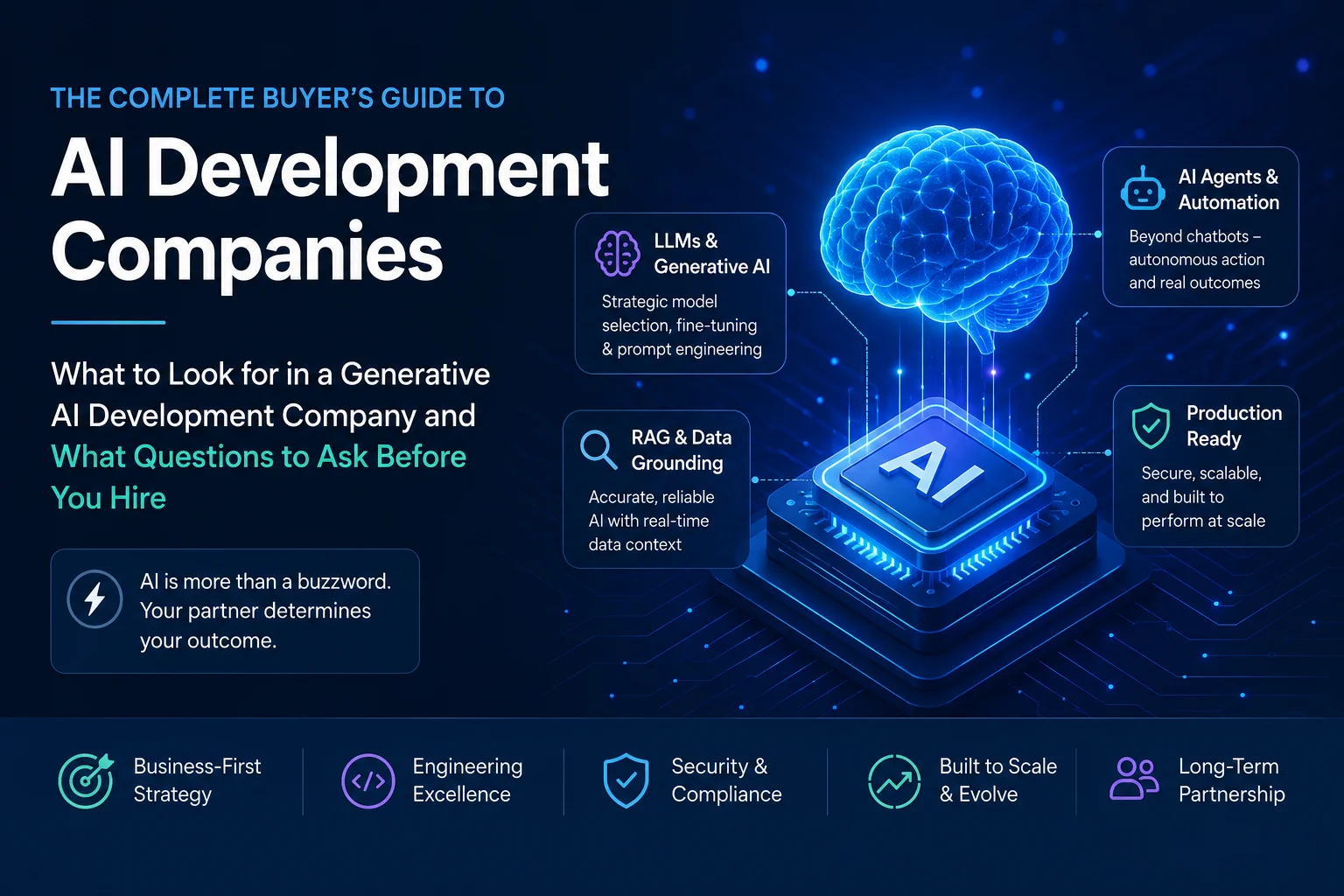
Generative AI is the most commercially visible part of this space right now — and also the most commonly oversold. A genuine generative AI development company should be able to speak fluently, and specifically, about:
Large Language Models (LLMs) — not just which model to call through an API, but how to fine-tune, prompt-engineer, and architect around one for a specific business use case.
Retrieval-Augmented Generation (RAG) — because generative AI without grounding in real, verified data is a liability, not an asset. Any vendor proposing a customer-facing generative AI application without a RAG strategy should raise a flag.
AI agents and agentic workflows — the difference between a chatbot that answers questions and an AI agent that actually completes multi-step tasks (processing a claim, qualifying a lead, reconciling a dataset) is significant, and it's where most of the real business value now lives.
Production-grade engineering, not prototypes — a working demo is not the same as a system that holds up under real user load, real data volume, and real security requirements.
If a vendor's pitch stops at "we can build you a chatbot," that's usually a sign you're talking to a development shop wearing an AI label — not an AI engineering partner.
The Real Business Case for Working With an AI Development Company
Setting aside the hype cycle, there are concrete reasons businesses are actively investing in AI development partnerships right now:
- Operational cost reduction through AI agents and workflow automation handling work that previously required manual effort
- Faster product development cycles, particularly for startups building AI-native MVPs that need to reach market before well-funded competitors
- Improved customer experience through AI copilots, intelligent search, and recommendation systems that personalize interactions at scale
- Better decision-making through predictive analytics and intelligent document processing that surface insights buried in unstructured data
- Competitive differentiation — in categories like healthcare, financial services, retail, and logistics, AI-native products are increasingly outcompeting legacy alternatives on both cost and experience
None of this happens by simply "adding AI" to an existing product. It happens when AI is engineered into the core architecture from the start — which is the central difference between hiring a vendor for a feature and partnering with a company that engineers intelligent products.
Questions to Ask Before Hiring an AI Development Company
Before signing with any AI development company or generative AI development company, enterprise buyers should be asking:
- Can you show a production system, not just a proof of concept? Anyone can demo an AI feature. Few can show one running reliably with real users and real data.
- How do you handle hallucination and accuracy risk? The answer should involve RAG, grounding strategies, and human-in-the-loop review — not "the model is pretty good now."
- How does this integrate with our existing systems? AI that can't connect to your core software, data, or workflows is a science experiment, not a business solution.
- What does this look like at scale, not just at launch? Architecture decisions made for a 50-user pilot often fail completely at 50,000 users.
- Who owns the long-term relationship? A single project delivery is very different from a partner who continues optimizing, securing, and evolving the system after launch.
The Bottom Line
The AI development market is crowded, and the label alone won't tell you who's capable and who isn't. The businesses winning with AI right now aren't the ones that added a chatbot to their homepage — they're the ones that partnered with engineering teams who treat AI as core product architecture, not an add-on feature.
Whether you're a founder building an AI-native MVP, or an enterprise CTO modernizing legacy systems with generative AI and AI agents, the vendor selection question is really a product engineering question in disguise. Choose the partner who understands both.


.webp)