Sign up with Google
 Sign in with Zoho
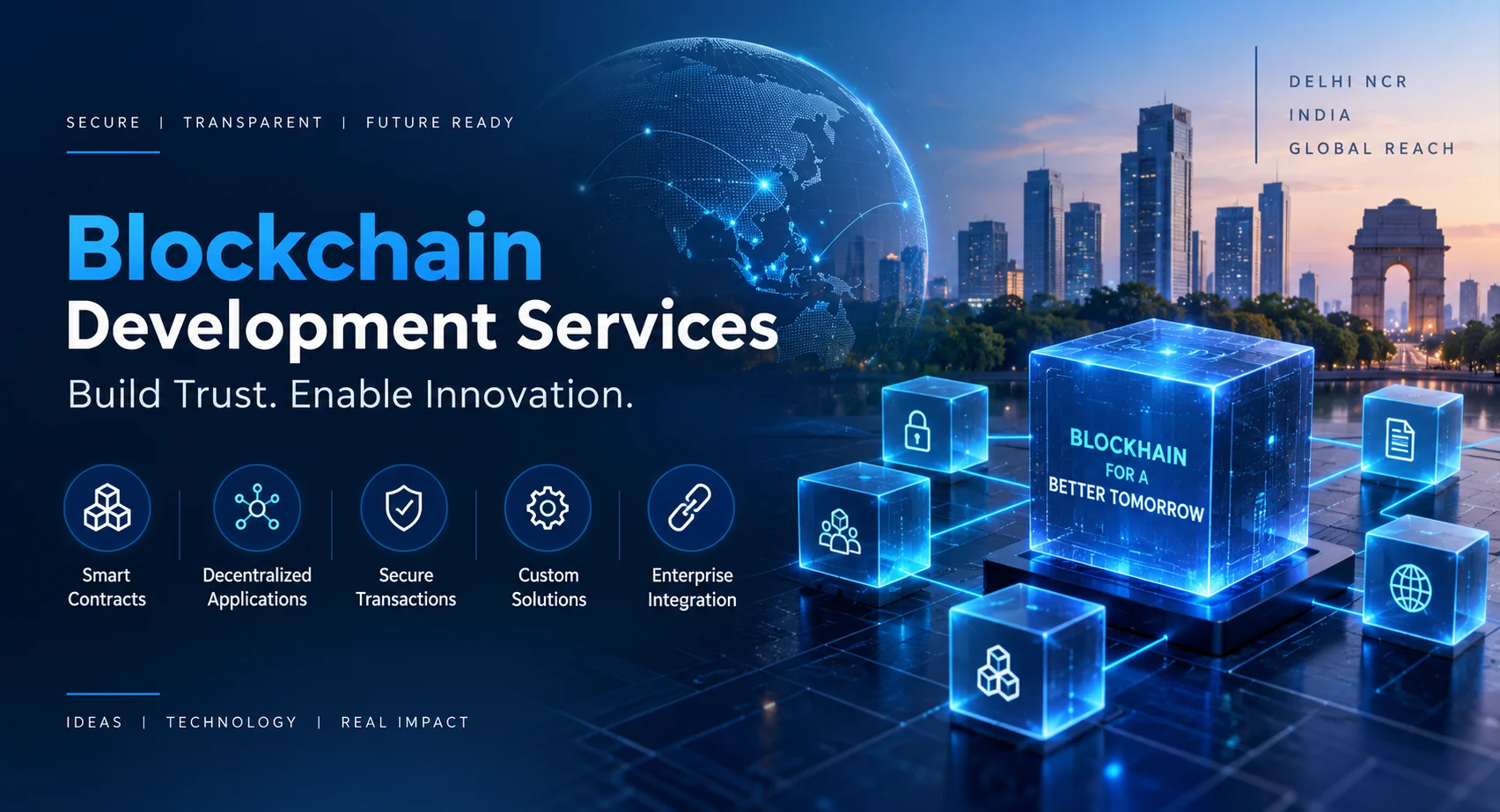
Blockchain has moved beyond cryptocurrency and is now used to design digital systems where multiple participants need shared records, controlled access, traceability, or programmable transactions. Businesses exploring blockchain should focus less on adopting the technology simply because it is popular and more on whether it solves a genuine operational or product requirement.
Professional Blockchain Development Services India can support businesses through planning, architecture, development, integration, testing, deployment, and ongoing maintenance. The right approach depends on the business model, users, data requirements, security expectations, and whether a public, private, or permissioned blockchain is appropriate.
What Are Blockchain Development Services?
Blockchain development involves creating applications and infrastructure that use distributed ledger technology to record and exchange information according to predefined rules.
A blockchain solution may include smart contracts, decentralized applications, digital wallets, APIs, blockchain nodes, administrative interfaces, and integrations with existing business systems.
Before development begins, an important question should be answered: Does the project actually need blockchain?
A conventional database may be more practical when a single organization controls the entire system and there is no meaningful requirement for decentralized verification or shared trust. Blockchain becomes more relevant when multiple parties need to interact with shared records while maintaining verifiable transaction history and defined rules.
Why Businesses Consider Custom Blockchain Development
Every blockchain project has different requirements. A ready-made solution may not provide the required transaction logic, permissions, integrations, governance model, or user experience.
Custom Blockchain Development allows the architecture and application logic to be designed around specific business requirements.
For example, a custom solution can define who is permitted to perform particular actions, what information is stored on-chain, what remains off-chain, how smart contracts operate, and how the blockchain communicates with existing applications.
Customization may be useful for projects involving supply-chain workflows, asset management, identity systems, tokenized applications, decentralized platforms, or multi-party business processes.
However, customization also increases development responsibility. Architecture, smart-contract security, scalability, privacy, transaction costs, upgradeability, and regulatory considerations should be evaluated before implementation.
What Does a Blockchain App Development Company Do?
A Blockchain App Development Company typically helps convert a blockchain use case into a working digital application.
The process normally begins with requirement analysis. Developers assess the intended users, transaction model, data flow, integrations, permissions, and technical constraints before selecting an appropriate architecture.
Development may then involve smart contracts, frontend and backend applications, wallet connectivity, APIs, authentication, blockchain integration, and administrative functionality.
Testing is particularly important. Smart-contract errors can be difficult or expensive to correct after deployment, depending on the architecture. Code review, functional testing, access-control testing, integration testing, and security assessment should therefore be part of the development lifecycle.
Deployment should also include monitoring and a clear maintenance strategy rather than treating launch as the end of development.
Choosing a Blockchain Development Company in Delhi NCR
Businesses searching for a Blockchain Development Company Delhi NCR should evaluate technical capability rather than selecting a provider based only on location or promotional claims.
Start by discussing the actual business problem. A capable development team should be able to explain whether blockchain is suitable and why a particular architecture is being recommended.
Ask how the company approaches smart-contract development, application security, testing, wallet integration, APIs, data privacy, and ongoing maintenance. The team should also be able to explain technical trade-offs in understandable business terms.
Project scope should be clearly documented. This includes expected functionality, supported platforms, integrations, ownership of source code, deployment responsibilities, testing requirements, and post-launch support.
Public, Private, or Permissioned Blockchain?
Choosing the correct blockchain model is an important architectural decision.
A public blockchain allows participation according to the rules of an open network. It may be suitable for decentralized applications where transparency and broad network participation are important.
A private blockchain limits network participation and is controlled within a defined environment. It may be considered for internal or enterprise use cases requiring tighter governance.
A permissioned blockchain restricts specific activities to authorized participants. This model can be useful when several organizations need shared infrastructure but access cannot be completely public.
There is no universally superior option. The correct choice depends on governance, privacy, performance, security, interoperability, and business requirements.
Important Features of a Blockchain Application
A well-designed blockchain application should balance blockchain functionality with conventional application usability.
Depending on the project, important capabilities can include secure authentication, wallet integration, smart-contract execution, transaction tracking, role-based permissions, API integration, administrative controls, and clear transaction status information.
Not every piece of data should automatically be stored on-chain. Developers should determine what information genuinely benefits from blockchain properties and what can remain in conventional storage. This can improve privacy, application performance, and maintainability.
Blockchain Development Services at Tycho Technologies
Tycho Technologies provides blockchain development as part of its broader technology services. A project can begin with requirements analysis to determine the appropriate application architecture, blockchain components, integrations, and development approach.
For organizations considering Blockchain Development Services India, the priority should be building a solution around a valid use case rather than introducing blockchain where a simpler technology would work better.
Businesses can discuss requirements for custom blockchain applications, smart-contract-based functionality, blockchain integrations, and related digital product development with Tycho Technologies.
Frequently Asked Questions
What is custom blockchain development?
Custom blockchain development means designing blockchain-based software around specific business, user, security, transaction, and integration requirements rather than relying entirely on a predefined solution.
Does every business application need blockchain?
No. Many applications work effectively with conventional databases. Blockchain should be considered when its characteristics, such as shared transaction records, programmable rules, or distributed verification, provide a meaningful advantage.
What should I check before choosing a blockchain development company?
Evaluate its approach to requirements analysis, architecture, smart contracts, security, testing, integrations, deployment, source-code ownership, and ongoing maintenance.
Can blockchain applications integrate with existing software?
Yes, depending on the systems involved. APIs and backend services can connect blockchain components with existing web applications, mobile applications, databases, and business platforms.
Final Takeaway
Successful blockchain development starts with the business requirement, not the technology. Define the participants, transactions, data, permissions, security requirements, and expected outcomes first. Then determine whether blockchain provides a practical advantage over a conventional architecture.
For businesses evaluating Custom Blockchain Development or looking for a Blockchain App Development Company, this requirement-first approach can lead to a clearer architecture, more appropriate technology choices, and a product that addresses the intended use case.