Sign up with Google
 Sign in with Zoho

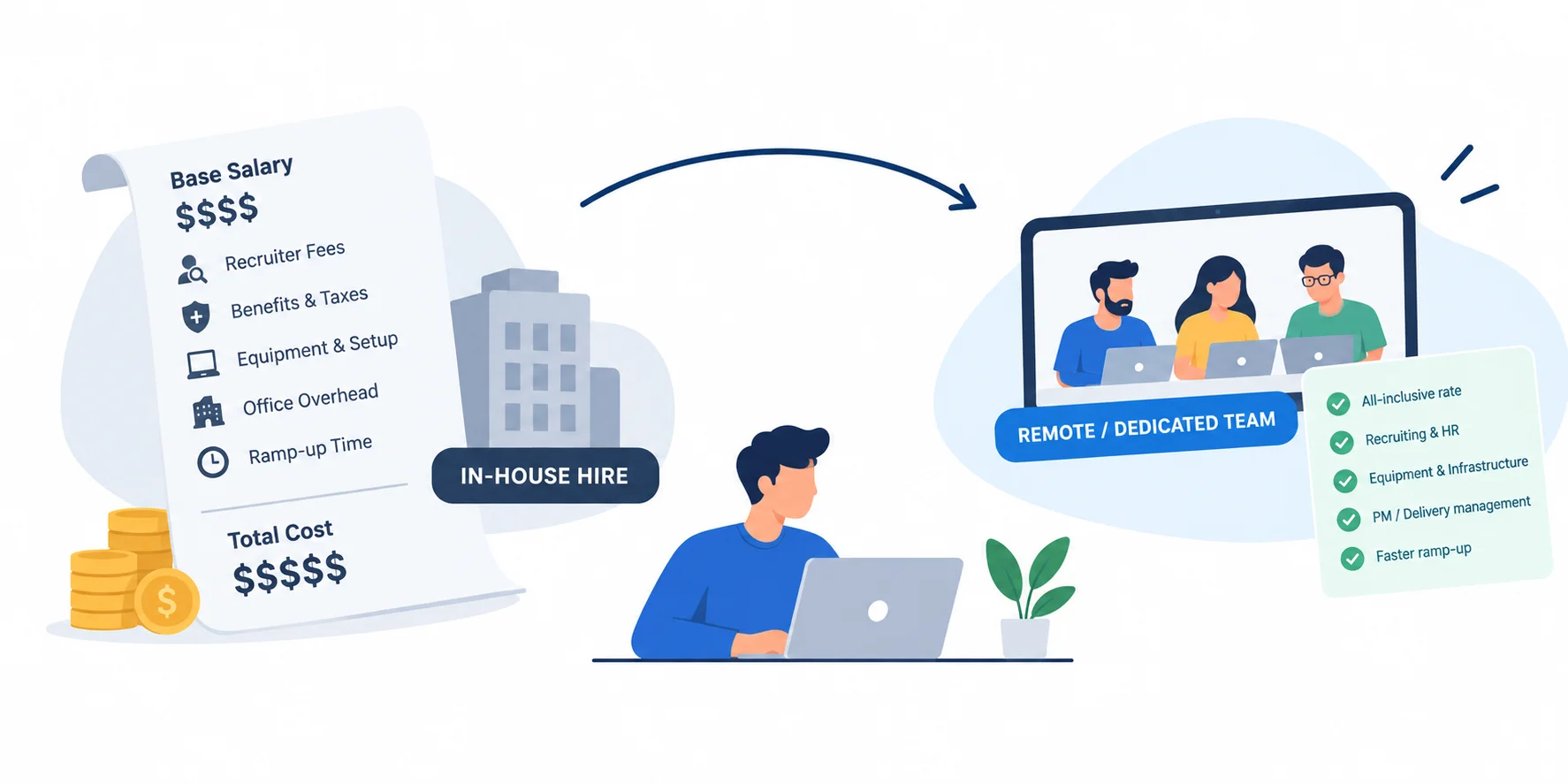
The salary numbers were accurate. What nobody had accounted for was everything that sits underneath the salary line: the recruiter fees, the six-week onboarding ramp, the Slack seat, laptop, and health stipend, and the three months of reduced output while a new hire learned the codebase. By the time someone added it all up, the "affordable" $140,000 developer had cost closer to $210,000 in year one alone.
That gap between the number on the offer letter and the number that actually leaves the bank account is where most hiring budgets quietly fall apart. And it's exactly where the conversation around remote and dedicated developers gets misunderstood.
Why the Sticker Price Is Never the Real Price
When companies compare local hires to remote or outsourced teams, they almost always compare base salary to base salary. That comparison is broken from the start.
A full-time in-house developer in the US or Western Europe doesn't just cost their salary. Add recruiter or agency fees (often 15-25% of first-year pay), payroll taxes, benefits, equipment, office overhead, and the ramp-up period where a new hire is productive at maybe 40-50% capacity, and the "loaded cost" of an employee typically runs 1.25 to 1.4 times their base salary before they've shipped a single feature that matters.
Now compare that to a team that decides to hire dedicated developers through an established partner instead. The rate quoted usually already includes recruiting, HR administration, equipment, and infrastructure. There's no six-week gap between "signed contract" and "writing code," because the vetting happened before you ever saw a resume. The apples-to-apples math looks very different once you strip out the parts of the local hire's cost that were hidden in other budget lines.
Where Teams Actually Overpay
Having watched a lot of these hiring decisions play out, the overpaying rarely happens because someone chose the wrong hourly rate. It happens in three specific places:
Turnover you didn't price in. Junior-to-mid-level developer turnover in tech has hovered in the 15-20% range industry-wide. Every time someone leaves, you're not just re-recruiting; you're losing institutional knowledge and paying the ramp-up tax all over again. Teams that skip this line item when they compare hiring options are comparing a real cost against a fantasy one.
Management overhead that scales with headcount, not output. Adding three more in-house developers usually means adding project management time, more 1:1s, more performance reviews, more org-chart complexity. When you hire remote developers through a team that already has its own delivery management built in, that overhead doesn't disappear, but it stops multiplying the same way.
Paying full-time rates for part-time-shaped work. Plenty of roadmaps need serious engineering effort for four months, then taper off. Companies that lock in full-time local salaries for that kind of work end up either overstaffed by month five or scrambling to lay people off, both of which cost money and morale.
None of this is an argument that remote or dedicated hiring is automatically cheaper in every case. Highly specialized, deeply institutional-knowledge roles often are worth keeping in-house no matter the cost. The point is narrower: teams that only compare salary lines are making decisions on incomplete information, in either direction.
What "Avoiding Overpaying" Actually Looks Like
A few things tend to separate the companies that get this right from the ones that get burned:
They ask for the fully loaded cost up front, not just the rate card. A vendor or partner that can't clearly explain what's included in the quoted rate- infrastructure, PM support, replacement guarantees, IP handling- is a vendor you'll be renegotiating with in month three.
They match the engagement model to the actual shape of the work. Staff augmentation makes sense when you need specific skills inside your own process. A dedicated team makes more sense when you're standing up a product line that needs its own cadence. Treating every hiring decision the same way, regardless of what the work actually looks like, is how budgets get misallocated.
They price in ramp-up time honestly, whichever direction they go. Remote and dedicated developers who are already used to working as an integrated part of a client's team tend to close that gap faster than a fresh in-house hire would, but "faster" isn't "instant," and pretending otherwise sets budgets up to miss.
The Bottom Line
The real cost of a developer was never just their rate. It's the rate plus everything a company pays around it, minus everything a good hiring structure eliminates. Companies that get burned on remote hiring almost always got burned by skipping that math, not by the model itself.
We walk engineering leaders through this exact comparison for a living, and the pattern is remarkably consistent: the teams that run the full-cost comparison before they hire almost never regret the decision they make. The ones that compare only the headline number are the ones writing the "how did we blow the budget" postmortem a year later.
Techiebutler helps companies build and scale dedicated development teams, pairing them with vetted remote engineers who plug straight into an existing sprint cycle.