Sign up with Google
 Sign in with Zoho
Top Brands Marketing Strategies: 15 Lessons You Can Apply to Your Business
Why do some brands attract customer attention more easily, communicate their value more clearly, and build recognizable positions in competitive markets?
Is it because they spend more on advertising?
Do they have better products?
Are their offers stronger?
Or have they developed a better understanding of how customers discover, evaluate, and purchase products?
The answer is rarely one factor.
Recognizable brands often combine product positioning, customer understanding, creative communication, website experiences, distribution, and long-term customer relationships.
Studying top brands marketing strategies can help founders, performance marketers, agencies, and growth teams understand how these different activities connect.
However, learning from established brands does not mean copying their advertisements or websites.
A strategy that suits a globally recognized brand may not be appropriate for a new ecommerce business with a limited budget.
The more useful approach is to examine the principles behind publicly visible marketing activities, understand the customer experience, and develop ideas that can be tested in your own business.
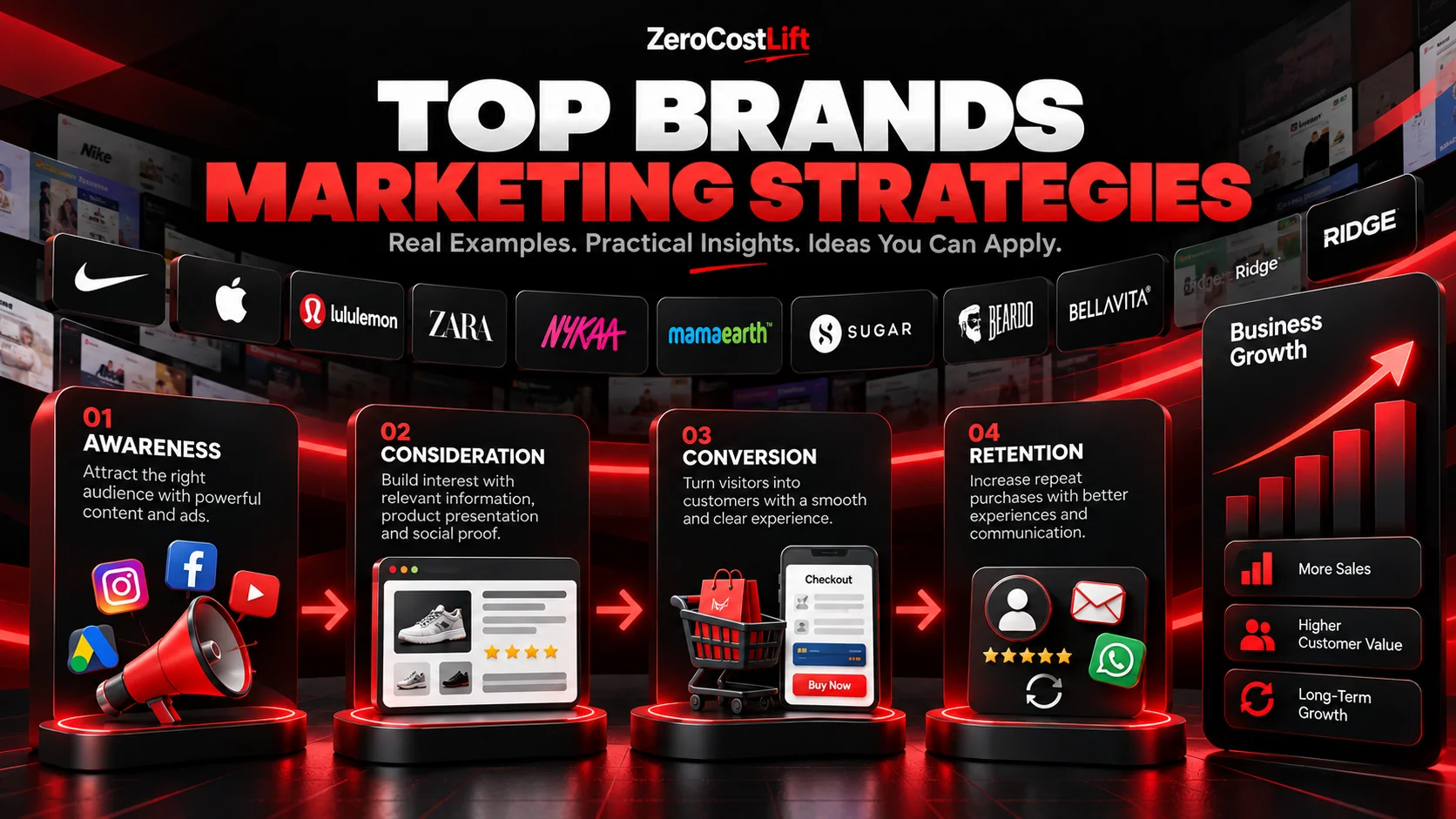
In this guide, we explore 15 marketing strategy lessons using examples from brands such as Nike, Apple, Lululemon, Zara, Nykaa, Mamaearth, BellaVita, Beardo, and others.
We also explain how to study marketing funnels, identify conversion opportunities, and turn competitor research into a practical action plan.
What Are Top Brands Marketing Strategies?
Top brands marketing strategies are the approaches recognizable businesses use to communicate their products, reach customers, develop brand preference, support purchases, and maintain customer relationships.
These strategies may involve:
- Brand positioning and differentiation
- Audience research and segmentation
- Product and offer communication
- Advertising creatives and storytelling
- Organic content and search visibility
- Ecommerce website experiences
- Customer journey design
- Lead generation and follow-up
- Retention and repeat purchase communication
- Performance measurement and experimentation
Marketing strategy is broader than advertising.
Advertising creates opportunities for customers to discover a product.
The broader strategy determines what the business communicates, who it communicates with, where customers are directed, and how the experience supports business objectives.
For example, two brands may advertise similar skincare products.
One might emphasize product ingredients and educational information.
Another might emphasize lifestyle, fragrance, gifting, or convenience.
Neither approach is automatically better.
Its suitability depends on the target customer, product, brand positioning, and business economics.
Understanding these differences is one of the main benefits of studying real-brand marketing examples.
Why Study Marketing Strategies From Established Brands?
Established brands provide useful examples because their customer-facing communication is often visible across multiple channels.
Marketers can examine advertisements, websites, product descriptions, social media content, offers, and customer experiences.
This research helps answer practical questions.
How does a brand explain its product?
What makes its positioning recognizable?
Which customer problems does it address?
How does it organize products?
What information appears before checkout?
How does it communicate after a purchase?
These observations can help marketers develop hypotheses for their own businesses.
But there is an important limitation.
Publicly visible marketing activity does not reveal a brand's actual campaign profitability, private conversion rates, customer acquisition costs, or complete internal strategy.
A visible advertisement may be part of an experiment.
A promotional offer may serve a specific customer segment.
A website feature may be designed for a brand with different economics from your business.
Therefore, real-brand research should be used for learning and hypothesis development, not as proof that a particular tactic guarantees results.
Strategy 1: Build Clear Brand Positioning
One of the most important lessons from recognizable brands is the value of clear positioning.
Brand positioning explains how a business wants customers to understand its product relative to alternatives.
It may focus on performance, convenience, design, affordability, lifestyle, quality, or another meaningful benefit.
Example: Nike
Nike provides a recognizable example of marketing communication that connects sports products with performance, athletic identity, and personal motivation.
Its customer-facing messages frequently extend beyond technical product descriptions.
The broader lesson is that customers may respond to what a product represents as well as what it does.
How to Apply This Strategy
Start by answering four questions:
- Who is the product designed for?
- What important customer need does it address?
- What makes the offer meaningfully different?
- What evidence supports the positioning?
A small sportswear brand does not need to imitate Nike's campaigns.
It can instead develop clear communication around its own customer segment and product strengths.
For example, a brand specializing in comfortable everyday activewear could focus on practical fit, material information, and specific use cases.
The objective is clarity, not imitation.
Strategy 2: Make Product Value Easy to Understand
Recognizable brands often invest in communicating product benefits clearly.
Customers need to understand what a product does, why it matters, and whether it suits their needs.
Example: Apple
Apple's public product communication offers useful examples of presenting product capabilities through visuals, demonstrations, and customer-facing explanations.
Rather than treating every specification as equally important, product pages often organize information around features and experiences.
How to Apply This Strategy
Review your product page.
Can a new visitor understand the product within a few seconds?
Are the main benefits clear?
Are important specifications available?
Do images help customers evaluate the product?
Does the content explain who the product is suitable for?
Avoid replacing accurate product information with vague claims.
For ecommerce businesses, a clear value proposition can help customers make more informed decisions.
Strategy 3: Connect Products With Customer Lifestyle
Some brands communicate their products through activities, interests, and customer identity.
This can help customers understand where a product fits into everyday life.
Example: Lululemon
Lululemon provides a useful example of activewear communication connected with movement, fitness, lifestyle, and community.
A marketer can study how product imagery and customer-facing messaging connect the clothing with relevant activities.
How to Apply This Strategy
Identify the situations in which customers use your products.
A travel accessories brand might show products during packing, commuting, and travel.
A home organization brand might demonstrate practical everyday use.
A fashion brand might organize messaging around specific occasions.
Use authentic product scenarios rather than inventing benefits.
Lifestyle communication works best when it remains relevant to the actual product and audience.
Strategy 4: Organize Products Around Customer Intent
Product discovery is an important part of ecommerce marketing.
Customers do not always shop by brand name or technical product category.
They may shop by occasion, problem, budget, style, or intended use.
Example: Zara
Zara provides a useful context for studying fashion product discovery, category organization, imagery, and seasonal merchandising.
A marketer can examine how a fashion website helps customers browse different types of clothing and collections.
How to Apply This Strategy
Review how your customers search for products.
Do they look for wedding outfits, workwear, travel clothing, or everyday essentials?
Do they compare products by price, material, fit, or occasion?
Use this understanding to organize collections and landing pages.
For example, an advertisement featuring festive outfits should lead to a destination where relevant products are easy to find.
A clear product discovery experience can reduce unnecessary effort for customers.
Strategy 5: Use Educational Content to Support Decisions
Not every customer is ready to purchase immediately.
Some need information before they can evaluate a product.
Educational content can support this process.
Example: Nykaa
Nykaa provides a useful example of beauty ecommerce, where customers may research product categories, ingredients, application methods, and suitability before purchasing.
The broader lesson is that useful information can support product evaluation.
How to Apply This Strategy
Identify the questions customers ask before purchasing.
For a skincare brand, these may involve ingredients, product usage, skin-type suitability, or compatibility with an existing routine.
For an electronics brand, customers may need feature comparisons and technical specifications.
For a B2B service, prospects may need information about deliverables, processes, and implementation.
Create content that answers genuine questions accurately.
Avoid exaggerated claims or educational material that hides important limitations.
The objective is to help customers make informed decisions.
Strategy 6: Communicate a Consistent Brand Message
Consistency makes a brand easier to recognize.
Customers may encounter a business through advertisements, search results, social media, product pages, and emails.
If these channels communicate completely different messages, the experience can become confusing.
Example: Mamaearth
Mamaearth offers a useful example for studying how a personal care brand communicates product categories and brand-related themes across customer-facing touchpoints.
A marketer can examine whether the messaging on advertisements, product pages, and other channels supports a recognizable identity.
How to Apply This Strategy
Document your brand's core messaging.
Define the target audience, main product benefits, communication style, and evidence standards.
Then review important touchpoints.
Does the advertisement match the landing page?
Are product descriptions consistent with the offer?
Does the website use clear terminology?
Does customer communication reflect the same positioning?
Consistency does not mean repeating identical content everywhere.
It means maintaining a recognizable message while adapting to each channel.
Strategy 7: Develop Offers That Customers Can Understand
An offer is more than a discount.
It includes the product, price, included value, conditions, and reason for purchasing.
A clear offer helps customers understand what they receive.
Example: BellaVita
BellaVita is a relevant fragrance brand for studying publicly visible product presentation, bundles, promotional messaging, and customer-facing offers.
The important lesson is to analyze how the offer is explained, not assume that a particular promotion is profitable.
How to Apply This Strategy
Review your offer from a customer's perspective.
What is included?
Is the pricing transparent?
Are discounts and conditions clear?
Does the offer match the product's positioning?
Are there meaningful reasons to consider a bundle?
A useful offer should make sense for both the customer and the business.
Discounts that increase sales volume but damage contribution margin may not support sustainable growth.
Strategy 8: Create Advertising That Matches the Landing Page
One of the most common marketing problems occurs when advertisements create expectations that the destination does not satisfy.
A customer clicks because of a particular product, message, or offer.
After arriving, they encounter something different.
This disconnect can create friction.
Example: Fashion Ecommerce
Imagine a brand advertising a specific wedding outfit.
The creative features the product prominently.
But clicking the advertisement opens a general homepage containing hundreds of unrelated items.
The customer now has to search for the product.
A more relevant destination would make the advertised item or closely related collection easy to find.
How to Apply This Strategy
Check the relationship between the creative and the destination.
Does the landing page feature the advertised product?
Is the offer consistent?
Can visitors identify the next step?
Is important information available without unnecessary searching?
Does the experience work on mobile?
Advertising performance and landing page relevance should be analyzed together.
A campaign with strong engagement can still produce weak business outcomes when the post-click experience is unsuitable.
Strategy 9: Use Customer Reviews and Relevant Evidence
Customers often look for information that helps them evaluate whether a product or service is suitable.
Reviews, demonstrations, specifications, and transparent policies can support this process.
Example: Consumer Ecommerce Brands
Beauty, fashion, accessories, and personal care brands provide useful contexts for studying how product pages present customer feedback and decision-support information.
The goal is to understand what evidence is available to customers.
How to Apply This Strategy
Use genuine reviews and accurate product information.
Make important terms easy to find.
Where appropriate, include useful demonstrations, measurements, material details, or explanations.
Avoid fabricated testimonials, misleading ratings, or unsupported claims.
Customer trust should be built through accurate information and a reliable experience.
Strategy 10: Build a Complete Ecommerce Marketing Funnel
Top brands marketing strategies are easier to understand when individual activities are connected into a customer journey.
A simplified ecommerce funnel may look like this:
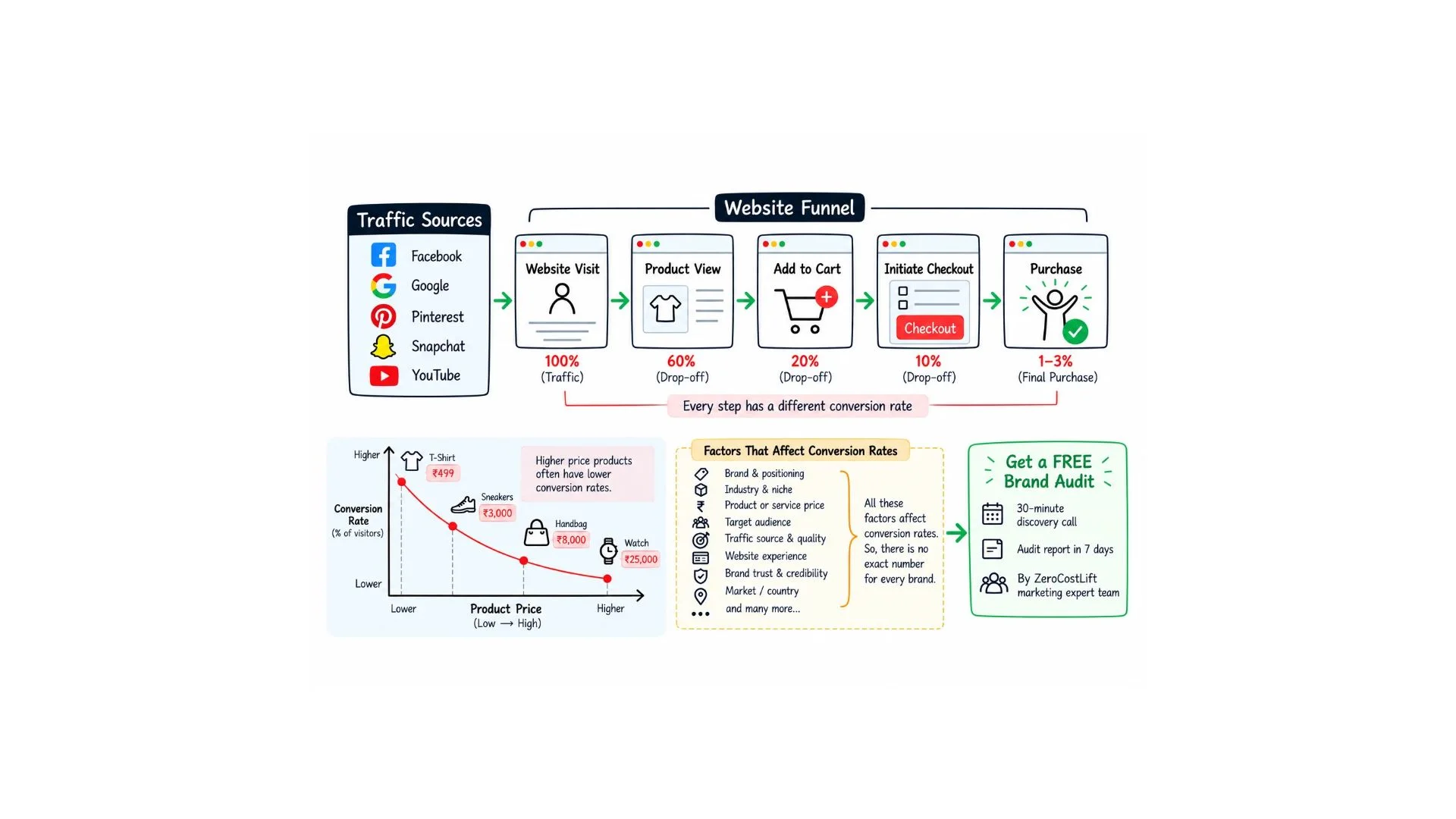
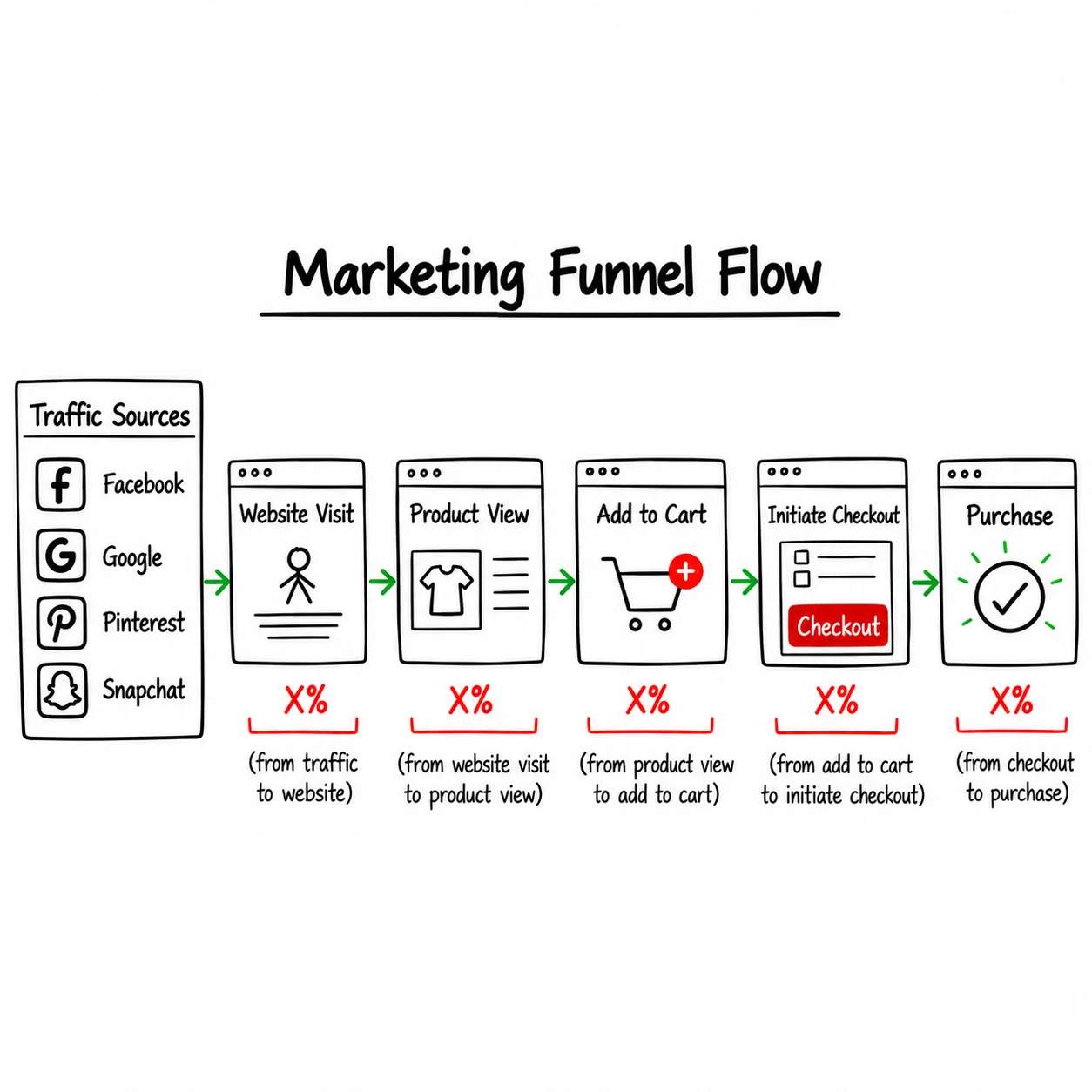
Advertisement → Relevant Landing Page → Product Evaluation → Add to Cart → Checkout → Purchase → Retention
Each stage has a different purpose.
The advertisement attracts relevant attention.
The landing page supports product discovery.
Product information helps customers evaluate the offer.
Checkout enables the transaction.
Post-purchase communication supports the customer relationship.
Example: Beardo
Beardo offers a relevant men's grooming category example for examining product communication, offers, and customer-facing ecommerce journeys.
The useful exercise is to map observable touchpoints and identify questions worth investigating.
How to Apply This Strategy
Document the complete journey for one product or collection.
Identify where customers enter.
Review the destination.
Examine the information provided.
Test the conversion process.
Measure relevant stage-level outcomes.
Use the findings to develop improvements.
You can explore examples through the ZeroCostLift Real-Brand Marketing Funnel Breakdowns.
Strategy 11: Adapt Marketing to the Customer's Buying Process
Not every business can use the same conversion journey.
A low-consideration ecommerce purchase differs from a real estate enquiry or a B2B service agreement.
Example: Godrej Properties
Godrej Properties provides a relevant example for studying publicly visible real estate marketing and enquiry experiences.
Real estate customers may need to understand project location, property details, budgets, availability, and next steps before arranging a conversation or site visit.
How to Apply This Strategy
Map the actual decision process.
For ecommerce, the journey may lead directly to checkout.
For real estate, it may involve enquiry submission, qualification, consultation, and site visits.
For B2B services, it may involve a discovery call, proposal, and approval process.
Build your funnel around the customer's decision requirements rather than forcing every business into the same structure.
Strategy 12: Use Retention to Support Long-Term Customer Value
Customer acquisition is important, but the relationship may continue after the first transaction.
Retention strategies can include customer support, useful product information, relevant recommendations, and appropriate follow-up.
Example: Personal Care Brands
Personal care products may create opportunities for replenishment or repeat purchase communication when the product and customer need justify it.
A brand can provide order updates, usage guidance, and relevant future recommendations.
How to Apply This Strategy
Start with the customer experience.
Are orders delivered as expected?
Can customers get help when needed?
Is post-purchase information useful?
Are future messages relevant and appropriately permission-based?
Measure repeat purchase behavior and customer satisfaction.
Do not assume every product category has the same retention potential.
A mattress brand and a consumable skincare brand may have very different purchase frequencies.
Strategy 13: Study Competitors Without Copying Blindly
Competitor research is useful when it helps businesses understand market communication and customer expectations.
It becomes less useful when teams simply copy advertisements or offers.
Example: Comparing Fragrance Brands
A marketer might compare the publicly visible marketing communication of BellaVita and Adil Qadri.
The research could examine product imagery, messaging, collections, offer presentation, and landing page experiences.
The objective is to understand differences in positioning and customer communication.
It is not to claim that one brand has better internal performance without supporting data.
A Practical Competitor Research Framework
For each brand, document:
- Product category and target customer.
- Main customer-facing message.
- Publicly visible advertising approaches.
- Landing page structure.
- Product and offer presentation.
- Conversion action.
- Trust and decision-support information.
- Ideas worth testing in your own business.
Organize the findings in a consistent format.
This makes comparisons more useful and reduces reliance on scattered screenshots.
Strategy 14: Measure the Complete Customer Journey
Marketing decisions become more useful when performance data is connected with customer behavior.
Consider the following hypothetical ecommerce example.
These figures are illustrative and are not actual results from any featured brand.
The session-to-purchase conversion rate is:
675 ÷ 25,000 × 100 = 2.7%
But this overall conversion rate does not explain where improvements are needed.
Why did some visitors never reach a product page?
Why did many product-viewing sessions not lead to an add-to-cart action?
Why did some customers start checkout without purchasing?
Possible causes include traffic relevance, pricing, product information, stock availability, usability, or payment issues.
These are hypotheses.
A marketer should investigate them using additional evidence.
Important Marketing Metrics
Conversion Rate: Conversions divided by a clearly defined visitor or session denominator.
Average Order Value: Revenue divided by orders.
Customer Acquisition Cost: Relevant acquisition costs divided by new customers acquired.
Return on Ad Spend: Attributed advertising revenue divided by advertising spend.
Cost per Qualified Lead: Advertising spend divided by qualified leads.
Contribution Margin: Net revenue remaining after relevant variable costs.
Use consistent definitions when comparing campaigns or periods.
Advertising platform attribution may differ from actual transaction reporting.
Strategy 15: Build a Continuous Testing and Learning Process
Established brands may have the resources to run multiple marketing experiments.
Smaller businesses can still benefit from a structured testing process.
The objective is not to copy the scale of a large brand.
It is to improve how decisions are made.
Step 1: Identify a Specific Problem
For example, customers may view a product but rarely add it to the cart.
Step 2: Investigate the Customer Experience
Review product information, pricing, imagery, availability, and customer questions.
Step 3: Develop a Hypothesis
For example:
"Customers may need clearer size information before they feel ready to add this product to the cart."
Step 4: Design a Relevant Improvement
Test a clearer size guide or product information layout.
Step 5: Define Success Metrics
Measure relevant add-to-cart behavior and downstream purchases.
Step 6: Evaluate the Results
Use an appropriate testing method and sufficient data where possible.
Avoid claiming certainty from small samples.
Step 7: Document the Learning
Record what changed, why it changed, what happened, and what should be tested next.
A repeatable learning process is more valuable than making random changes every time campaign performance fluctuates.
Comparing Marketing Strategies Across Industries
Different business categories often require different communication and conversion approaches.
This comparison shows why one universal marketing strategy cannot fit every business.
The right approach depends on the product, customer, purchase process, and business economics.
How to Analyze Top Brands Marketing Strategies Yourself
You do not need access to a competitor's private advertising account to learn from its public marketing communication.
Start with information that is legitimately available.
Step 1: Choose a Relevant Brand
Select a business operating in your category or serving a similar customer need.
Step 2: Review Public Advertising Communication
Observe the products, messages, visuals, and offers used in available advertising materials.
Step 3: Examine the Landing Experience
Check where the advertisement directs visitors and what information appears on the destination page.
Step 4: Study Product Positioning
Identify how the brand communicates benefits, features, and differences.
Step 5: Map the Conversion Journey
Document the main actions a customer can take.
Step 6: Identify Customer Questions
Consider what information a customer may need before proceeding.
Step 7: Compare With Your Business
Review differences in audience, pricing, positioning, and customer expectations.
Step 8: Create Testable Hypotheses
Choose ideas that address a specific business problem.
Step 9: Measure Outcomes
Use relevant performance and customer data to evaluate the change.
Step 10: Record the Learning
Maintain a research document so useful observations can inform future decisions.
This process turns brand research into a practical marketing activity.
Common Mistakes When Learning From Top Brands
Mistake 1: Assuming Every Visible Advertisement Is Profitable
An advertisement being active or visible does not prove that it generates profitable sales.
Mistake 2: Copying Large-Brand Messaging Without Context
Established brands may have different levels of recognition and customer trust.
A newer business may need more explanation and supporting evidence.
Mistake 3: Focusing Only on Creative Design
A visually attractive advertisement cannot automatically compensate for a weak landing experience.
Mistake 4: Ignoring Business Economics
An aggressive offer may increase purchases while reducing profitability.
Mistake 5: Using Competitor Revenue as Proof of a Specific Funnel's Performance
A company's reported revenue does not establish that one publicly visible campaign or landing page caused that revenue.
Mistake 6: Testing Too Many Changes Simultaneously
When several major changes occur together, identifying their individual effects becomes difficult.
Mistake 7: Forgetting Customer Retention
Acquiring customers is only part of the business relationship.
Relevant post-purchase experiences may influence long-term customer value.
A 30-Day Plan to Learn From Top Brands
A structured learning plan can help marketers turn observations into useful action.
Week 1: Research and Positioning
Choose three relevant brands.
Document their target customers, product categories, positioning, and customer-facing messages.
Deliverable: Brand positioning comparison.
Week 2: Funnel Mapping
Review available advertising, landing pages, product information, and conversion actions.
Map each brand's publicly observable customer journey.
Deliverable: Three simplified funnel maps.
Week 3: Business Comparison
Compare the research with your own website, offers, and customer journey.
Identify meaningful differences and potential friction points.
Deliverable: Prioritized improvement hypotheses.
Week 4: Optimization Planning
Choose one issue that can be investigated or tested.
Define the change, measurement plan, and review criteria.
Deliverable: A documented experiment plan.
Some experiments require longer than 30 days to gather enough information.
The main objective is to establish a repeatable research and improvement process.
How ZeroCostLift Helps You Study Top Brands Marketing Strategies
At ZeroCostLift, we focus on making real-brand marketing funnel research easier to understand and apply.
We publish digital funnel breakdowns that organize publicly observable marketing communication, offers, landing pages, and customer journeys.
Our resources are designed for founders, performance marketers, agencies, freelancers, and growth teams.
Instead of studying only advertising creatives, readers can explore how different customer-facing touchpoints connect.
What Can You Explore?
Real-Brand Funnel Breakdowns
Study publicly visible marketing approaches from recognizable brands across ecommerce, D2C, beauty, fashion, and other categories.
Ecommerce Customer Journeys
Explore how advertisements, product pages, offers, and checkout experiences connect.
Lead Generation Funnels
Understand how enquiry-based businesses structure customer journeys involving qualification and follow-up.
Competitive Analysis Resources
Organize competitor research and identify differences in product positioning and communication.
Marketing Templates and Checklists
Use practical resources to support planning, analysis, reporting, and funnel reviews.
ZeroCostLift does not claim access to private brand advertising accounts or guarantee that applying an observed strategy will produce identical results.
The goal is to support research and more informed testing.
You can explore the available resources through the ZeroCostLift Marketing Resources Collection.
Frequently Asked Questions About Top Brands Marketing Strategies
1. What are top brands marketing strategies?
They are the approaches recognizable businesses use to position products, reach customers, communicate value, support purchases, and develop customer relationships.
2. Why should small businesses study established brands?
Studying publicly visible marketing can help small businesses understand positioning, customer communication, product presentation, and funnel structures.
3. Can I copy a successful brand's marketing strategy?
You can learn from public examples, but copying a strategy without considering your own audience, product, costs, and market conditions may not be effective.
4. Which brands provide useful marketing examples?
Brands such as Nike, Apple, Lululemon, Zara, Nykaa, Mamaearth, BellaVita, and others offer different publicly observable approaches worth studying.
5. What is the role of a marketing funnel in brand growth?
A marketing funnel helps connect customer discovery, product evaluation, conversion actions, and retention into a measurable journey.
6. How can I improve my ecommerce marketing strategy?
Review traffic quality, advertising-to-landing-page alignment, product information, checkout usability, customer acquisition costs, and retention opportunities.
7. What is the difference between brand marketing and performance marketing?
Brand marketing often focuses on recognition, positioning, and preference. Performance marketing emphasizes measurable actions and outcomes. In practice, the two can support each other.
8. How can I research competitor marketing strategies?
Study publicly available advertisements, websites, product pages, offers, and customer journeys. Organize observations and develop hypotheses for testing.
9. Do top brands always have better conversion rates?
Not necessarily. Conversion rates vary by audience, product, pricing, traffic intent, business model, and measurement definitions.
10. Where can I find real-brand marketing funnel breakdowns?
You can explore the ZeroCostLift Homepage to discover available brand marketing funnel breakdowns, playbooks, and practical marketing resources.
Final Thoughts: Learn the Principles, Not Just the Advertisements
Studying top brands marketing strategies can help businesses understand how positioning, advertising, product communication, customer journeys, and retention work together.
But the most valuable lesson is not that every business should imitate an established brand.
It is that marketing decisions should be based on customer understanding, clear communication, relevant experiences, and reliable measurement.
Start by identifying your business challenge.
Study relevant brand examples.
Understand the customer journey.
Develop practical hypotheses.
Test suitable improvements.
Measure meaningful outcomes.
At ZeroCostLift, our goal is to make this process easier through real-brand funnel breakdowns and marketing resources.
Don't just copy what top brands show customers. Understand the thinking behind the journey—and use that knowledge to build a smarter marketing strategy for your own business.