Sign up with Google
 Sign in with Zoho
India is the world's largest producer of jute, contributing nearly 70% of global jute production. Despite this dominance, rising electricity tariffs continue to increase production costs for manufacturers.
Energy-intensive processes in jute mills such as spinning, weaving, batching, and finishing require an uninterrupted power supply. This is why electricity is one of the largest operational expenses of this industry. To remain competitive, many jute mills are turning to solar energy.
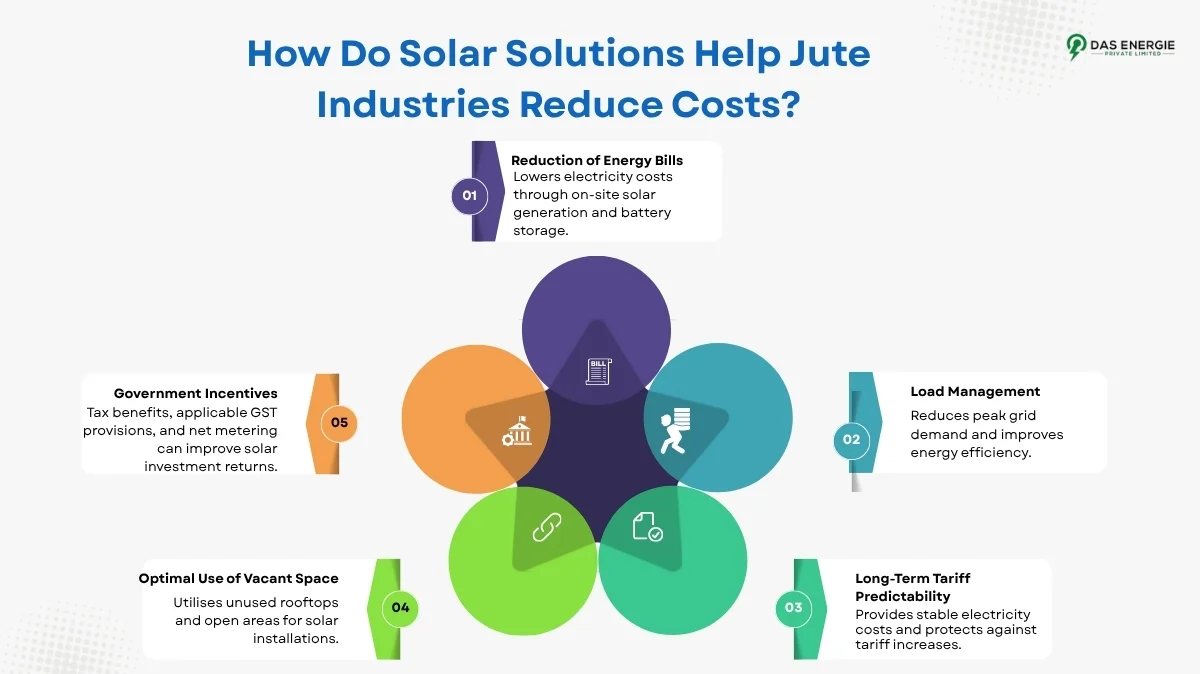
How Do Solar Solutions Help Jute Industries Reduce Costs?
A commercial solar installation helps jute industries significantly reduce their carbon footprint. Solar energy enables jute mills to generate electricity directly at their manufacturing facilities.
Since industrial operations primarily run during daylight hours, a significant portion of the solar power generated is consumed instantly. This reduces dependence on expensive grid electricity while improving overall energy efficiency.
Other reasons include:
- Reduction of Energy Bills:
Electricity accounts for 20% to 35% of the total operating cost in many manufacturing industries. For jute mills that operate heavy machinery throughout the day, monthly electricity bills can significantly impact profitability.
Installing a solar system for jute mill allows manufacturers to generate clean electricity on-site. Depending on system size and energy consumption, industries can reduce annual utility costs up to 50% using a combined system of solar and BESS (Battery Energy Storage System).
Businesses can also include net metering, which will allow them to export surplus electricity to the utility grid. This additional income further improves the overall financial return on the investment.
2. Load Management:
Industrial power demand fluctuates throughout the day as multiple machines operate simultaneously. These peak loads often lead to higher electricity charges and increased pressure on the internal electrical network.
Solar systems generate maximum electricity during daylight hours, precisely when production activity is at its peak. This helps to reduce grid dependency during high-demand periods and lowers peak electricity consumption.
Effective load management also minimises stress on transformers and electrical equipment. As a result, industries experience better energy efficiency and improved operational reliability.
With consistent daytime power generation, manufacturers can maintain uninterrupted production while optimising energy usage across the facility.Long-term
3. Tariff Predictability:
Industrial electricity tariffs have steadily increased over the last decade due to rising fuel prices and transmission costs. These fluctuations make budgeting difficult for manufacturing businesses.
Solar power provides a stable and predictable source of electricity for over 25 years. Once installed, operating costs remain extremely low because sunlight is freely available.
This enables manufacturers to accurately forecast future energy expenses without worrying about sudden tariff hikes or electricity inflation. Stable electricity costs improve financial planning and strengthen long-term profitability.
The predictable savings opportunities generated through solar installations also make future business expansion easier to plan and finance.
4. Optimal Use of Vacant Space:
Most jute mills have large factory rooftops, warehouse sheds, and other unused open areas that remain underutilised. Solar installations convert these idle spaces into productive energy-generating assets.
A 1 MW rooftop solar plant typically requires around 90,000 - 100,000 square feet of roof space and can generate approximately 17 lakh units (kWh) of electricity annually, depending on location and sunlight availability.
The same strategy is benefiting other energy-intensive sectors. Businesses are planning to invest in a solar system rice mill to utilise expansive rooftops to lower electricity costs while improving operational efficiency.
Similarly, commercial establishments are increasingly installing solar panels for hotels to reduce utility bills and provide guests with environmentally responsible accommodation.
5. Government Incentives:
To encourage renewable energy adoption, the Government of India offers several financial incentives for commercial solar projects, including:
a) Accelerated Depreciation:
Eligible businesses can currently claim depreciation benefits of around 40% in the first and second year and an additional 20% in the third year under prevailing tax regulations, if the installed solar system has been in operation for at least 180 days of a year.
If the system was operational for less than 180 days, the depreciation benefit would be reduced to 30%.
b) Goods and Services Benefits:
The GST on solar power generating systems is 5%. It is comparatively lower than industrial equipment. This can also reduce the overall expenses of jute industries.
Industries can also benefit from net metering policies and competitive commercial loans, making solar installations more affordable than ever before.
When combined with long-term electricity savings, these incentives often reduce the payback period to 3 - 5 years, after which the system continues generating virtually free electricity for decades.
Final Words
Solar energy is reshaping the economics of India's jute manufacturing industry. By reducing electricity bills, improving load management, stabilising long-term energy costs, and maximising the use of existing infrastructure, solar installations help businesses strengthen both profitability and sustainability.
With government incentives further improving project viability, there has never been a better time for manufacturers to invest in clean energy. Partner with Das Energie Pvt. Ltd. for a customised industrial solar solution that delivers maximum savings and reliable performance for your jute manufacturing business.





.webp)