Sign up with Google
 Sign in with Zoho

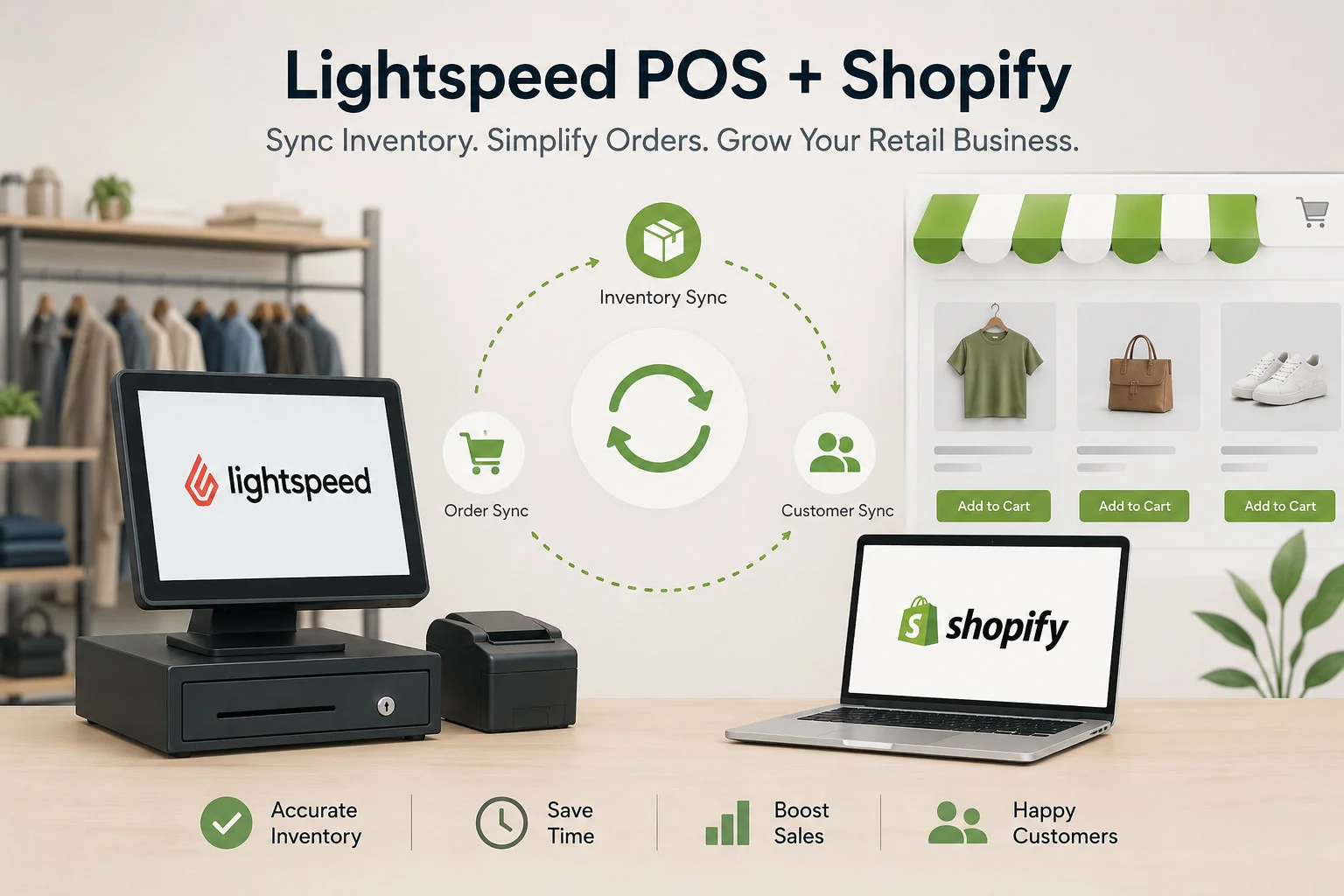
Walk into any busy retail store on a Saturday afternoon and you'll see the same scene play out: a customer asks if a product is available, the associate checks the back room, comes up empty, and then mentions "we might have it online." Meanwhile, the website shows the item in stock, an order comes through, and there's nothing left to ship. That gap between what's happening in the store and what's happening online is one of the most expensive problems in modern retail, and it's exactly the problem a Lightspeed Shopify Integration is built to solve.
If you run a brick-and-mortar shop with an online presence, or you're planning to expand from a physical store into eCommerce, understanding how your point-of-sale system talks to your website matters more than almost any other operational decision you'll make this year.
The Real Cost of Disconnected Systems
Most retailers don't start out thinking about integration. You open a store, you get a POS system to ring up sales, and at some point you launch a Shopify store because customers keep asking if they can buy online. For a while, you manage both separately. It works, sort of.
Then the cracks appear.
You sell the last unit of a popular item in-store, but your website still shows it available. A customer orders it, you can't fulfill it, and now you're issuing a refund and an apology. Multiply that across hundreds of SKUs and a few thousand monthly transactions, and you're not dealing with an occasional hiccup anymore. You're dealing with a structural problem.
Without proper retail POS integration, the typical day looks something like this. Someone on your team exports a spreadsheet of inventory counts from Lightspeed. Someone else manually updates quantities in Shopify, usually at the end of the day, sometimes only once a week. Online orders get printed out and re-entered into the POS so the store's records stay accurate. Customer information lives in two places that never quite match. And every one of those manual steps is a chance for a typo, a delay, or a missed update.
The deeper issue is that disconnected systems force your staff to do the work that software should be doing. That's time they're not spending with customers, not merchandising the floor, and not growing the business.
What Integration Actually Does
Connecting Lightspeed POS Shopify environments means the two systems share data automatically and continuously, without anyone copying numbers between them. Here's where it makes the biggest difference.
Inventory Sync That Actually Works
This is the headline benefit. Good inventory sync software keeps your stock levels accurate across both channels in near real time. Sell three units at the register, and your Shopify store reflects three fewer units within moments. Receive a shipment and log it in Lightspeed, and your online quantities update on their own.
The practical result is that you stop overselling. When the website says something is in stock, it actually is, because the count is pulled from the same source of truth as your physical store. For retailers running tight inventory or dealing with seasonal demand spikes, this alone justifies the entire setup.
Order Management Without the Re-Entry
When a customer buys something on your Shopify store, that order flows back into Lightspeed automatically. Your sales reporting stays unified, your inventory adjusts, and your team doesn't have to manually log online sales into the POS. Everything lives in one consolidated view.
This matters at tax time, during inventory audits, and whenever you're trying to understand which products are actually moving across all your channels combined.
Customer Data That Follows the Shopper
A customer who buys from you in-store and then orders online shouldn't look like two different people in your records. Integration syncs customer profiles so you get a complete picture of purchase history, regardless of where the transaction happened. That unified view is what makes meaningful loyalty programs, targeted promotions, and genuinely personal service possible.
Manual Process vs. Automated Integration
To make the contrast concrete, here's how the two approaches compare on the tasks retailers deal with every day.
The manual column isn't a strawman. It's how a large share of small and mid-sized retailers operate right now, and it works until volume outpaces the team's ability to keep up. The automated column is simply what becomes possible when the systems are connected.
Omnichannel Selling Becomes Realistic
The phrase "omnichannel retail software" gets thrown around a lot, but for most independent retailers it really just means one thing: customers can buy from you however they want, and the experience is consistent.
A connected setup makes options like buy-online-pickup-in-store actually feasible, because your website knows what's physically on your shelves. It lets you list the same products across your store and online without maintaining two separate catalogs by hand. And it gives you reliable numbers on which channel is driving which sales, so you can make decisions based on data instead of guesswork.
Consider a clothing boutique that runs both a storefront and a Shopify shop. Before integration, the owner spent every Sunday night reconciling inventory and dreaded the regular oversells around the holidays. After connecting the systems, that Sunday ritual disappeared, oversells dropped to near zero, and she was able to confidently offer in-store pickup, which brought foot traffic from online shoppers who'd never visited before. The integration didn't just save time; it opened a sales channel she couldn't have run otherwise.
Common Challenges (And Honest Expectations)
Integration isn't magic, and it's fair to know what to plan for.
Product data needs to be clean and consistent. If your SKUs, barcodes, and product names don't match well between systems, the initial mapping takes some effort. It's worth doing right, because the sync is only as good as the data underneath it.
You'll also want to decide which system is your "source of truth." For most retailers running a physical store, Lightspeed is the master and Shopify reflects it, but that's a deliberate choice to make up front.
And while a quality Shopify POS integration handles the heavy lifting, the initial configuration benefits from someone who understands both platforms. Once it's running, maintenance is light, but the setup is where attention pays off. For retailers who want to understand the technical side more deeply, resources covering Lightspeed Shopify integration walk through how the data flows between the two platforms.
Frequently Asked Questions
Does integration work with both Lightspeed R-Series and X-Series? Yes. Integration solutions generally support both the R-Series (Retail) and X-Series platforms, though the specific fields and capabilities can vary between them. It's worth confirming which series you're on before you start.
How quickly does inventory update between the systems? With a real-time or near-real-time integration, stock changes typically reflect within moments to a few minutes. The exact timing depends on the solution you use and your transaction volume.
Will I oversell products if both channels sell the same item at once? A properly configured integration is specifically designed to prevent this by drawing stock counts from a single source. Overselling is the core problem these tools exist to eliminate.
Do I need technical skills to set this up? The initial setup, especially product mapping, goes more smoothly with someone who knows both platforms. Day-to-day operation, though, requires little technical involvement once everything is connected.
Can I sync customer data and not just inventory? Yes. Most integrations sync customer profiles and order history alongside inventory, giving you a unified view of each shopper across both channels.
What happens to my existing data when I connect the systems? Your existing products and customers can typically be matched and mapped during setup. This is why clean, consistent data matters before you begin.
Is this only for large retailers? Not at all. Small and mid-sized retailers often see the biggest relative benefit, because they're the ones currently spending hours on manual work that integration eliminates.
The Bottom Line for Your Business
Retail has always been about meeting customers where they are. Today that means being equally present and equally accurate whether someone is standing at your counter or shopping from their phone at midnight. The retailers who pull that off aren't necessarily the ones with the biggest budgets. They're the ones who've stopped doing by hand what their systems should be doing for them.
Connecting Lightspeed POS Shopify environments turns two systems that fight each other into one that works as a unit. Inventory stays accurate, orders flow without re-entry, customers get consistent service, and your team gets their time back for the work that actually grows the business.
If you're spending evenings reconciling spreadsheets or fielding apologies for orders you can't fill, the question isn't really whether integration is worth it. It's how much longer the manual approach can keep up with where your business is headed.