Sign up with Google
 Sign in with Zoho

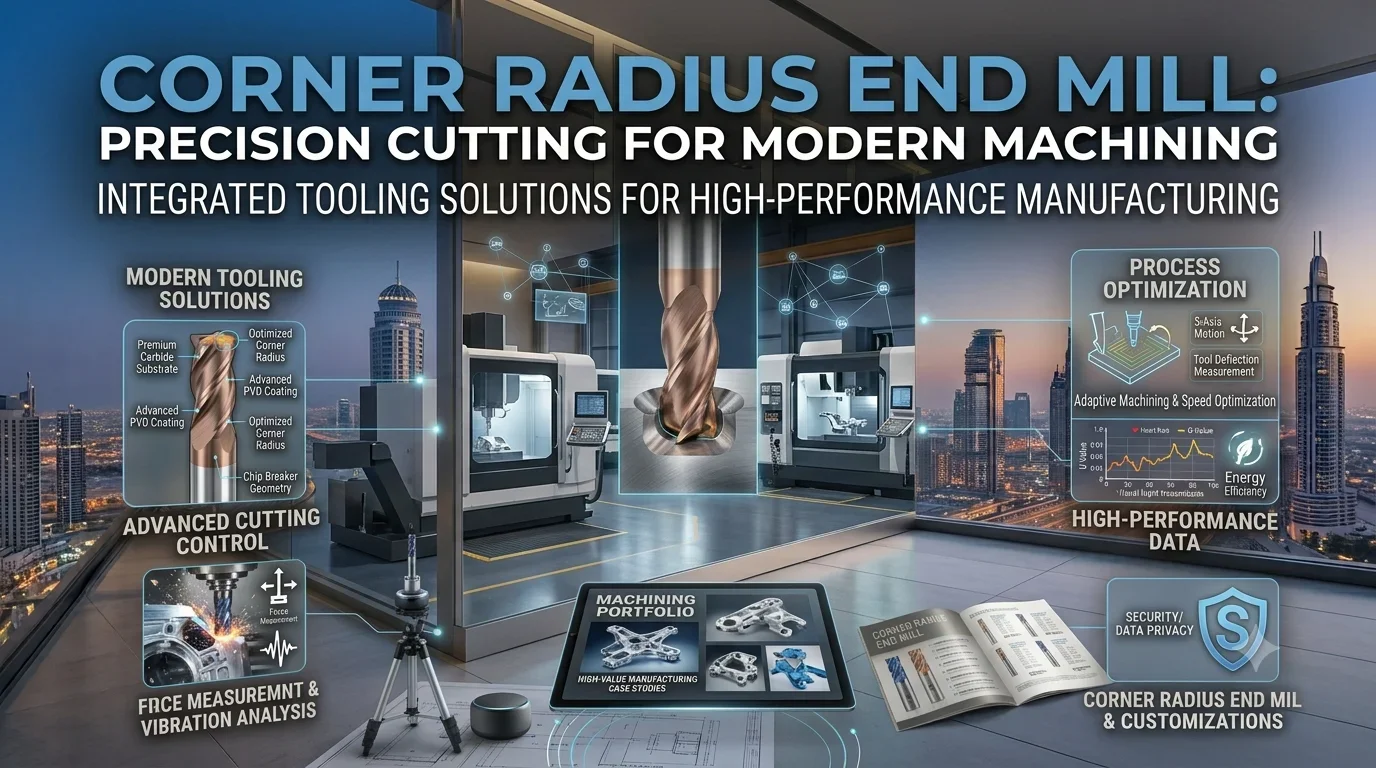
A corner radius end mill is a precision cutting tool designed to machine components efficiently while providing a rounded transition between the tool's cutting edge and workpiece surface. Unlike a traditional square end mill, its rounded corner helps reduce stress concentration at the cutting edge, improving tool durability and machining stability. Corner radius cutters are widely used for CNC milling, profiling, slotting, contouring, and finishing applications where dimensional accuracy and surface quality matter. Selecting the correct carbide grade, diameter, flute configuration, coating, and corner radius is essential for achieving consistent machining performance.
What Is a Corner Radius End Mill?
A corner radius end mill is a milling cutter with a small radius ground onto the cutting corners. This geometry combines characteristics of square end mills and ball nose cutters.
The rounded corner can help:
- Reduce cutting-edge chipping
- Improve tool strength
- Increase resistance to wear
- Produce smoother transitions
- Support higher machining stability
- Improve tool life in demanding applications
Solid carbide construction makes these cutters suitable for high-speed CNC machining where rigidity, accuracy, and wear resistance are important.
Why Use a Corner Radius Milling Cutter?
During machining, sharp tool corners can experience concentrated cutting forces. A corner radius distributes these forces more gradually across the cutting edge.
This geometry can be particularly useful when machining harder materials or performing heavy material removal.
Improved Cutting Edge Strength
The rounded corner provides more material behind the cutting edge than a sharp square corner. This can help reduce premature corner failure during demanding operations.
Better Surface Finish
A suitable corner radius can create smoother transitions along machined profiles, especially when the cutter is used for contouring and finishing.
Longer Tool Life
Reduced stress at the cutting corner may help minimize chipping and edge wear, allowing the tool to maintain its cutting performance for longer.
Solid Carbide Corner Radius End Mills
Solid carbide is widely used for precision milling because it provides high hardness, rigidity, and resistance to wear. These characteristics make carbide end mills suitable for CNC machining applications requiring consistent dimensions and reliable cutting performance.
Solid carbide cutters can be used for materials such as:
- Aluminum
- Stainless steel
- Carbon steel
- Alloy steel
- Tool steel
- Cast iron
- Titanium and other difficult-to-machine alloys
The correct tool grade and geometry should always be selected according to the workpiece material and machining conditions.
Choosing the Right Corner Radius
The corner radius is one of the most important specifications when selecting a cutter. A smaller radius may be appropriate for detailed profiles, while a larger radius can provide greater edge strength for heavier machining.
Consider:
- Workpiece material
- Required profile
- Radial depth of cut
- Axial depth of cut
- Spindle speed
- Feed rate
- Machine rigidity
- Desired surface finish
For example, a component requiring a precise internal profile may benefit from a smaller corner radius, while roughing a stronger material may require a more robust geometry.
Corner Radius vs Square End Mill
A square end mill has sharp cutting corners, making it suitable for producing square shoulders, slots, and sharp internal features. A corner radius end mill introduces a controlled radius at the corner, improving edge strength and reducing stress concentration.
Square End Mill
- Sharp cutting corners
- Suitable for square shoulders
- Useful for slots and pockets
- Effective for general profiling
Corner Radius End Mill
- Rounded cutting corners
- Greater corner strength
- Reduced risk of edge chipping
- Suitable for profiling and finishing
- Useful for demanding machining applications
The choice depends on the geometry being produced and the required machining performance.
Applications of Corner Radius End Mills
Corner radius tools are used across different CNC machining industries where accurate and repeatable cutting is required.
Common applications include:
- CNC milling
- Profile machining
- Contouring
- Slotting
- Pocketing
- Die and mold manufacturing
- Aerospace component machining
- Automotive parts production
- General engineering
- Precision metalworking
They are particularly valuable when a component includes curved transitions or when additional corner strength is desirable.
Flute Configuration and Tool Geometry
The number of flutes affects chip evacuation, feed capability, cutting action, and surface finish. Two-flute cutters are often suitable for materials requiring efficient chip clearance, while cutters with more flutes can provide additional cutting edges and support higher feed rates in suitable applications.
Helix angle, rake geometry, core design, and end geometry also influence machining behavior. Therefore, tool selection should consider the complete geometry rather than focusing only on diameter.
Coatings for CNC End Mills
Coatings can improve resistance to heat, abrasion, and wear depending on the application. Different coatings are designed for different workpiece materials and cutting conditions.
Common coating considerations include:
- Heat resistance
- Abrasion resistance
- Friction reduction
- Tool life
- Material compatibility
The correct coating can help maintain edge performance during demanding CNC operations.
How to Improve Tool Performance
Even a high-quality corner radius cutter requires appropriate machining parameters. Excessive cutting speed, insufficient coolant, incorrect feed rates, or excessive tool engagement can accelerate wear.
For better results:
- Use manufacturer-recommended cutting parameters
- Maintain proper tool holding
- Ensure machine rigidity
- Control chip evacuation
- Avoid unnecessary tool overhang
- Select coolant according to the material
- Monitor cutting-edge wear regularly
Proper setup is just as important as selecting the right cutter.
Frequently Asked Questions
What is a corner radius end mill used for?
It is used for CNC milling, profiling, contouring, slotting, pocketing, and finishing where rounded cutting corners and improved edge strength are beneficial.
Is a corner radius end mill better than a square end mill?
Neither is universally better. A corner radius cutter provides stronger rounded corners, while a square end mill is preferable when sharp shoulders and corners are required.
What materials can carbide end mills machine?
Depending on their geometry and grade, solid carbide end mills can machine aluminum, steel, stainless steel, cast iron, titanium, and other engineering materials.
**How do I choose the correct corner radius?
Consider the component geometry, workpiece material, depth of cut, machine capability, desired finish, and required cutting performance.
Conclusion
A corner radius end mill provides a practical combination of precision, cutting strength, and durability for demanding CNC machining applications. Its rounded cutting corners can reduce edge stress, support improved tool life, and produce consistent results across profiling, contouring, pocketing, and finishing operations. Solid carbide construction further supports high-performance machining when the correct geometry and parameters are selected. For reliable results, machinists should evaluate the material, cutter diameter, corner radius, flute configuration, coating, and machine conditions before choosing an end mill for a specific application.