Sign up with Google
 Sign in with Zoho

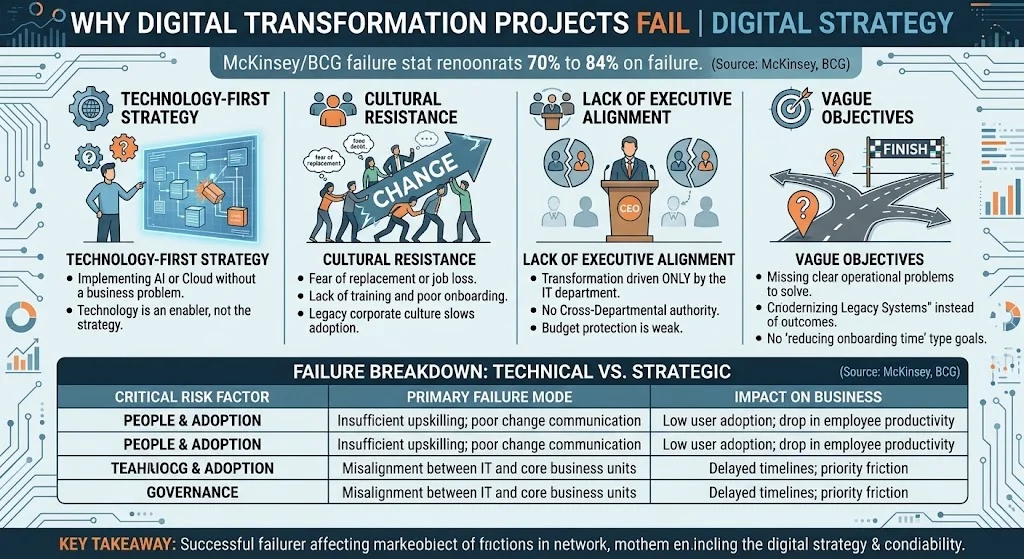
Why Digital Transformation Projects Fail Even When Businesses Have the Right Technology
Why the Right Technology Can Still Fail
Businesses invest in technology to improve efficiency, understand customers and create better digital experiences. However, having the right technology does not guarantee successful transformation.
Many digital transformation projects fail because companies focus on buying and implementing technology rather than changing the way the business operates.
A successful digital transformation strategy connects technology with business goals, customer needs, internal processes and measurable results.
The problem is often not the technology itself. It is how the technology is selected, integrated, managed and adopted.
1. Technology Is Chosen Without a Clear Business Objective
One of the biggest reasons digital transformation projects fail is that businesses start with platforms instead of problems.
A company may purchase a CRM, marketing automation system or analytics platform without defining what it needs the technology to achieve.
Before investing in technology, businesses should identify clear objectives such as:
- Improving lead quality
- Increasing conversion rates
- Reducing manual tasks
- Improving customer retention
- Creating a better digital customer experience
- Reducing customer acquisition costs
Technology should support these objectives rather than become an objective itself.
2. Marketing Systems Are Not Properly Integrated
Modern marketing teams often use several platforms, including CRM systems, advertising tools, analytics platforms and automation software.
When these systems do not communicate effectively, important information becomes fragmented.
This creates data silos and disconnected workflows.
Common problems include:
- Duplicate customer records
- Inconsistent reporting
- Manual data entry
- Poor campaign targeting
- Delayed information
- Repeated customer communications
Effective technology integration allows relevant information to move between systems and gives teams a clearer view of the customer journey.
3. Poor Customer Data Limits Technology Performance
Technology is only as useful as the data supporting it.
Incomplete, outdated or inconsistent customer data can reduce the effectiveness of automation, segmentation and marketing analytics.
For example, if customer records contain different information across systems, automated campaigns may target the wrong people or send irrelevant messages.
Businesses should establish clear data standards covering:
- Customer information
- Lifecycle stages
- Data ownership
- Duplicate records
- Required fields
- Data updates
- System responsibilities
Strong data governance should come before large-scale automation.
4. Automation Is Built on Inefficient Workflows
Marketing automation can save time, but automating a poor process does not necessarily make the process better.
If leads are already being passed slowly between marketing and sales, adding more automation may simply make the existing problem more complicated.
Businesses should first map the customer journey and identify where delays or unnecessary manual tasks occur.
Automation can then be used for suitable activities such as:
- Lead assignment
- Email follow-ups
- Customer notifications
- Data synchronisation
- Reporting
- Customer segmentation
The goal should be to improve the workflow, not simply automate it.
5. Marketing and Sales Technology Are Disconnected
Marketing and sales teams need access to consistent customer information. When each department uses different processes or definitions, valuable leads can be lost.
A strong CRM integration strategy can help create a shared view of customers and prospects.
Marketing and sales should agree on:
- What qualifies as a lead
- When a lead becomes sales-ready
- Who owns the lead
- How quickly leads should be followed up
- How opportunities are tracked
- How customer information is updated
Technology should reinforce these shared processes rather than operate separately from them.
6. Employees Do Not Fully Adopt New Technology
Even an excellent platform can fail when employees do not use it correctly.
Technology adoption depends on more than providing login details. Employees need to understand why the system has been introduced and how it improves their work.
Effective implementation should include:
- Practical training
- Role-specific workflows
- Clear instructions
- Ongoing support
- Regular performance reviews
Businesses should also monitor actual usage. Low adoption may indicate that employees need additional training or that the technology does not fit the existing workflow.
7. Businesses Measure Activity Instead of Results
Another common mistake is measuring technology usage instead of business performance.
For example, the number of emails sent or workflows created does not necessarily show whether transformation has delivered value.
Businesses should focus on meaningful outcomes such as:
- Lead quality
- Conversion rates
- Customer acquisition costs
- Revenue
- Customer retention
- Response times
- Marketing-generated opportunities
These measures help businesses understand whether their technology investment is contributing to real growth.
8. How to Build a Digital Transformation Strategy That Works
A practical digital transformation roadmap should focus on business priorities rather than implementing every available technology.
Businesses can follow a structured approach:
- Audit the existing technology stackIdentify current platforms, their purpose and how effectively they are being used.
- Find integration gapsLook for disconnected systems, duplicate data and manual processes.
- Improve customer dataEstablish consistent data structures, ownership and governance.
- Review business workflowsIdentify inefficient processes before introducing automation.
- Prioritise automationAutomate repetitive activities that provide clear operational benefits.
- Define measurable KPIsConnect technology initiatives to specific business and marketing outcomes.
- Implement changes in stagesTest, measure and improve each stage before expanding the transformation.
This approach reduces unnecessary disruption and makes it easier to demonstrate the value of technology investments.
Conclusion
Digital transformation is not simply about purchasing modern software. It is about using technology to improve processes, customer experiences and business results.
Companies should therefore look beyond platforms and consider how their technology, customer data, workflows and employees work together.
A well-planned strategy can help businesses avoid common transformation problems and make technology investments more valuable.
For businesses looking to strengthen their digital strategy, marketing technology and technology integration, Skoma Digital can be a relevant resource for exploring practical digital solutions and transformation opportunities.