Sign up with Google
 Sign in with Zoho
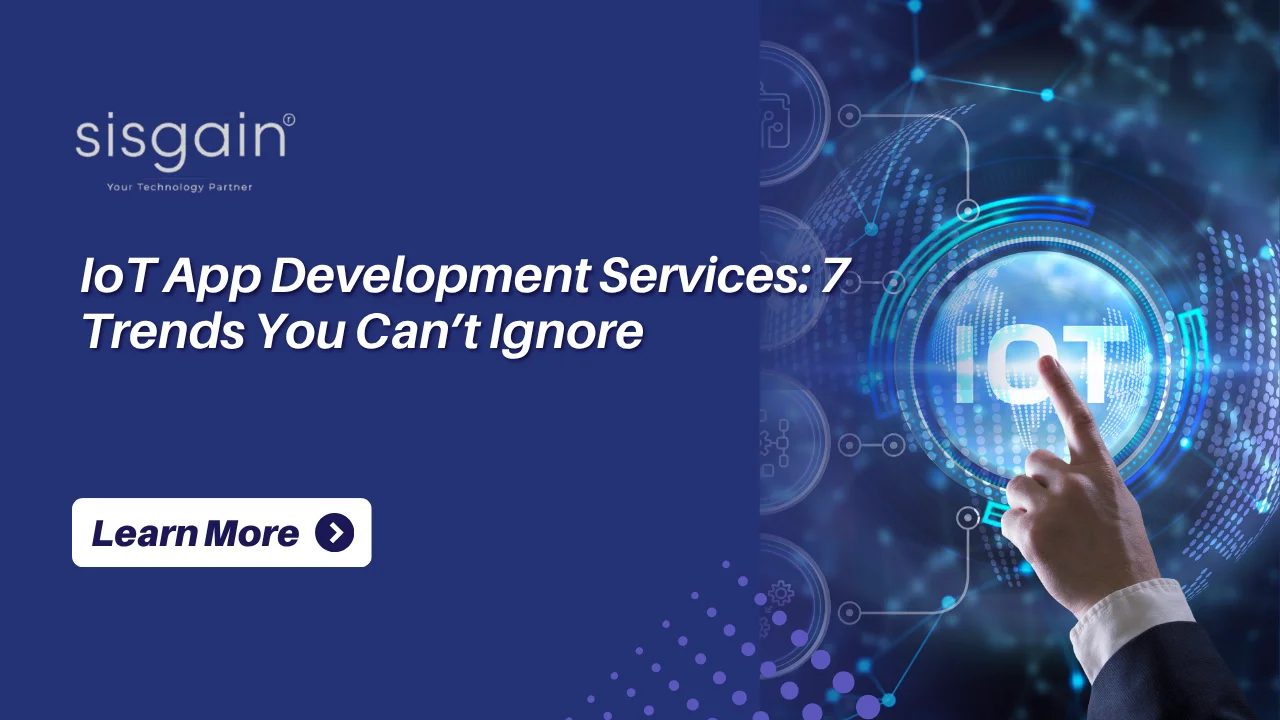
The Internet of Things (IoT) has moved far beyond smart home devices and connected watches. Businesses now use connected sensors, machines, vehicles, equipment, and applications to collect data, automate operations, reduce costs, and improve customer experiences. As connected ecosystems become more sophisticated, companies need software that can turn device data into useful business actions.
This is where iot app development services become valuable. An IoT application connects physical devices with software platforms, databases, dashboards, cloud systems, and users. The goal is not simply to connect a device. The real value comes from making that connection useful, secure, scalable, and easy to manage.
For U.S. businesses, the demand is particularly strong across manufacturing, healthcare, logistics, retail, energy, agriculture, and smart infrastructure. So, what is changing the IoT landscape? Here are seven important developments businesses should keep on their radar.
1. How Is Edge Computing Changing IoT Applications?
Traditional IoT systems often send device data to a centralized cloud environment for processing. That model still works, but it is not ideal for every situation. When an application needs an immediate response, sending every piece of data to the cloud can introduce unnecessary delay.
Edge computing solves part of this problem by processing data closer to where it is generated.
For example, a manufacturing machine can analyze sensor information locally and detect an abnormal temperature before sending selected information to a central platform. This reduces latency, lowers bandwidth requirements, and can improve operational reliability.
Modern IoT app development trends increasingly focus on combining edge computing with cloud infrastructure rather than treating them as competing approaches.
Why does edge computing matter?
- Faster decision-making
- Lower network dependency
- Reduced data-transfer costs
- Better support for real-time applications
- Improved performance in remote environments
For applications involving industrial automation, autonomous systems, connected vehicles, and real-time monitoring, edge computing can be a major advantage.
2. Why Is AI Becoming a Core Part of IoT?
IoT produces enormous amounts of data. But raw data alone does not create business value. Companies need systems that can identify patterns, detect problems, and recommend actions.
Artificial intelligence and machine learning help IoT applications move from simple monitoring toward intelligent decision-making.
An application can analyze equipment behavior, identify unusual patterns, predict maintenance requirements, or personalize customer experiences. This combination is often described as AIoT, or Artificial Intelligence of Things.
Among the latest IoT app development trends, AI-powered analytics stands out because it changes how businesses use connected-device data.
Consider predictive maintenance. Instead of waiting for a machine to fail, an intelligent system can analyze vibration, temperature, pressure, and operating history to identify potential problems earlier. That can reduce downtime and improve asset utilization.
3. Are IoT Applications Becoming More Secure?
As more devices become connected, the attack surface also grows. Every sensor, gateway, mobile application, API, and cloud service can introduce security considerations.
Security therefore needs to be designed into the application from the beginning rather than added after development.
A reliable IoT security strategy can include:
The IoT technology trends for businesses are increasingly connected with stronger identity management, encrypted communication, secure device provisioning, and continuous monitoring.
Security is especially important when IoT systems handle healthcare information, industrial operations, customer data, or critical infrastructure.
4. How Are 5G and IoT Working Together?
IoT applications often depend on reliable communication. 5G can support high-speed connectivity, lower latency, and large numbers of connected devices, making it useful for demanding IoT environments.
The combination becomes particularly interesting for smart factories, connected transportation, remote monitoring, logistics, and large-scale infrastructure.
For instance, a smart factory may have thousands of connected machines and sensors. Faster and more reliable communication can help these systems exchange information with less delay.
This does not mean every IoT project needs 5G. Wi-Fi, Bluetooth, LoRaWAN, NB-IoT, and other communication technologies still have important roles. The right option depends on factors such as range, power consumption, bandwidth, device density, and deployment environment.
That flexibility is one reason emerging IoT trends are becoming more diverse rather than moving toward one universal connectivity model.
5. Why Are Digital Twins Gaining Attention?
A digital twin is a virtual representation of a physical object, process, or system. It receives information from real-world assets and can help businesses monitor performance, test scenarios, and understand operational behavior.
Imagine a business operating a large industrial facility. Instead of relying only on physical inspections, the company can use connected sensors and software to create a digital representation of equipment and processes.
Digital twins can support:
- Equipment monitoring
- Performance analysis
- Predictive maintenance
- Process optimization
- Simulation and testing
- Asset lifecycle management
The future of IoT application development will increasingly involve systems that do more than display sensor readings. Applications will need to provide meaningful context around those readings and help teams understand what the information means.
6. What Role Will Connected Applications Play Across Industries?
IoT is not limited to one industry because almost every sector has physical assets, operational processes, or customer interactions that can benefit from connectivity.
Some important use cases include:
Manufacturing: Machine monitoring, predictive maintenance, quality control, and production optimization.
Healthcare: Remote patient monitoring, connected medical devices, medication tracking, and facility management.
Logistics: Fleet tracking, shipment monitoring, route optimization, and warehouse automation.
Retail: Smart inventory management, connected shelves, customer analytics, and automated checkout systems.
Energy: Smart meters, grid monitoring, renewable energy management, and equipment diagnostics.
Agriculture: Soil monitoring, irrigation management, weather tracking, and crop optimization.
Businesses exploring IoT development services should therefore begin with a clear business problem rather than choosing technology simply because it is popular.
7. How Will IoT Applications Become More Intelligent and Connected?
The next phase of IoT will be less about individual connected devices and more about connected ecosystems.
A modern application may communicate with cloud platforms, AI models, enterprise software, mobile applications, digital twins, analytics tools, and other technologies. This creates opportunities for companies to build complete digital workflows instead of isolated IoT solutions.
Integration with other technologies is also expanding. For example, ar vr development services can support immersive visualization of connected environments, while blockchain development and consulting can be relevant where businesses need specialized approaches to data provenance, transaction records, or multi-party workflows.
A capable IoT application development company should therefore understand integration architecture, APIs, cloud infrastructure, security, analytics, and user experience—not just device connectivity.
What Should Businesses Look for in an IoT Application?
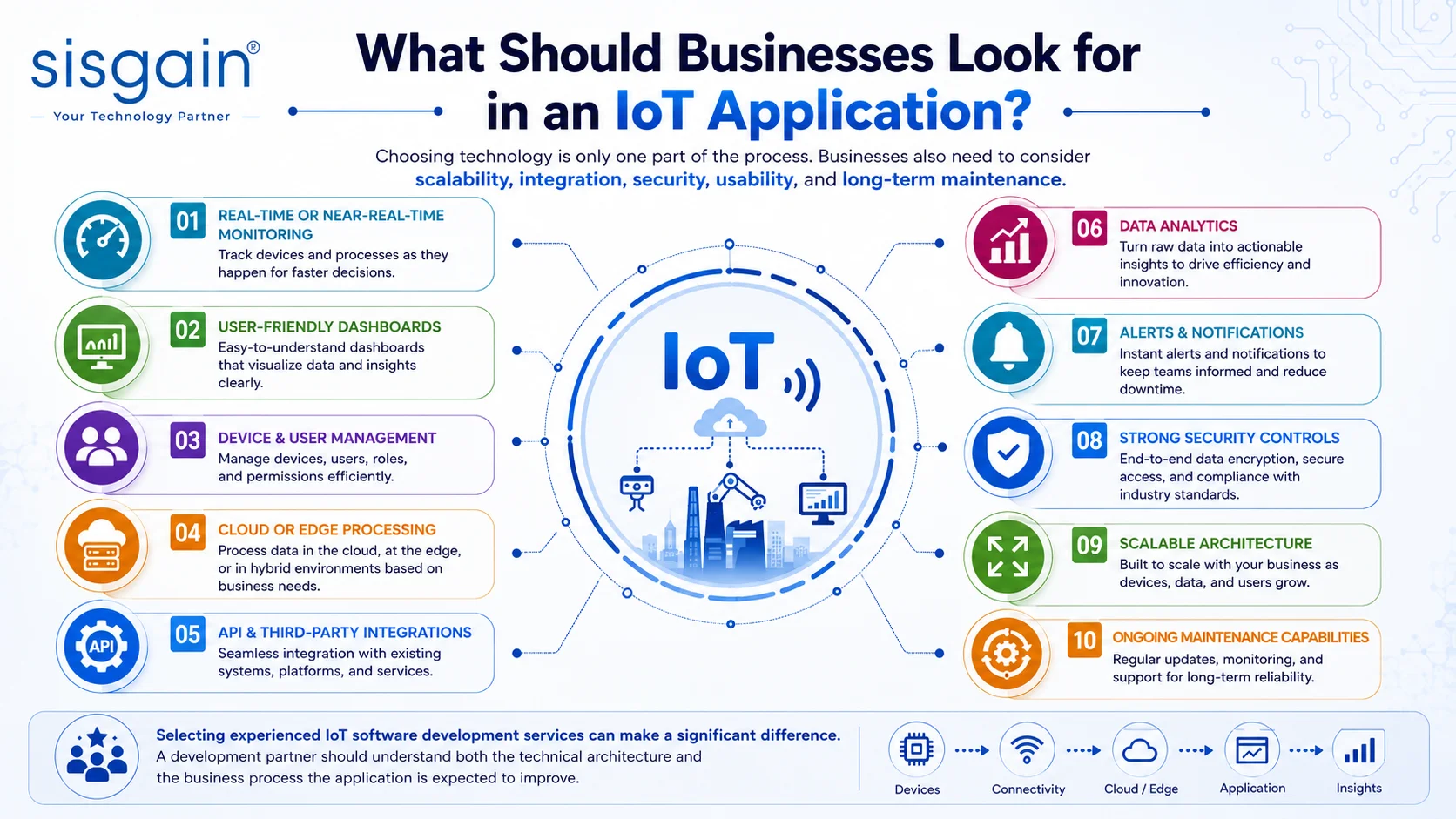
Choosing technology is only one part of the process. Businesses also need to consider scalability, integration, security, usability, and long-term maintenance.
A strong IoT solution should generally provide:
- Real-time or near-real-time monitoring
- User-friendly dashboards
- Device and user management
- Cloud or edge processing
- API and third-party integrations
- Data analytics
- Alerts and notifications
- Strong security controls
- Scalable architecture
- Ongoing maintenance capabilities
This is why selecting experienced IoT software development services can make a significant difference. A development partner should understand both the technical architecture and the business process the application is expected to improve.
How Can Companies Prepare for the Next Wave of IoT?
Businesses should avoid building an IoT system simply because competitors are doing it. The stronger approach is to identify a measurable problem first.
Start by asking:
- What business process needs improvement?
- Which physical assets generate useful data?
- What information needs to be collected?
- How quickly must the system respond?
- Who will use the application?
- What security requirements apply?
- Which existing systems need integration?
- How will success be measured?
These questions can prevent expensive technology decisions that look impressive but deliver limited business value.
Companies should also keep watching IoT app development trends 2026, particularly AI integration, edge processing, stronger security, digital twins, advanced connectivity, and interoperable platforms.
Where Do Other Software Technologies Fit Into the IoT Ecosystem?
IoT rarely operates as a standalone technology. Businesses may require mobile applications, cloud platforms, analytics systems, enterprise integrations, and specialized software to create a complete solution.
For organizations exploring broader digital transformation, an iot app development company can work alongside specialists in areas such as ar vr development services and blockchain development and consulting when those technologies support a specific business requirement.
The important point is integration. Technology should solve a business problem, not become a collection of disconnected features.
What Does the Future of IoT Application Development Look Like?
The direction is clear: IoT applications are becoming more intelligent, secure, automated, and connected.
The future of IoT application development will likely focus heavily on real-time intelligence, edge-to-cloud architecture, AI-driven decisions, digital twins, stronger cybersecurity, and seamless integration with enterprise systems.
At the same time, emerging IoT trends will continue to influence how companies design connected products and services. Businesses that build flexible architectures today will have a better foundation for adopting new technologies tomorrow.
For companies evaluating IoT development services, scalability should be treated as a long-term requirement rather than an optional feature.
Why Could SISGAIN Technology Be the Right Technology Partner?
SISGAIN Technology helps businesses transform technology requirements into practical digital solutions. Its software development capabilities cover IoT, mobile and web applications, cloud solutions, artificial intelligence, blockchain, and enterprise software. The company focuses on building solutions around business objectives, usability, scalability, and integration rather than adding technology for its own sake. For organizations planning connected products or digital transformation initiatives, SISGAIN Technology can provide development expertise across multiple technology layers while helping businesses create solutions designed for long-term growth.
Conclusion: Are These IoT Trends Worth Watching?
IoT is moving toward a more intelligent and interconnected future. Edge computing can improve response times, AI can turn data into actionable insights, 5G can strengthen connectivity, digital twins can improve visibility, and stronger security can help protect increasingly complex ecosystems.
For businesses, the opportunity is not simply to connect more devices. It is to use connected technology to make operations smarter, faster, safer, and more measurable.
The latest IoT app development trends show that successful IoT strategies will depend on thoughtful architecture, useful data, strong security, and seamless integration. Companies that approach IoT with clear business objectives can turn connected technology from an expensive experiment into a valuable long-term capability.