Sign up with Google
 Sign in with Zoho

If you've been dealing with a stuffed nose that never seems to clear, no matter how many decongestants or nasal sprays you try, nasal polyps might be the reason. They're one of those conditions people live with for years without knowing what's actually going on inside their nose. And once surgery gets mentioned, the questions pile up fast — is it painful, how long does recovery take, will the polyps come back, and honestly, what's this going to cost.
This guide walks through all of that in plain language, based on how ENT surgeons actually explain it to patients in the clinic, not how it reads in a medical textbook.
What Are Nasal Polyps, Really?
Nasal polyps are soft, painless growths that form on the lining of your nasal passages or sinuses. Think of them like little grape-shaped swellings caused by long-term inflammation. They're not cancerous, and they're not dangerous in the way a tumor would be — but they can seriously mess with your breathing, smell, and sleep if left alone.
They tend to show up in people who already deal with chronic sinusitis, allergies, asthma, or repeated sinus infections. Some people get one or two small polyps and barely notice them. Others develop clusters that block the entire nasal passage.
How Do You Know If You Actually Have Polyps?
A stuffy nose alone doesn't mean much — everyone gets that from a cold. But polyps usually come with a specific pattern of symptoms that stick around for months, not days:
- Persistent nasal blockage, often on both sides
- Reduced or completely lost sense of smell
- Post-nasal drip that won't quit
- A feeling of pressure across the forehead or cheeks
- Frequent headaches
- Snoring or disturbed sleep
- Repeated sinus infections that keep coming back
If this sounds familiar and it's been going on for a while, the next step is usually a nasal endoscopy — a quick, in-clinic exam where a thin scope lets the doctor actually see what's happening inside your nose. A CT scan of the sinuses often follows to map out exactly how far the polyps extend before any surgery is planned.
Do Polyps Always Need Surgery?
Not always, and this is where a lot of people get confused. Small polyps are often managed first with nasal steroid sprays, oral steroids, or newer biologic medications for people with severe allergic or asthmatic triggers. Surgery becomes the recommended path when:
- Medication stops working or the polyps keep regrowing
- Breathing through the nose becomes genuinely difficult
- Smell and taste are significantly affected
- Sinus infections keep recurring despite treatment
- The polyps are large enough to block airflow almost entirely
If you're at this stage, the procedure most commonly used is called Functional Endoscopic Sinus Surgery, or FESS for short.
What Happens During Nasal Polyp Removal Surgery
FESS sounds intimidating, but it's actually one of the more patient-friendly ENT procedures around today. Here's the general flow:
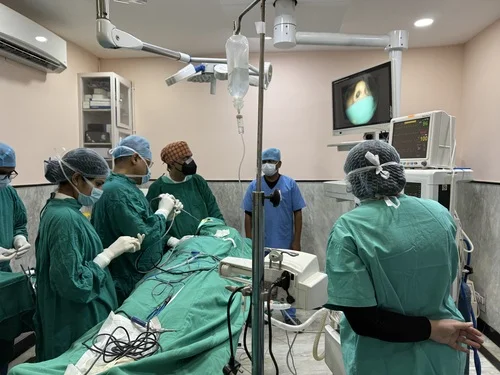
1. It's done through the nostrils. No external cuts, no visible scars. The surgeon uses a slim endoscope with a camera attached, so the entire surgery is guided by a live video view inside the nasal cavity.
2. Polyps are removed with precision instruments. Fine surgical tools, sometimes paired with a microdebrider (a small suction-and-shave device), gently clear out the polyps while preserving healthy tissue around them.
3. Blocked sinus openings get widened. This part matters more than people realize — it's not just about pulling out the polyps, it's about improving natural sinus drainage so they're less likely to return.
4. It's usually done under general anesthesia, and most patients go home the same day or after one night of observation.
The whole surgery typically takes anywhere from 45 minutes to about 2 hours, depending on how extensive the polyps are and whether both sides of the nose are involved.
Recovery: What the First Few Weeks Actually Look Like
Recovery from nasal polyp surgery is usually smoother than people expect, though the first week can feel uncomfortable.
- Days 1–3: Mild bleeding, nasal stuffiness, and some fatigue are normal. Saline rinses usually start within a day or two to keep the nasal passages clean.
- Week 1: Most people can return to light daily activity, though heavy lifting, bending forward, and strenuous exercise are off-limits.
- Weeks 2–3: Crusting inside the nose gradually clears, and breathing starts feeling noticeably better.
- 4–6 weeks: Follow-up visits are important here — the surgeon checks healing through the endoscope and clears out any residual crusting that could slow recovery.
Full recovery, meaning the nasal lining fully settles and smell returns to normal, can take up to 6–8 weeks. Long-term success also depends heavily on managing whatever caused the polyps in the first place — allergies, asthma, or chronic sinus inflammation — since polyps can regrow if that root cause isn't controlled with follow-up care.
Nasal Polyp Removal Surgery Cost: What Actually Affects the Price
This is usually the second question after "will it hurt," and it deserves an honest answer instead of a vague one.
Nasal polyp removal surgery cost in India typically ranges anywhere from ₹35,000 to ₹1,20,000, depending on several factors. There's no single fixed number because the price genuinely varies case to case. Here's what moves it up or down:
- Extent of the polyps — a single-side, limited procedure costs less than bilateral surgery involving multiple sinuses
- Type of anesthesia and hospital stay — day-care procedures cost less than those requiring overnight admission
- City and hospital infrastructure — metro cities with advanced endoscopic setups tend to have higher charges
- Surgeon's experience — more experienced ENT surgeons, especially those handling complex or revision cases, may charge differently
- Additional technology used — image-guided navigation systems or balloon sinuplasty add-ons can increase cost
- Pre and post-surgery care — CT scans, medications, and follow-up endoscopies are usually separate from the surgery fee itself
Many health insurance plans in India do cover FESS since it's classified as a medically necessary procedure rather than cosmetic, so it's worth checking your policy before assuming it's an out-of-pocket expense entirely.
The best way to get an accurate figure is a proper in-person or video consultation with endoscopy findings and a CT scan, since quoting a cost without seeing the actual extent of the polyps is really just a guess.
Will the Polyps Come Back After Surgery?
Fairly common question, and a fair one. Nasal polyps can recur, particularly in people with underlying conditions like asthma, aspirin sensitivity, or persistent allergic inflammation. That's not a failure of the surgery itself — it's the nature of the underlying disease. Staying consistent with prescribed nasal sprays, allergy management, and scheduled follow-ups significantly lowers the chances of regrowth.
Finding the Right ENT Surgeon for This Procedure
Because FESS involves working close to the eyes, brain, and major sinus structures, experience matters a lot here. It's worth choosing a surgeon who specializes in endoscopic sinus surgery specifically, not just general ENT care, and who can walk you through your CT scan findings clearly before recommending surgery.
Dr. (Major) Rajesh Bhardwaj, an ENT surgeon known for his endoscopic sinus surgery expertise, often points out to patients that the goal of this surgery isn't just removing what's visible — it's restoring proper sinus drainage so the problem doesn't just come right back in a few months. That distinction is usually what separates a temporary fix from a lasting one.
If you're weighing your options, a consultation at a clinic like Medfirst ENT Centre for a proper endoscopic evaluation is a reasonable first step before committing to surgery. It gives you clarity on whether medication could still work, or whether surgery is genuinely the next right move.
Frequently Asked Questions
Is nasal polyp removal surgery painful?
Most patients describe post-surgery discomfort as mild to moderate — more like nasal congestion and pressure than sharp pain. Pain medication is rarely needed beyond the first couple of days.
How long does the surgery take?
Typically between 45 minutes and 2 hours, depending on how many sinuses are involved.
Is it a day-care procedure or does it need hospital admission? Many cases are done as day-care surgery with discharge the same day, though some patients stay overnight for observation, especially with more extensive polyp removal.
How soon can I go back to work?
Most people return to desk-based work within 5–7 days. Physically demanding jobs usually need 2–3 weeks off.
Does insurance cover nasal polyp surgery?
In most cases, yes, since it's considered a medically necessary ENT procedure rather than elective or cosmetic. Coverage specifics depend on your individual policy.
What happens if polyps are left untreated?
Left untreated, they can cause permanent loss of smell, chronic sinus infections, sleep disruption, and in some cases, changes to facial structure over time due to prolonged blockage.
Can polyps be removed without surgery?
Small polyps sometimes shrink with steroid sprays or oral medication. Surgery becomes necessary when polyps are large, medication stops helping, or symptoms significantly affect daily life.