Sign up with Google
 Sign in with Zoho

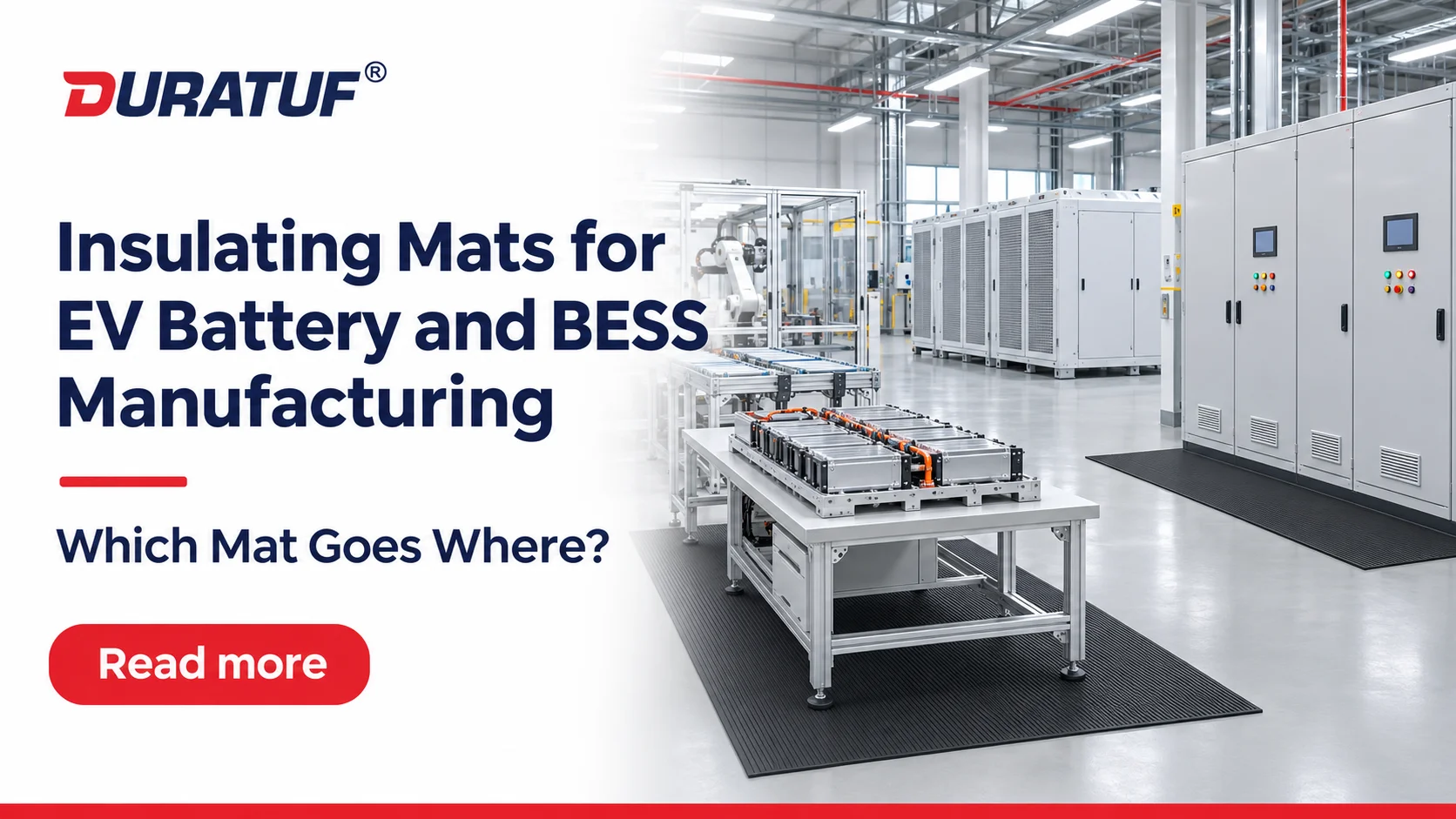
I compared the mat standards against battery plant voltages before writing this. In battery engineering, anything above 60 V DC counts as high voltage. Most EV packs run between 300 V and 800 V. "800 V" platforms peak at about 900 to 920 V when fully charged. ISO 6469-3 puts class B road-vehicle systems up to 1,500 V DC. The public copy of IS 15652:2006 lists 240 V DC for all its classes. A 920 V pack is 3.8 times that figure. An ESD floor needs to stay under 1×10⁹ ohms. An insulating mat is rated in a different range altogether. Buyers who treat these as one product category buy the wrong mat.
Which mat is appropriate around battery testing and production equipment?
The answer depends on the zone. This matrix is my own, built from the sources linked in this article. Your site's risk assessment decides the final choice.
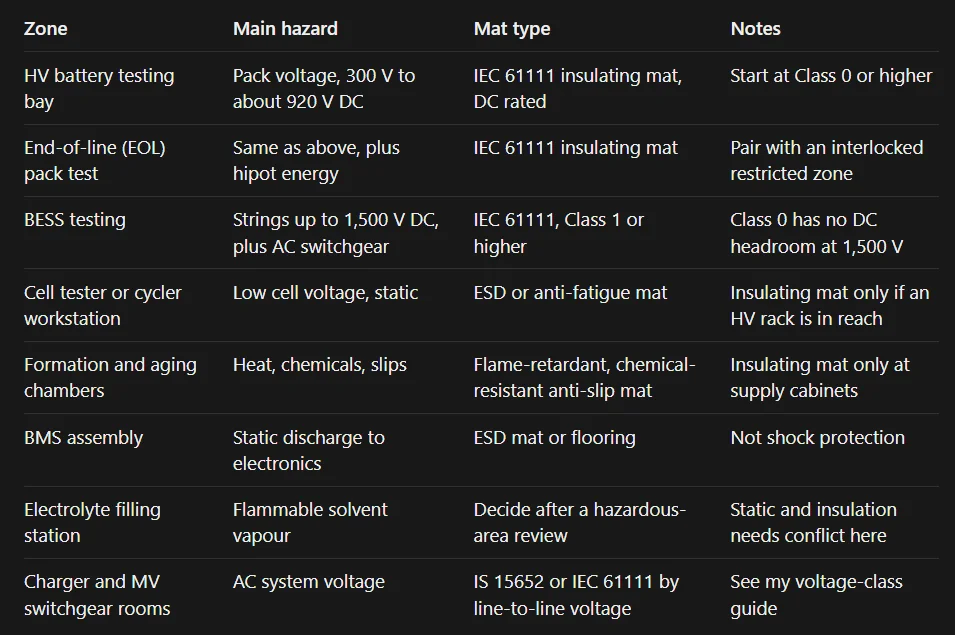
Quick summary: HV and EOL bays need a DC-rated insulating mat. BMS assembly needs an ESD mat. Filling stations need a review first.
Why can't an ESD mat protect against electric shock?
An ESD mat is built to drain charge, so it conducts on purpose. The standards describe it in resistance terms. ANSI/ESD S20.20 requires work surfaces in a protected area to be below 1×10⁹ ohms. A conductive floor and footwear system must stay below 3.5×10⁷ ohms under Method 1. Many ESD mats ground through a 1 MΩ resistor. An insulating mat does the opposite. A supplier TDS quoting IS 15652 values lists insulation resistance with water at 500 V of 1,000,000 MΩ, which is 1×10¹² ohms. That is at least 1,000 times the ESD ceiling.
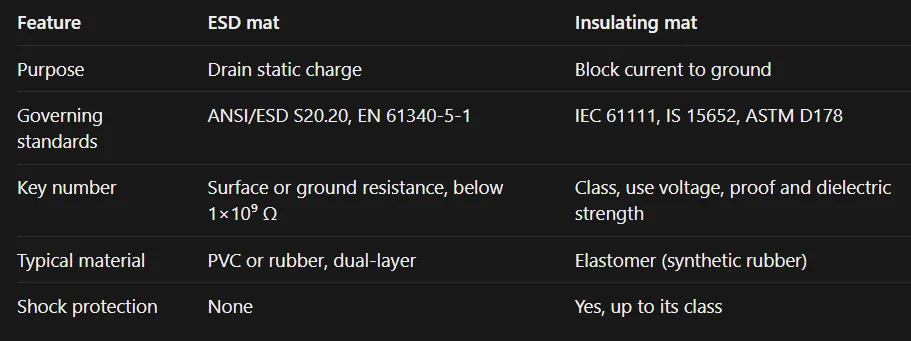
Material matters too. IS 15652 covers mats made of elastomer. One trader listing I reviewed sold a PVC "insulating mat" with no class stated. Ask for the class and the standard in writing.
Quick summary: ESD mats conduct by design. Insulating mats resist current by design. Never swap them.
Why should I check the DC rating first?
Battery systems run on DC, and mat standards rate AC first.
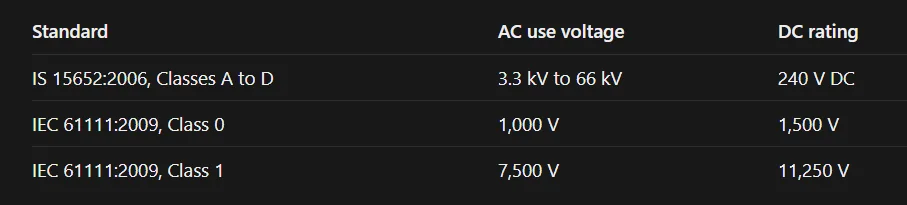
IEC values come from a supplier range table and the IS values from the public copy of IS 15652:2006. IEC published a new edition on 4 September 2026, so check these against the current text.
At a 920 V peak, Class 0 gives about 1.6 times headroom in DC. At 1,500 V DC it gives none. I would start at Class 1 for 1,500 V systems. That is my recommendation, not a rule from the standard. ASTM D178 Class 1 lists the same 7,500 V use voltage, according to one supplier's brochure.
Quick summary: IS 15652 gives no DC rating above 240 V. Use IEC 61111 DC values for pack voltages.
What about electrolyte, fire and chemical exposure?
Cell electrolytes use solvents such as ethylene carbonate, propylene carbonate, dimethyl carbonate, ethyl methyl carbonate and diethyl carbonate. OSHA notes that some of these are flammable liquids. Standard mat tests cover sulphuric acid and mineral oil, not these solvents. A supplier TDS I reviewed lists an 8-hour sulphuric acid test and a 2-hour oil test, with at least 75 percent retention of puncture resistance. So I ask for two things:
- A solvent immersion test on the mat compound, followed by a dielectric retest.
- A named flame test report. UL 94 V-0 is a plastics burn rating, and the flame test in the mat standards is a different method. I would not treat them as equal.
Filling stations raise a second issue. An insulating mat isolates the worker from ground, and that stops static charge from draining. Get the hazardous-area assessment before you place any insulating mat there.
Quick summary: Ask for solvent resistance data and a named flame test. Review static risk at filling stations.
How do I choose the class for a battery bay?
- Find the maximum DC voltage at the station, including peak charge voltage, not the nominal figure.
- Name the standard and edition in the RFQ, for example IEC 61111:2026.
- Pick a class whose DC use rating exceeds that peak with headroom.
- Ask for the proof test report for your lot and the type-test certificate.
- Request a solvent compatibility test and a flame test report.
- Check thickness against anti-fatigue needs, and ask for test reports on the exact construction supplied.
- Add the mat to your inspection register with a date.
Quick summary: Use peak DC voltage, name the edition, and ask for lot-wise reports.
What does an insulating mat not protect against?
A mat reduces the current path through the feet. It does not replace de-energising, insulated tools, lockout or a restricted access area. It is not arc-rated PPE, so arc flash needs arc-rated clothing and the controls from your site's arc-flash study. It does not protect from hand-to-hand contact across live parts. Treat it as one layer in the plan.
Quick summary: A mat is one layer. It does not stop arc flash or hand-to-hand contact.
Conclusion
Battery plants mix two hazards that need opposite floors. High-voltage test and EOL bays need a DC-rated IEC 61111 insulating mat. BMS assembly needs ESD control. Filling stations need a review before any choice. Check the DC rating first, because IS 15652 lists only 240 V DC.
At Duratuf I help buyers specify mats for domestic and export orders. Send me your zone list and the highest DC voltage per station. I will confirm the class and the test reports we can supply.
FAQs
What is the difference between an ESD mat and an insulating mat?
An ESD mat drains static charge. An insulating mat blocks current. Say a line has a BMS assembly bench and an EOL test cell. The bench gets an ESD mat. The test cell gets an IEC 61111 mat.
Can an anti-static mat protect me at an 800 V pack test station?
No. Anti-static mats conduct relative to rubber insulating mats and give no shock protection, according to one technical guide. Use a DC-rated insulating mat at that station.
Does IS 15652 cover DC battery systems?
Only up to 240 V DC in the public copy I read. Example: a 400 V pack is above that. Specify IEC 61111 and a DC rating for it.
Is UL 94 V-0 the same as the flame test in IEC 61111 or IS 15652?
No. They are different tests. Ask the supplier for the report of whichever flame test they claim.
Can one mat be both insulating and ESD-safe?
I would not buy one mat for both jobs. If both hazards exist in one area, I involve a qualified safety engineer, who may split it into separate zones.
What do I write in the RFQ for an EV plant?
Write the standard and year, such as IEC 61111:2026, the class, the DC rating, and the test reports you require. Add the solvent and flame test requirements.