Sign up with Google
 Sign in with Zoho

Introduction
Every year, in gatherings from Karbala to Karachi to small living rooms in Toronto, grown adults sit and weep over something that happened almost fourteen centuries ago. To an outsider, this can look strange — why mourn a death that far removed from the present? But for Shia Muslims, the tears shed for Imam Hussain (AS) aren't about a distant history lesson. They're about a wound that, in a very real sense, hasn't closed. Understanding why requires understanding what actually happened at Karbala, and why the AhlulBayt themselves treated the memory of that day as something worth preserving through grief.
What Happened at Karbala
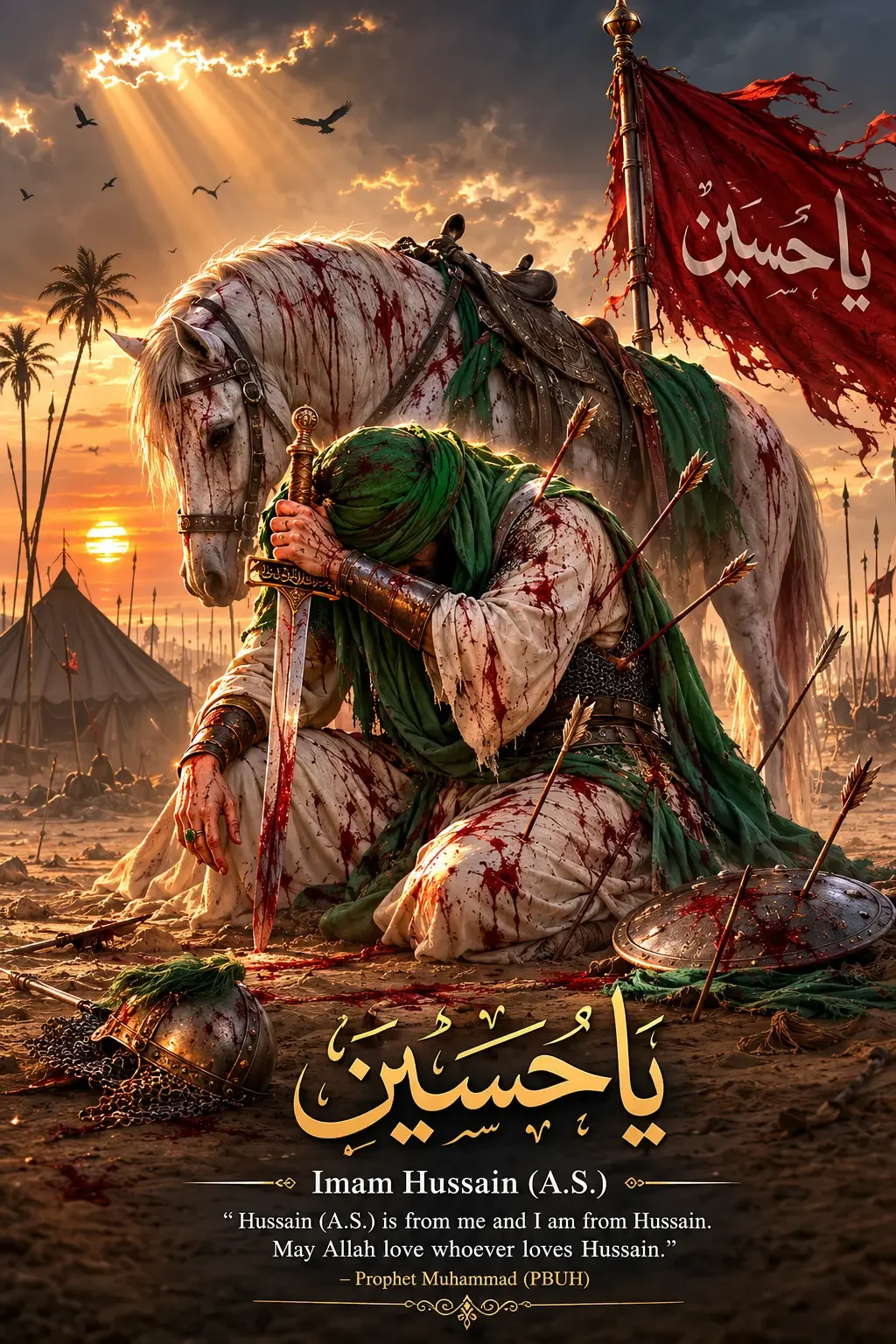
In 61 AH (680 CE), Imam Hussain, the grandson of the Prophet Muhammad (s) and son of Imam Ali (a) and Sayyida Fatima (a), refused to pledge allegiance to Yazid ibn Muawiyah, a ruler whose behavior openly violated the values of Islam. Hussain wasn't chasing power. By his own words, recorded in numerous early historical accounts, he said he sought only to reform the affairs of his grandfather's nation, to enjoin what is right and forbid what is wrong. That single refusal — a matter of conscience, not politics in the modern sense — put him on a collision course with an empire.
He set out from Mecca toward Kufa with his family and a small group of loyal companions, responding to letters inviting him to lead the people there. Along the way, at a desolate plain called Karbala, Yazid's forces surrounded them, cut off their access to the Euphrates River, and after days of thirst, on the tenth of Muharram — a day known as Ashura — massacred Hussain and nearly all the men in his camp, including his six-month-old son Ali Asghar. The women and children, including Hussain's sister Zainab (a), were taken captive and paraded through the streets of Kufa and Damascus.
What makes Karbala different from countless other tragedies in history is what it stood for: a small, principled stand against tyranny, made by someone who knew from the outset that it would likely cost him his life, and who chose to make that stand anyway rather than legitimize injustice with his silence.
The Roots of Mourning in Quran and Hadith
Grief over Hussain isn't a later invention tacked onto Islam — it traces back to the Prophet (s) himself. Several early Islamic sources report that the Prophet wept when Angel Jibrael informed him of his grandson's future martyrdom, years before it happened, and that he would sometimes hold the infant Hussain and cry, unable to shake the foreknowledge of what awaited him. Umm Salama, one of the Prophet's wives, is reported to have kept soil that Jibrael said would turn to blood on the day of Hussain's death — and to have witnessed it happen exactly as described.
The Quran itself doesn't name Karbala directly, but Shia scholars point to several verses that frame the reasoning behind this grief. The verse of Mawaddah — "Say: I do not ask you for this any reward except love for [my] relatives" (Surah Ash-Shura 42:23) — establishes that love for the Ahlul Bayt is not optional sentiment but a Quranic instruction. And the verse of Purification, "Allah only wishes to remove impurity from you, O people of the House, and to purify you with a thorough purification" (Surah Al-Ahzab 33:33), is widely understood by Shia exegetes to include Hussain among those whose sanctity makes his death a matter of cosmic weight, not an ordinary loss.
Imam Ja'far as-Sadiq (a), generations later, is reported to have said that whoever's eyes shed even a single tear for Hussain will be rewarded by Allah with Paradise — a hadith cited often enough in Shia devotional literature that weeping itself became something closer to worship than mere emotion. The Imams didn't discourage this grief; they actively cultivated it, holding gatherings of remembrance themselves and encouraging others to do the same.
Why the Grief Still Matters
It would be easy to reduce Ashura to a story about violence, but that misses what the Ahlul Bayt were actually trying to preserve. Zainab (a), Hussain's sister, survived Karbala and delivered fierce, unflinching speeches in the courts of Kufa and Damascus, refusing to let the massacre be quietly buried or spun into something else. Imam Zain al-Abideen (a), Hussain's son who survived the tragedy due to illness, spent the rest of his life reminding people of what had happened through prayer and remembrance. In other words, the grief wasn't incidental — it was the mechanism by which the truth of Karbala survived at all, passed down mourning gathering by mourning gathering, generation after generation, long before it was written into history books.
So when Shias cry today, they aren't only grieving a death. They're grieving injustice itself — the specific injustice of a good man killed for standing against a corrupt ruler, and by extension every injustice that has echoed since. The tears are a form of protest that refuses to let the memory soften into something safe and distant.
The Benefit of Weeping
There's something the mourning rituals of Muharram accomplish that a history lecture never could. Crying for Hussain forces an emotional reckoning with tyranny and sacrifice that pure information doesn't reach. It builds empathy — anyone who has genuinely wept for a stranger's suffering finds it a little harder to stay indifferent to suffering happening in front of them today. It keeps the values Hussain died for — honesty, courage, refusing to bow to corrupt power — alive as something felt, not just something known.
For children especially, growing up watching parents and elders cry at these gatherings communicates something no lecture can: that this story matters enough to still hurt. That kind of inherited emotional memory tends to outlast facts memorized from a textbook.
Conclusion
Shias cry for Imam Hussain (AS) because the Ahlul Bayt themselves treated his death as something too significant to be remembered coldly. The tears are rooted in the Prophet's own grief, encouraged explicitly by the Imams, and kept alive deliberately by Zainab's refusal to let the truth be silenced. Fourteen centuries later, the crying continues not out of habit, but because the injustice Hussain stood against is, in one form or another, still very much alive in the world — and so, it seems, is the grief.