Sign up with Google
 Sign in with Zoho

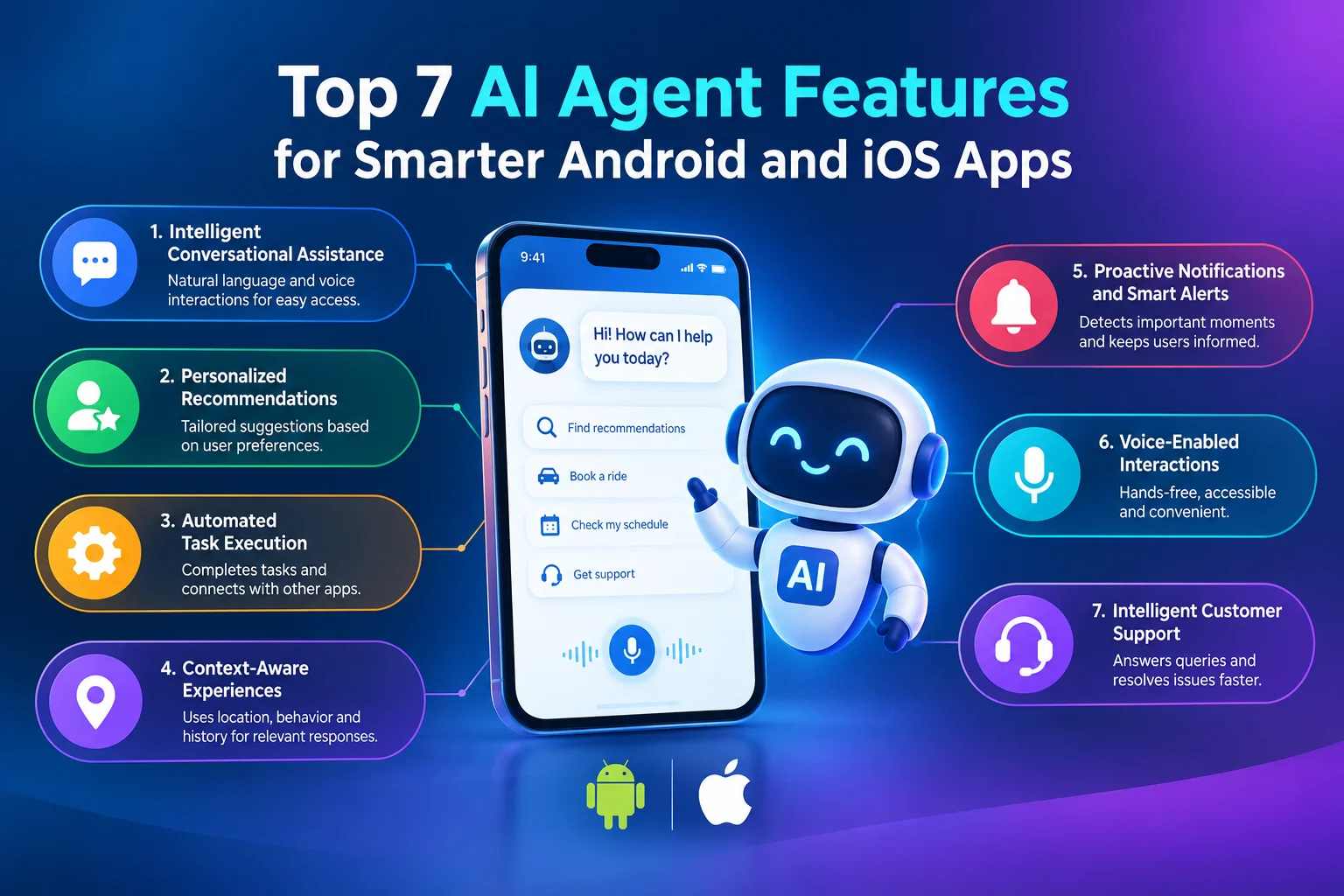
Mobile applications are becoming more intelligent as businesses integrate artificial intelligence into everyday digital experiences. From personalized recommendations to automated customer support, AI-powered features are changing how users interact with Android and iOS applications.
AI agents take these capabilities further by understanding user requests, accessing relevant information, and completing tasks through connected systems. Instead of simply displaying information, mobile apps can offer proactive assistance and automate routine activities.
Understanding the most valuable AI agent features can help businesses develop smarter, more engaging mobile applications.
What Are AI Agents in Mobile Applications?
AI agents are intelligent software systems that use artificial intelligence to understand instructions, process information, and perform specific actions.
In mobile applications, these agents can interact with APIs, databases, and external services to provide personalized assistance.
For example, an AI-powered travel app might help users compare destinations, organize itineraries, and retrieve booking information.
Unlike traditional chatbots, AI agents can coordinate multiple steps within authorized workflows, making mobile applications more interactive and useful.
Top 7 AI Agent Features for Smarter Mobile Applications
1. Intelligent Conversational Assistance
Conversational AI agents allow users to interact with mobile applications through natural-language messages or voice commands.
Instead of navigating multiple screens, users can describe what they need.
For example, a banking app might allow customers to ask about recent transactions or request spending summaries.
Key benefits:
- Faster access to information
- Improved user convenience
- Reduced navigation complexity
Developers should ensure that conversational assistants provide accurate information and protect sensitive user data.
2. Personalized Recommendations
AI agents can analyze authorized user preferences, previous interactions, and application activity to provide relevant recommendations.
An eCommerce application might suggest products based on shopping interests, while a learning app could recommend educational materials.
Personalization helps applications deliver experiences that reflect individual requirements.
Key benefits: Better content discovery, improved engagement, and more relevant user experiences.
3. Automated Task Execution
One of the most useful AI agent features is the ability to complete tasks through connected applications and services.
For example, a productivity app could create reminders, organize schedules, and update task lists based on user instructions.
AI agents can also coordinate multi-step workflows that would otherwise require several manual actions.
Organizations can Hire AI Agent Developers to build mobile applications with customized task automation and secure system integrations.
Key benefits: Reduced manual effort, improved productivity, and faster task completion.
4. Context-Aware User Experiences
Context awareness allows AI agents to consider relevant information before responding to user requests.
This may include conversation history, application activity, preferences, or location data when users provide permission.
For example, a travel app could suggest nearby attractions based on a user's selected destination and interests.
Context-aware features help applications deliver more relevant responses without requiring users to repeat information.
Key benefits: More useful recommendations, smoother interactions, and improved convenience.
5. Proactive Notifications and Smart Alerts
Traditional mobile notifications usually follow predefined rules.
AI agents can support more intelligent alerts by analyzing relevant information and identifying situations that may require attention.
For example, a finance app could detect unusual spending patterns and notify users about potential budget concerns.
Similarly, a delivery app might identify shipment delays and provide updated information.
Key benefits: Timely updates, improved awareness, and more responsive application experiences.
Developers should allow users to control notification preferences.
6. Voice-Enabled AI Interactions
Voice-enabled AI agents make mobile applications easier to use through spoken instructions.
Users can ask questions, request information, or initiate supported tasks without typing.
For example, a fitness application might allow users to record workouts or request exercise information through voice commands.
Voice interaction can also improve accessibility for users who find traditional navigation difficult.
Key benefits: Hands-free convenience, improved accessibility, and faster interactions.
Applications should clearly communicate when voice information is collected or processed.
7. Intelligent Customer Support and Troubleshooting
AI agents can help mobile applications provide faster customer support by answering common questions and guiding users through troubleshooting steps.
For example, an eCommerce app could use an AI agent to retrieve order details, explain return policies, and initiate support requests.
Complex issues can be transferred to human representatives when necessary.
Key benefits: Faster support, reduced repetitive inquiries, and improved service availability.
Challenges of Integrating AI Agents Into Mobile Apps
Although AI agents offer valuable capabilities, implementation involves several challenges.
Data privacy: Applications must protect sensitive user information and follow applicable regulations.
- Integration complexity: AI agents need secure connections with databases, APIs, and external platforms.
- Response accuracy: Incorrect outputs can affect user trust and application reliability.
- Performance costs: AI model usage and infrastructure requirements can increase operational expenses.
- Security: Developers must prevent unauthorized actions and protect connected systems.
Careful testing and continuous monitoring help address these challenges.
Best Practices for Building AI-Powered Mobile Apps
Businesses should begin with clearly defined user needs rather than adding AI features unnecessarily.
Development teams should select suitable models, establish secure permissions, and evaluate performance using realistic scenarios.
Human approval should be required for sensitive actions, particularly those involving financial transactions or personal information.
Regular updates and user feedback can help improve AI agent functionality over time.
Conclusion
AI agents are making mobile applications smarter through conversational assistance, personalized recommendations, automated tasks, contextual awareness, and intelligent support.
These features can improve convenience, engagement, and operational efficiency when implemented responsibly.
By combining thoughtful mobile app design with secure AI integration, businesses can create more responsive Android and iOS applications that meet evolving user expectations.