Sign up with Google
 Sign in with Zoho

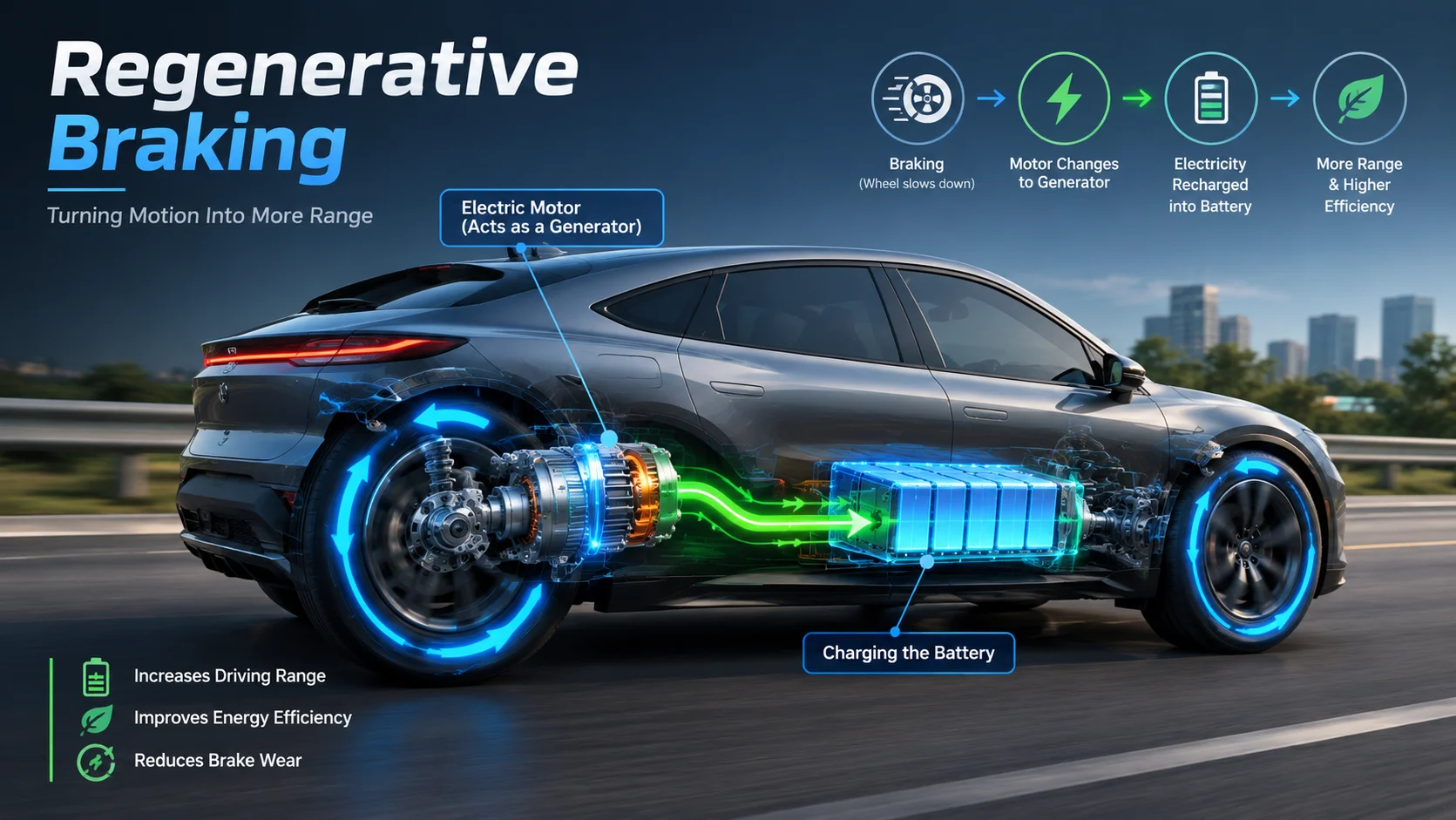
Press the brake pedal in an electric car, and something unexpected happens. The car slows down, but no brake dust flies off the rotors. Instead, energy flows backward into the battery. This process is called regenerative braking. It sounds futuristic, yet the concept is remarkably simple. Many new EV owners feel confused when they first experience it. The pedal feels different, and the car slows down earlier than expected. Understanding this technology removes that confusion quickly. It also helps you drive more efficiently and extend your range. This guide explains regenerative braking in plain language. You will learn how it works, why it matters, and how to use it well. Let's start with the basic mechanics.
Regenerative braking reverses how a motor normally works. Usually, a motor uses electricity to create motion. During regenerative braking, this process runs backward instead. The motor becomes a generator temporarily. As wheels slow down, they spin the motor rather than the motor spinning them. This spinning motion generates electricity, which flows back into the battery. Traditional brakes rely on friction, converting motion into heat instead. That heat simply disappears into the air, wasting energy completely. Regenerative braking captures energy that would otherwise vanish. This recovered energy extends driving range noticeably, especially in stop-and-go traffic. Understanding this basic principle explains why EVs feel different to drive. It also explains why city driving often delivers better efficiency than steady highway cruising.
Efficiency gains from regenerative braking matter most when comparing electric vehicles directly. Many shoppers researching the best value electric vehicle specifically check how aggressively each model's regenerative system recovers energy. Stronger regenerative braking often means better range in city driving conditions. Some vehicles allow drivers to adjust regeneration strength through dashboard settings. Others include one-pedal driving modes for maximum energy recovery. Compare these features across models during test drives. Notice how each system feels during deceleration, since strength varies significantly. A well-tuned system feels smooth and predictable rather than jarring. Ask dealers about adjustable regeneration levels for different driving preferences. This comparison helps you choose a vehicle matching your driving style while maximizing real-world value and range efficiency.
The Physics Behind Energy Recovery
Every moving vehicle carries kinetic energy, related to its speed and weight. Traditional braking destroys this energy, converting it entirely into heat. Regenerative braking instead captures a portion of that energy. The motor's magnetic resistance creates the slowing force, similar to pedaling backward on a bicycle generator light. This resistance converts kinetic energy into electrical energy efficiently. The recovered electricity then charges the battery for later use. This process cannot capture one hundred percent of the energy, though. Some loss occurs through heat and mechanical inefficiency regardless. Still, recovering even sixty to seventy percent significantly improves overall efficiency. Understanding this physics helps explain why EVs excel in city driving. Frequent stops and starts create more opportunities for energy recovery throughout typical urban commutes.
Why City Driving Benefits Most
City driving involves constant acceleration and deceleration patterns. Each stop provides an opportunity for regenerative braking to capture energy. This explains why many EVs show higher efficiency ratings in city conditions. Highway driving offers fewer braking opportunities, since speeds stay relatively constant. Consistent highway cruising relies more heavily on stored battery energy alone. Stop-and-go traffic, while frustrating for drivers, actually helps EV efficiency. Delivery vehicles and rideshare cars particularly benefit from this pattern. Urban commuters often see better real-world range than official highway estimates suggest. Understanding this pattern helps set realistic expectations based on your typical driving routes. If you drive mostly city streets, factor this efficiency advantage into your range calculations and daily planning accordingly.
One-Pedal Driving Explained
Many electric vehicles offer one-pedal driving as a specific mode. This feature increases regenerative braking strength significantly when you lift off the accelerator. The car slows down noticeably without touching the brake pedal at all. In many cases, the vehicle can come to a complete stop this way. Drivers quickly learn to modulate speed using only the accelerator pedal. This driving style maximizes energy recovery throughout every drive. It also reduces wear on traditional friction brakes significantly. However, this mode feels unusual for drivers used to conventional cars. Passengers might notice more pronounced deceleration during lift-off moments. Most manufacturers allow drivers to disable or adjust this feature. Trying it during your test drive helps determine whether this driving style suits your preferences.
Adjusting Regeneration Settings
Many EVs let drivers customize regenerative braking intensity through settings menus. Options typically range from low to high regeneration strength. Low settings feel more similar to traditional gas-powered vehicle coasting. High settings provide stronger deceleration, closer to one-pedal driving experiences. Some vehicles automatically adjust regeneration based on traffic conditions detected ahead. Others require manual selection through steering wheel paddles or touchscreen menus. Experiment with different settings during your ownership to find your preference. Some drivers prefer maximum regeneration for efficiency gains. Others prefer lighter regeneration for smoother, more familiar driving feel. Weather conditions can also influence ideal settings, since icy roads sometimes benefit from gentler deceleration. Understanding these options helps you customize your driving experience while balancing comfort and efficiency.
Maintenance Benefits of Regenerative Braking
Regenerative braking offers practical maintenance advantages beyond pure efficiency gains. Traditional friction brakes wear down through regular use over time. Since regenerative systems handle much of the slowing work, friction brakes experience less wear. Many EV owners report significantly longer brake pad lifespans compared to conventional vehicles. This reduces long-term maintenance costs and replacement frequency noticeably. Brake dust, which typically coats wheels over time, also decreases substantially. This creates cleaner wheels and reduced particulate emissions into the environment. However, friction brakes still remain necessary for emergency stops and low-speed situations. Regular brake inspections remain important, even with reduced wear patterns. Understanding this maintenance benefit adds another practical advantage when considering long-term ownership costs alongside fuel savings and environmental benefits.
Final Thoughts
Regenerative braking represents one of electric vehicles' most practical innovations. It captures energy that traditional braking simply wastes as heat. Understanding this technology helps you drive more efficiently and choose vehicles wisely. Test different regeneration settings and one-pedal driving during your test drives. Consider your typical driving patterns when evaluating potential range benefits. With this knowledge, you can maximize both efficiency and enjoyment from your electric vehicle.