Sign up with Google
 Sign in with Zoho

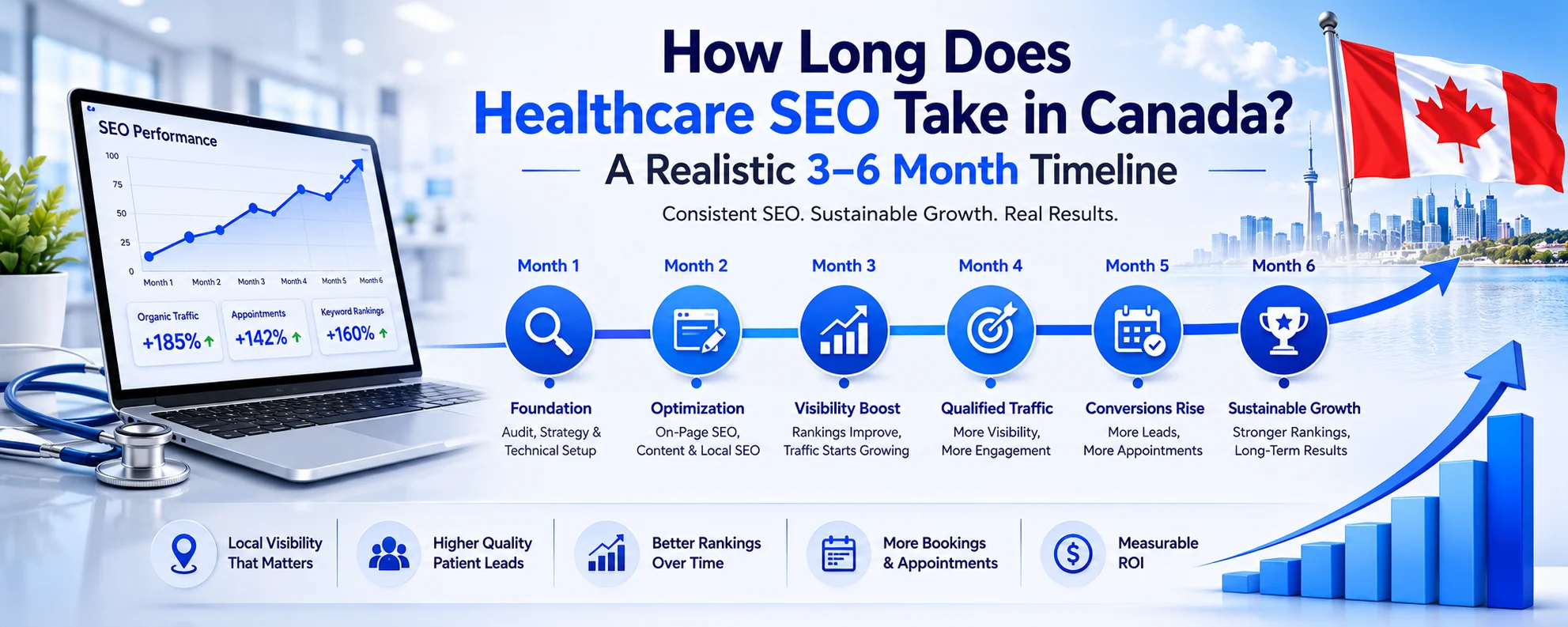
Healthcare SEO in Canada realistically takes three to six months for meaningful ranking and traffic movement, with technical and AI-visibility fixes showing early signals within weeks and full citation-driven authority compounding over the full window. Anyone promising page-one rankings in two weeks is either describing paid ads, not SEO, or setting a clinic up for disappointment. Here’s a realistic, month-by-month picture of what actually happens.
Why "How Long Does SEO Take" Doesn’t Have a One-Size Answer
A brand-new clinic website with zero citations and no reviews starts from a completely different position than an established multi-location practice with a decade of local presence but a technically broken site. Both timelines fall broadly within three to six months, but what happens inside that window looks very different.
Month-by-Month: What Actually Happens
Month 1: Audit & Foundation
The first month is diagnostic and structural: a full technical and AI visibility audit, Google Business Profile cleanup, citation and NAP consistency fixes, and schema implementation. Almost none of this is visible in rankings yet it’s the foundation everything else depends on.
Months 2–3: Technical & Content Build
This is where the bulk of the visible production work happens service and location pages rebuilt around real patient questions, FAQ schema added, and the content depth needed to meet Google’s E-E-A-T standard for medical content put in place.
Months 3–4: Early Movement
Most clinics start seeing their first meaningful signals in this window not top rankings yet, but movement worth noting.
What "Early Movement" Actually Looks Like
Impressions climbing in Google Search Console before clicks catch up, a handful of FAQ answers starting to surface in featured snippets, and Map Pack position improving for a subset of target searches these are the honest early indicators, not a flood of new patient calls yet.
Months 4–6: Compounding Authority
This is where citation volume, review velocity, and content depth start compounding together Map Pack rankings solidify, more competitive keywords start moving, and AI citations from ChatGPT and Gemini typically begin appearing as third-party trust signals accumulate.
Want a realistic, honest timeline specific to your practice’s current starting point?
Factors That Speed Up or Slow Down the Timeline
- Existing domain age and history an established site with prior content typically moves faster than a brand-new domain.
- Local competition density a solo clinic in a smaller city often ranks faster than a downtown Toronto practice competing against a dozen similar clinics.
- Review velocity clinics that consistently generate new reviews see both Map Pack and GEO signals build measurably faster.
- Technical site health at the start a slow, poorly built site adds weeks to the foundation phase before content work can be fully effective.
- Content publishing consistency sporadic content production stretches the timeline compared to a steady monthly cadence.
What About AEO and GEO Timelines?
AEO and GEO run on a slightly different clock than classic rankings. Schema and content restructuring can influence AI Overview visibility within weeks, since it’s largely a technical and structural fix. GEO, getting cited directly by ChatGPT and Gemini, depends more heavily on third-party review and directory authority, which is why it typically tracks closer to the three-to-six month window than the faster AEO wins.
Setting Realistic Expectations With Your Team
The clinics that get the most value from SEO are the ones whose internal team understands this timeline going in, front desk staff who know not to expect an overnight flood of new patients, and practice owners who evaluate month three progress against the right milestones rather than against a "should be ranking #1 by now" assumption borrowed from paid ads. This is exactly why a properly scoped marketing plan for a medical clinic sets expectations explicitly at kickoff, not after month two when patience is already running out.
“Paid ads buy attention this week. SEO builds the visibility that keeps working long after you stop paying for that specific piece of content.”
A Note on Comparing SEO Timelines to Paid Ads
It’s worth naming the comparison most clinics are implicitly making: paid ads can generate bookings within days, which sets an unfair expectation for SEO if the two aren’t explained as fundamentally different tools. Paid ads rent visibility for as long as spend continues; SEO builds an asset that keeps working after a specific piece of work is finished. Both have a place in a well-built growth plan, running paid ads during the SEO foundation-building months is a common, sensible way to keep new patients coming in while the slower organic work compounds in the background.
How Rankingeek Reports Progress Along the Way
Through SEO, AEO & GEO services in Canada, Rankingeek reports on leading indicators from month one, technical fixes shipped, schema validated, citations built, rather than only reporting rankings once they finally move. That’s paired with ongoing local SEO for healthcare work and healthcare web development company-grade technical foundations, plus steady medical reputation management services to keep review velocity compounding throughout the full timeline.
A Sample 6-Month Reporting Cadence
What a realistic, honest monthly report should actually surface at each stage of the timeline:
A report that only ever shows a single overall "traffic went up" chart, without any of these underlying leading indicators, makes it very hard to tell whether the work is actually on track or just riding pre-existing momentum.
What Happens After Month Six
The six-month mark isn’t a finish line, it’s roughly where the foundational work shifts into an ongoing compounding phase. Rankings that took six months to build the first time tend to be defended and extended much faster after that, since the citation base, content depth, and review velocity are already in place and simply need to be maintained and expanded rather than built from zero.
Frequently Asked Questions
Can healthcare SEO in Canada ever move faster than three months?
Occasionally, for low-competition niches or specific featured snippet opportunities, but meaningful, durable ranking movement across a full service line realistically takes the full three-to-six month window in most Canadian markets.
Why do I see impressions increase before I see more phone calls?
Impressions and rankings typically move before click-through and conversion rates catch up, since patients need to see a page consistently ranking before trust builds enough to click and eventually call.
Does a bigger monthly budget speed up the timeline?
To a point more budget can mean faster content production and citation building, but the timeline has a floor set by how quickly Google and third-party review platforms actually process and trust new signals, which spend alone can’t bypass entirely.
What should I ask my agency if I’m past six months with no movement?
Ask for the specific leading indicators tracked so far technical fixes, schema validation, citation and review growth and whether any of them show progress. No movement on any of these underlying signals after six months is a legitimate reason to ask harder questions.
Is the timeline different for AEO and GEO than for classic SEO?
AEO tends to show results faster since it’s largely structural. GEO tends to track closer to the full three-to-six month window since it depends on accumulating third-party trust signals like reviews and directory presence.
Get an honest, month-by-month projection specific to your practice’s starting point.


.webp)