Sign up with Google
 Sign in with Zoho

Quick Summary
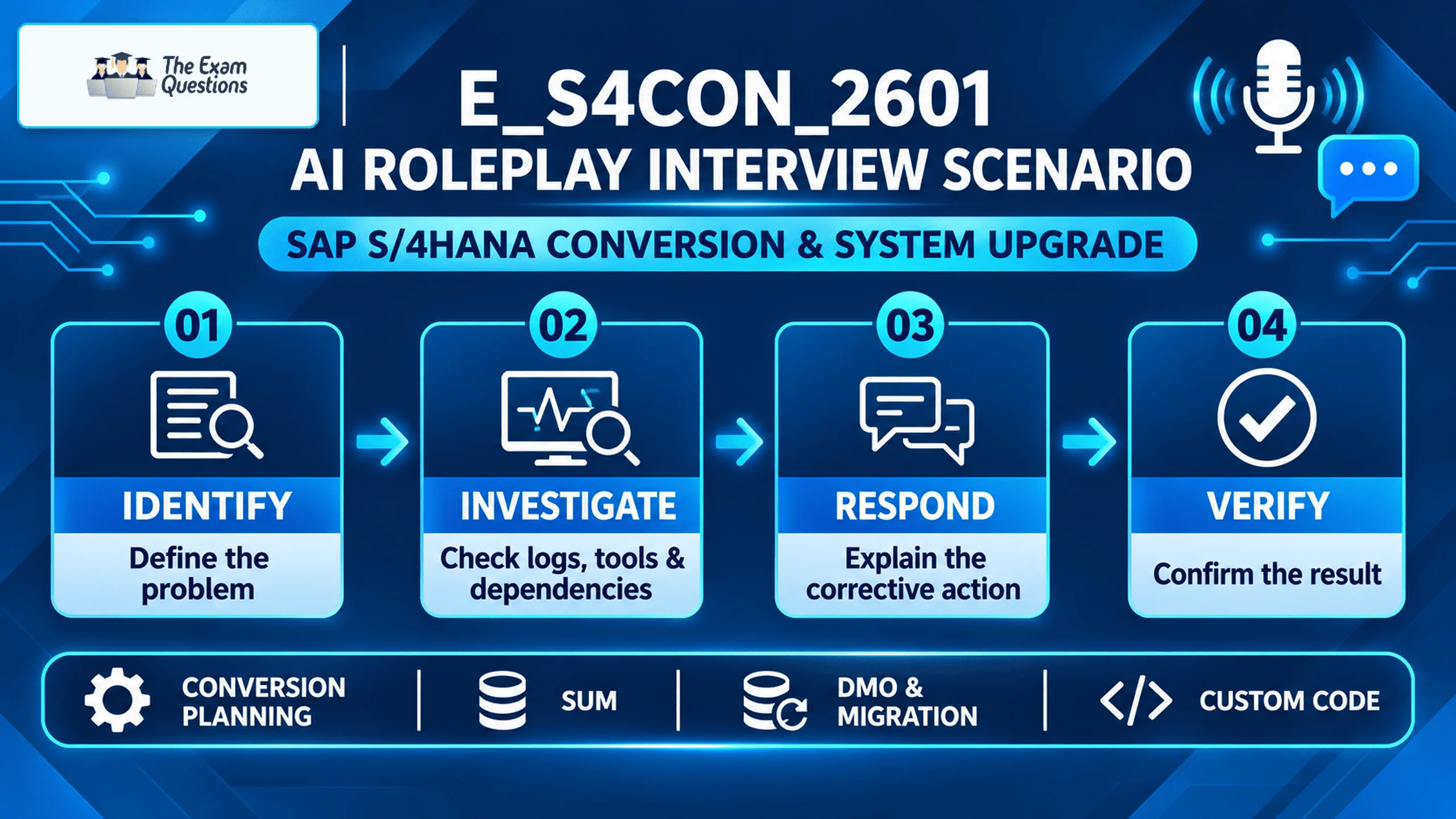
The E_S4CON_2601 AI Roleplay Interview Scenario asks candidates to explain SAP S/4HANA conversion and upgrade decisions in a spoken, practical format. Strong preparation combines technical knowledge with clear communication. This guide covers how the assessment works, key topics, original practice scenarios, and a four-step answer method.
Introduction
An AI-guided interview calls for a different study approach than a multiple-choice test. You apply your SAP knowledge to a project problem and explain your reasoning aloud.
The SAP S/4HANA Conversion and SAP System Upgrade certification covers conversion planning, software maintenance, database migration, system monitoring, and custom code analysis. Candidates searching for the E_S4CON_2601 AI Roleplay Interview Scenario usually want to know how the virtual interviewer works, which situations may come up, and how to structure answers. Sample answers help, and the technical reasoning behind each one delivers the real value.
What Is an AI Roleplay Interview Scenario?
An AI roleplay interview is a simulated professional conversation. A virtual interviewer describes a practical situation, and the candidate explains how to handle it.
For example, the interviewer might describe an issue during conversion preparation. You then explain which checks to run, what to investigate, and how to resolve the problem. Each response should be technically relevant, logically ordered, and tied to the situation described.
How SAP's AI-Guided Assessment Works
SAP lists E_S4CON as one scenario-based activity with a two-hour duration and a 60% passing score. Two routes are available: an AI-guided roleplay, and a recorded video reviewed by an SAP evaluator.
In the AI-guided route, the system evaluates the meaning of your answer and weighs it against expert-defined criteria. Each exam objective receives a rating from 1 (Insufficient) to 5 (Excellent). You sign in with your SAP Universal ID and enable microphone access, and you can review the score analysis before submitting.
Technical Areas to Prepare
SAP S/4HANA Conversion Planning
Planning starts with the existing environment: installed components, dependencies, and compatibility requirements. Key concepts are Maintenance Planner, the Simplification Item Check, system prerequisites, and custom code analysis. When a readiness check flags an incompatible component, investigate the finding and apply the correction before continuing. A strong answer explains the purpose of the check and how its results shape the plan.
Software Update Manager and SUM Troubleshooting
Software Update Manager (SUM) supports maintenance, upgrades, and conversion. Learn its preparation, execution, and follow-up phases, and practise reviewing logs, monitoring progress, and identifying failed phases. When describing a SUM problem, name where execution stopped, then cover the logs, likely causes, corrective actions, and checks before continuing.
Database Migration and DMO
The Database Migration Option (DMO) combines the software update with a database migration in supported scenarios. Know its role in a conversion project and how database requirements influence the plan. Useful discussion points include source and target requirements, migration preparation, downtime, and post-migration verification.
Custom Code and Post-Conversion Activities
Custom ABAP developments may need modification or replacement for the target environment. Code analysis identifies incompatible objects. After conversion, plan for SPDD and SPAU adjustments, monitoring, application checks, and technical validation. A strong answer covers investigation, the change, and testing of the affected function.
Original Practice Questions and Answers
These examples are original educational scenarios written for revision. They illustrate reasoning and stay separate from actual SAP examination content.
Scenario 1: Conversion Readiness
Interviewer: Your organisation plans to convert an existing SAP environment to SAP S/4HANA. How would you check whether the system is ready?
Suggested answer: I would examine the system landscape and review the installed software components. Then I would use the readiness checks and Maintenance Planner information to find compatibility issues and missing prerequisites. I would also review the Simplification List and custom code dependencies, and resolve important findings before the conversion starts.
Why it works: It links system checks to practical conversion decisions.
Scenario 2: SUM Execution Failure
Interviewer: Software Update Manager stops during an execution phase. What would you do?
Suggested answer: I would identify the phase where the interruption occurred and review the SUM logs and error details. Then I would check configuration, prerequisites, and system resources. After correcting the cause, I would follow the supported procedure to continue.
Why it works: Investigation comes first, and the fix follows the evidence.
Scenario 3: Database Migration
Interviewer: A project requires database migration as part of the conversion. Which approach would you consider?
Suggested answer: I would first check whether DMO suits the planned scenario. I would review source and target database requirements, migration dependencies, and downtime considerations, and prepare a verification plan for the database and the wider system after migration.
Why it works: Migration connects to planning and post-migration checks.
Scenario 4: Custom Code Compatibility
Interviewer: A custom ABAP development is flagged as incompatible with the target environment. How would you handle it?
Suggested answer: I would examine the object and identify the compatibility problem, then decide whether it needs modification or replacement. After the change, I would test it and confirm the function works in the target environment.
Why it works: Investigation, action, and validation appear in clear order.
For a visual walkthrough with more scenario practice, watch this video:
How to Give Clear Answers
A strong response stays focused and explains the reasoning behind each action. Use four steps:
- Identify: State the problem and its possible impact.
- Investigate: Name the logs, checks, tools, or dependencies you would examine.
- Respond: Describe the action and why it fits.
- Verify: Explain how you would confirm the issue is resolved.
For a readiness issue, go beyond naming Maintenance Planner: describe what you would examine and how the findings shape the conversion plan. Practise answering aloud in your own words, since this builds natural delivery and prepares you for follow-up questions.
Common Mistakes to Avoid
Listing tools works best when each one connects to the actual problem. Mentioning SUM or DMO adds value once you explain its role in the situation.
Tailor each answer to the specific scenario so it addresses the details the interviewer gave.
Investigate the cause first, then recommend the correction.
Close every answer with validation: checks and testing that confirm the expected result.
Frequently Asked Questions
What happens during an AI-guided SAP interview?
Candidates speak with a virtual interviewer, respond to professional situations, and receive evaluation against expert-defined criteria.
How does the AI evaluate answers?
SAP states that the AI considers the meaning and intent of each response, so clear reasoning carries more weight than keyword lists.
Is a recorded-video option available?
Yes. SAP offers a recorded-video route reviewed by an SAP evaluator, where available for the certification.
Which SAP topics deserve the most attention?
Focus on conversion planning, Maintenance Planner, SUM, DMO, system compatibility, custom code analysis, and post-conversion verification.
How can candidates improve interview performance?
Practise explaining problems in a logical order: identify the issue, describe the investigation, recommend an action, and explain the verification.
Conclusion
Success in an AI-guided SAP interview comes from understanding conversion activities, spotting problems, proposing sound solutions, and communicating your reasoning clearly. Original practice scenarios, solid command of SAP technical processes, and regular speaking practice build that skill. Concentrate on conversion planning, SUM, database migration, and custom code compatibility.