Sign up with Google
 Sign in with Zoho
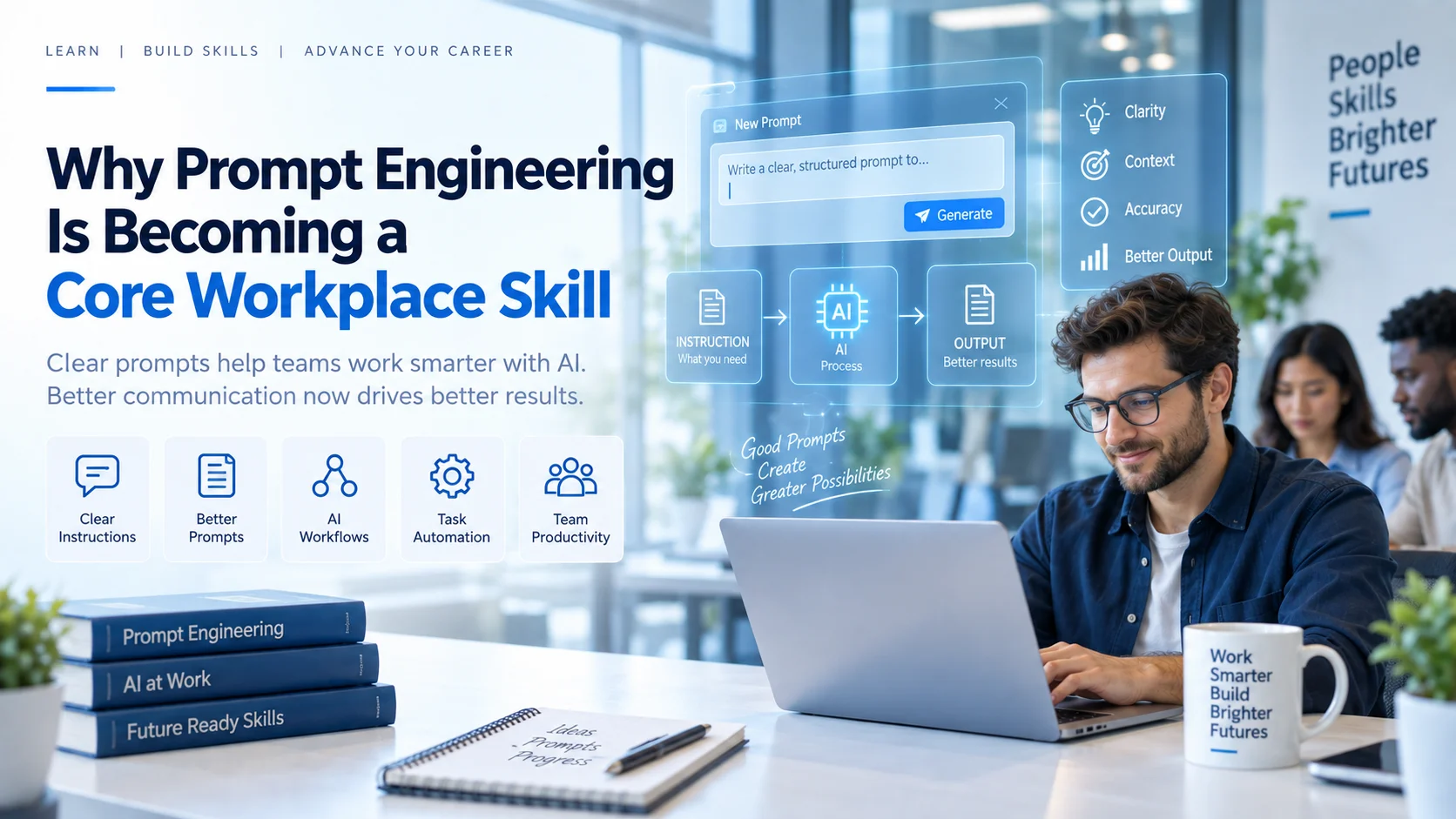
Artificial intelligence is becoming part of everyday work. Employees now use AI to summarize documents, organize research, analyze information, draft reports, create presentations, and handle repetitive tasks. As these tools become more common, another skill is becoming increasingly important: knowing how to communicate clearly with AI.
That skill is prompt engineering. The term may sound technical, but the basic idea is simple. Prompt engineering means giving an AI system clear instructions, useful context, and enough detail to produce a result that matches what you actually need.
What Prompt Engineering Means in the Workplace
A prompt is the instruction you give an AI system. It might be a short question, a detailed request, or a set of rules describing exactly how a task should be completed.
The difference between an average prompt and a useful one is usually clarity. Asking AI to “write a project update” leaves many details open. Asking it to “write a 200-word project update for department managers covering completed tasks, current risks, and next steps” creates a much clearer target.
Prompt engineering is increasingly sitting alongside other digital abilities covered through professional training courses, as employees are expected to work confidently with changing software and AI-powered tools.
Why Better Prompts Lead to Better Results
AI can produce an answer from only a few words, but that does not mean the answer will always be useful. When instructions are vague, the system has to make decisions about the audience, tone, level of detail, purpose, and format. Clear prompts reduce that guesswork.
Imagine asking an AI tool to “summarize this sales report.” The response could focus on revenue, customer behavior, regional differences, or almost anything else in the document. A more specific prompt could ask for five bullet points covering revenue changes, underperforming regions, and the biggest risks for the next quarter.
The goal is not to make every prompt longer. It is to give the system the information it needs to understand the task correctly.
Prompt Engineering Applies Across Different Roles
One reason prompting is becoming a core workplace skill is that AI is no longer limited to developers, data scientists, or technology departments.
Marketing professionals can use AI to organize campaign ideas or summarize customer feedback. Analysts can use it to structure reports and explain trends. Human resources teams may use it to prepare training materials or organize employee feedback. IT professionals can use prompts to document processes, explain technical concepts, or support troubleshooting.
Employees still need knowledge of their own field to judge the results. This is similar to the role that professional certification paths play in building subject knowledge: the technology can support the work, but understanding the subject remains important when evaluating what the technology produces.
What Makes a Good Workplace Prompt?
There is no single perfect formula for writing prompts, but strong prompts often include a few common elements. They explain the task, provide useful context, identify important limitations, and describe the desired output. If the audience matters, that should be included as well.
Consider the difference between these two requests:
“Give me ideas for employee training.”
“Create five training ideas for a customer support team learning a new CRM. Explain the skill each activity develops and keep every idea practical enough to complete within one hour.”
The second prompt gives the system a clearer understanding of the audience, situation, limits, and expected result.
Prompting Is an Iterative Process
Good prompt engineering does not mean writing one perfect instruction every time. Often, the first response reveals what needs to be improved. Perhaps the answer is too broad. Maybe the tone is wrong. Important context could be missing, or the response may need to be reorganized into a table instead of paragraphs.
Rather than starting again completely, users can refine the prompt. They might add an example, specify an audience, remove unnecessary details, or explain the expected format more clearly. This process of testing, reviewing, and adjusting is one of the most practical ways to develop stronger prompting skills.
Human Judgment Still Matters
Prompt engineering should not be confused with handing over an entire task to AI. AI systems can misunderstand instructions, overlook context, or provide information that needs verification. A response can sound confident and professional while still containing errors.
Employees therefore need to review the result rather than simply accepting it. They should ask whether the information is accurate, whether anything important is missing, whether the response suits the intended audience, and whether sensitive information has been handled appropriately. This becomes especially important when AI is being used across departments. Shared standards around prompting, data handling, and review can become part of broader group training when organizations introduce new technology across teams.
Why Practice Matters More Than Memorizing Prompts
There are plenty of prompt templates available online, but copying templates alone does not build strong prompting skills. The most useful practice comes from applying AI to real work. Someone might start by asking AI to summarize meeting notes, reorganize research, compare two options, explain a technical concept, or create the first outline for a report.
After seeing the result, the user can identify what worked and what did not. Over time, patterns become easier to recognize. You learn when more context is necessary, when examples improve the response, and when shorter instructions are actually more effective. Different AI systems may also respond differently to the same wording, so experimentation remains part of the process.
Prompt Engineering Will Evolve With AI
AI tools are becoming better at understanding natural language, maintaining context, working with documents, and completing multi-step tasks. As these systems improve, some of today’s more complicated prompting techniques may become less necessary. However, clear communication will still matter.
Employees will continue to define goals, provide business context, explain limitations, and decide whether an AI-generated result is useful. Those are communication and judgment skills rather than purely technical abilities.
AI-related subjects are also appearing more frequently alongside established technology topics in professional class schedules, reflecting how closely these tools are becoming connected with everyday digital work.
A New Form of Workplace Communication
Prompt engineering is becoming a core workplace skill because communicating with AI is becoming part of normal work.
The employees who use these systems effectively are not necessarily the people who know the most complicated prompts. They are often the people who can define a task clearly, provide the right context, recognize a weak response, and improve the instructions when necessary.
As AI becomes more deeply integrated into workplace tools, these habits will become useful across more roles. Prompt engineering is ultimately less about learning how to “talk to a machine” and more about learning how to communicate goals clearly, think critically about results, and use technology more effectively in daily work.







 (1).webp)