Sign up with Google
 Sign in with Zoho

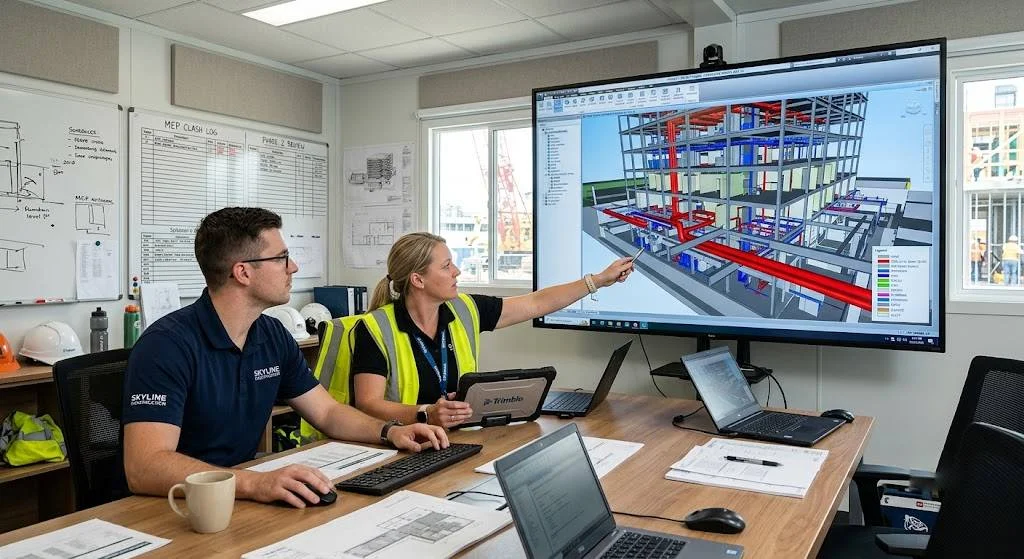
Multi-trade construction projects bring structural, architectural, mechanical, electrical, plumbing, and fire protection teams onto the same site, often working from separate design models. When these models are not aligned, field clashes, rework, and schedule delays follow. BIM Coordination Services solve this problem by merging trade models into one federated environment where conflicts are identified and resolved before construction begins.
For General Contractors, Construction Managers, and BIM Coordinators, this coordination process has become a standard part of preconstruction planning on commercial, healthcare, industrial, and institutional projects across the United States.
Understanding the Role of BIM Coordination Services
BIM Coordination Services involve combining Building Information Modeling data from every trade, architectural, structural, mechanical, electrical, and plumbing, into a single federated model. Coordinators use platforms such as Autodesk Navisworks and Autodesk BIM 360 to run clash detection, review spatial conflicts, and document resolutions before fabrication or installation starts.
According to Autodesk, BIM is a process supported by intelligent, model-based technology that helps project teams plan, design, and manage buildings more efficiently throughout their lifecycle. Coordination is the applied layer of this process, where models from different disciplines are tested against each other for physical and functional conflicts.
Why Multi-Trade Construction Projects Need Coordination
On a Multi-Trade Construction project, each subcontractor typically models their own scope independently. Ductwork, structural beams, sprinkler piping, and electrical conduit often occupy the same ceiling cavity or shaft space. Without a shared coordination process, these conflicts surface on site, where they are far more expensive to fix.
Common problems on uncoordinated projects include
- Field clashes between ductwork, piping, and structural elements
- Rework that delays trade sequencing
- Increased RFIs and change orders
- Inaccurate as-built documentation
Clash Detection and Coordination addresses these issues directly by running systematic checks across all trade models at defined project milestones, well before installation crews mobilize.

MEP Coordination and Its Role in Reducing Field Conflicts
Mechanical, electrical, and plumbing systems account for a large share of coordination conflicts on any commercial build. MEP Coordination focuses specifically on aligning ductwork, piping, conduit, and equipment routing within tight ceiling and shaft spaces.
Spatial Coordination Above the Ceiling
Ceiling cavities are shared by HVAC ducts, sprinkler mains, cable trays, and structural framing. A dedicated MEP Coordination process establishes routing priorities early, so each trade knows its allocated zone before shop drawings are finalized.
Sequencing and Installation Priority
Coordinators assign installation order based on system size and flexibility. Large ductwork typically routes first, followed by piping, then conduit and cable tray, since smaller systems can flex around fixed elements more easily.
Shop Drawing Accuracy
Once conflicts are resolved digitally, trade contractors generate shop drawings directly from the coordinated model. This reduces discrepancies between design intent and field installation.
BIM for General Contractors Across the Project Lifecycle
BIM for General Contractors extends beyond clash detection. During preconstruction, coordinated models support accurate quantity takeoffs and cost estimation. During construction, they guide prefabrication, sequencing, and site logistics. After completion, the coordinated model becomes the basis for as-built documentation and facility management data.
BIM services for General Contractors typically include model federation, clash detection reporting, coordination meeting support, and construction documentation, allowing GCs to manage subcontractor deliverables against a single source of truth rather than disconnected trade drawings.
Key Components of an Effective Coordination Workflow
Model Federation
All trade models are combined into one coordinate system using consistent origin points and units, so geometry aligns accurately across disciplines.
Clash Detection Rounds
Coordinators run scheduled clash tests, typically weekly or biweekly, grouped by priority such as hard clashes, clearance issues, and workflow conflicts.
Coordination Meetings
Trade representatives review flagged conflicts together and agree on resolutions, which are then updated in each trade's native model.
RFI and Change Order Reduction
Resolving conflicts digitally before installation lowers the volume of RFIs and change orders during construction, a benefit widely documented in industry research on Building Information Modeling adoption.
Measurable Benefits for Multi-Trade Projects
Projects using structured BIM coordination consistently report
- Fewer field conflicts and less rework
- Shorter installation timelines through prefabrication
- Lower RFI volume during construction
- More accurate as-built records for facility management
- Better subcontractor accountability through documented clash logs
These outcomes matter most on projects with dense MEP systems, tight floor-to-floor heights, or aggressive schedules, where uncoordinated trades have little room for error.
Choosing the Right BIM Coordination Partner
Not every coordination team offers the same level of detail. General Contractors should look for a provider with experience across the specific building type, familiarity with Autodesk Navisworks and Revit workflows, and a clear process for tracking clashes from identification through resolution. Clear communication between the coordination team, design consultants, and field supervisors is what ultimately determines whether the coordinated model translates into a smooth construction sequence.
Conclusion
BIM Coordination Services give Multi-Trade Construction projects a way to resolve conflicts before they reach the field. Combined with focused MEP Coordination and BIM support built around the needs of General Contractors, coordinated models reduce rework, protect schedules, and produce more reliable documentation from design through facility handover.