Sign up with Google
 Sign in with Zoho
Learning to code can feel overwhelming when you are surrounded by programming languages, frameworks, tools, and endless tutorials. For beginners, the biggest challenge is often not finding learning resources but knowing what to learn first, what to practise next, and when to move to advanced concepts.
This is where Python Programming offers a practical starting point. Its readable syntax and wide range of applications make it suitable for learners who are completely new to coding as well as professionals who want to expand their technical skills. Python is used across areas such as web development, automation, data analysis, artificial intelligence, machine learning, and more.
But becoming a developer requires more than learning syntax. You need a structured roadmap that takes you from understanding basic concepts to building useful applications.
Here is a practical path to follow.
1. Start With the Programming Fundamentals
Before thinking about advanced frameworks or complex projects, build a strong foundation.
Start by understanding:
- Variables and data types
- Operators
- Conditional statements
- Loops
- Functions
- Lists, tuples, dictionaries, and sets
- Basic input and output
- Error handling
- File operations
At this stage, your goal should not be to memorize every command. Instead, focus on understanding how programming logic works.
For example, rather than simply learning how a loop is written, practise using loops to solve small problems. This develops logical thinking and makes it easier to handle unfamiliar coding challenges later.
2. Turn Knowledge Into Practice
One of the easiest ways to lose motivation is to spend weeks watching tutorials without writing your own programs.
After learning each concept, create something small with it.
You could begin with projects such as:
- A basic calculator
- A number guessing game
- A simple quiz application
- A to-do list
- A personal expense tracker
- A file-organising script
These projects may look simple, but they teach an important lesson: coding is about solving problems, not just remembering syntax.
As your confidence grows, combine multiple concepts in the same project. This is where programming knowledge starts becoming an actual skill.
3. Learn to Write Clean and Reusable Code
Knowing how to make a program work is only the beginning. A developer also needs to understand how to make code easier to read, maintain, test, and improve.
Start paying attention to:
- Meaningful variable and function names
- Functions and reusable components
- Code organisation
- Comments where necessary
- Exception handling
- Debugging techniques
- Basic testing practices
You should also become comfortable reading code written by other developers. This can improve your understanding of different approaches to solving the same problem.
The goal is to move from “I can write Python code” to “I can write Python code that other people can understand and maintain.”
4. Choose a Direction
One reason beginners struggle with Python is that the language can lead to many different career paths.
Once you understand the fundamentals, start exploring areas that match your interests.
Web Development
If you enjoy building websites and applications, explore Python-based web development and backend technologies.
Data Analytics
If working with numbers, reports, and insights interests you, learn how Python can be used for data analysis and visualisation.
Artificial Intelligence and Machine Learning
For learners interested in intelligent systems, Python provides a strong foundation for exploring machine learning, deep learning, and AI applications.
Automation
Python can also be used to automate repetitive tasks, process files, work with data, and improve everyday workflows.
You do not need to master every field. Choose one direction and develop depth before jumping into another.
5. Add Essential Supporting Skills
A Python developer does not work with Python alone.
As you progress, learn supporting technologies that complement your chosen career path.
Depending on your goals, these may include:
- SQL and databases
- Git and version control
- APIs
- Data structures and algorithms
- Basic command-line usage
- Testing
- Development environments
- Cloud fundamentals
For example, someone interested in backend development may need Python, databases, APIs, and a web framework. Someone moving toward data science may need Python along with data manipulation, statistics, and machine learning concepts.
The right combination depends on the role you want to pursue.
6. Build Projects That Demonstrate Your Skills
A certificate can show that you completed training, but a project can demonstrate what you can actually build.
Instead of creating ten unrelated beginner projects, focus on developing a few meaningful ones.
A strong project should ideally:
- Solve a specific problem.
- Use multiple Python concepts.
- Have a clear structure.
- Include error handling.
- Be documented properly.
- Demonstrate the skills relevant to your target role.
For example, an aspiring data professional could create a data analysis project using a real dataset. A future backend developer could build an application with database connectivity and APIs.
Your portfolio should tell a story: this is what I learned, this is what I built, and this is how I solved the problem.
7. Practise Problem-Solving Regularly
Programming ability grows through repetition.
Set aside consistent time to solve coding problems instead of studying only when you feel motivated. Start with simple challenges and gradually increase the difficulty.
When you get stuck, avoid immediately copying a solution. First try to understand:
- What exactly is the problem?
- What information do I have?
- What output is expected?
- Can I divide the problem into smaller steps?
- Which Python concepts can help?
This habit develops computational thinking and prepares you for real development work and technical interviews.
8. Learn Through Structured, Practical Training
Self-learning can work, but many beginners struggle because they do not have a clear sequence or someone to guide them when they get stuck.
A structured Python Programming training program can provide a more organised learning path, especially for learners who prefer guided instruction and practical exercises.
For example, training that combines fundamentals with hands-on applications can help learners understand not only how Python works but also how those concepts can be applied to real-world problems. Novelty Skills Training in Dubai includes Python Programming among its technical training programs and focuses on hands-on applications, assessments, and career-oriented learning.
The important factor is not simply completing a course. Choose learning that gives you opportunities to practise, build projects, receive feedback, and apply what you learn.
9. Create a Developer Mindset
Becoming a developer is a continuous learning process.
Technologies change, tools evolve, and new approaches appear regularly. Instead of trying to learn everything at once, develop habits that help you keep improving.
Read documentation. Explore projects. Debug your own code. Ask questions. Review your previous work. Learn from mistakes.
Most importantly, do not expect to become an expert overnight.
Your first program may be only a few lines long. Your next project might contain hundreds of lines. Over time, those small improvements add up.
Your Roadmap From Beginner to Developer
The journey can be simplified into a clear progression:
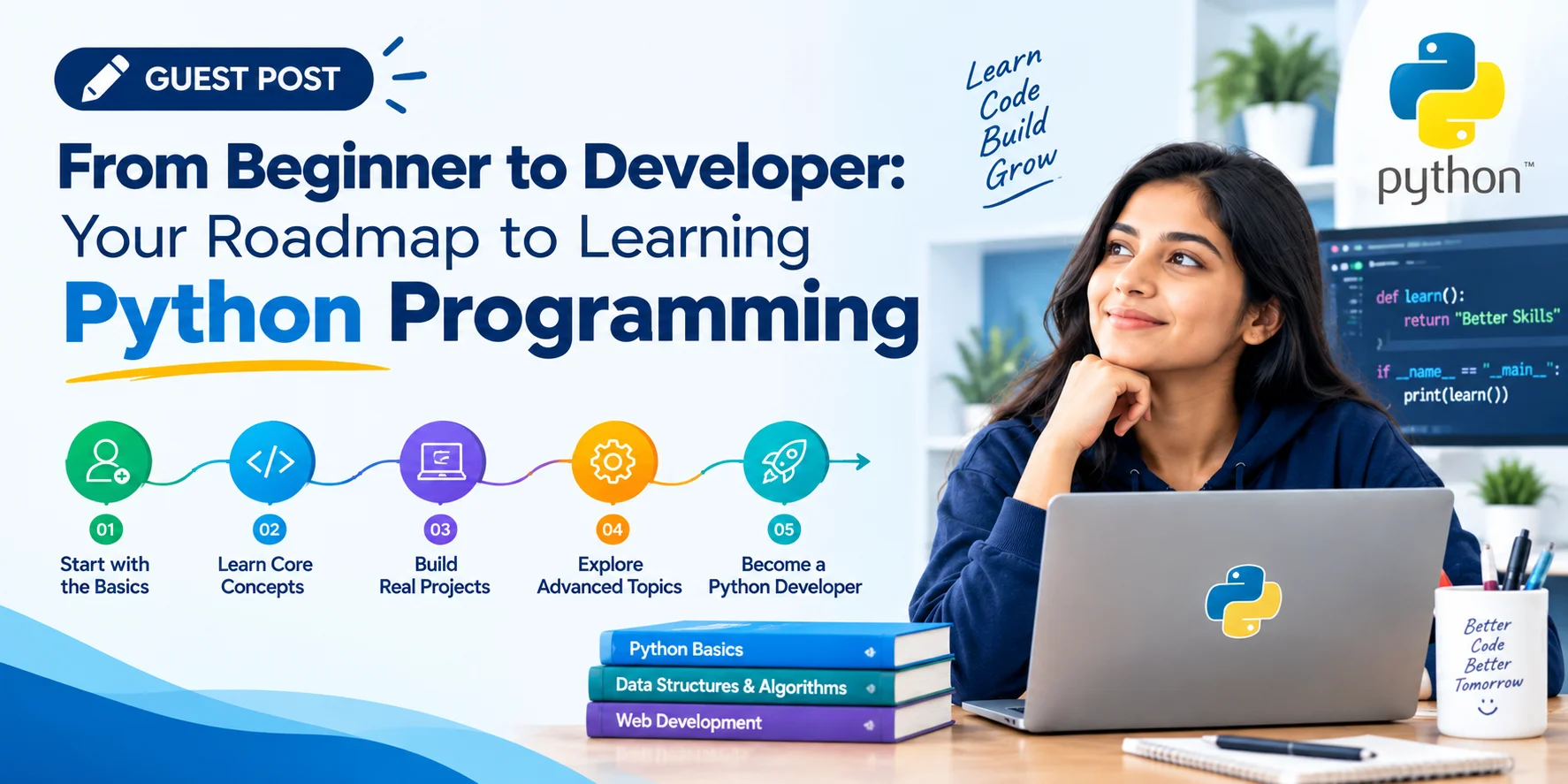
Learn the fundamentals → Practise consistently → Build small projects → Improve your coding habits → Choose a specialization → Learn supporting tools → Build real-world projects → Create a portfolio → Prepare for professional opportunities.
There is no shortcut that replaces practice. However, having a clear roadmap can prevent you from jumping randomly between tutorials and technologies.
Python can be the starting point, but your progress ultimately depends on what you do with it. Learn the concepts, apply them to real problems, build projects, and keep improving.
With consistency and the right learning approach, the journey from writing your first Python program to thinking and working like a developer becomes much more achievable.