Sign up with Google
 Sign in with Zoho

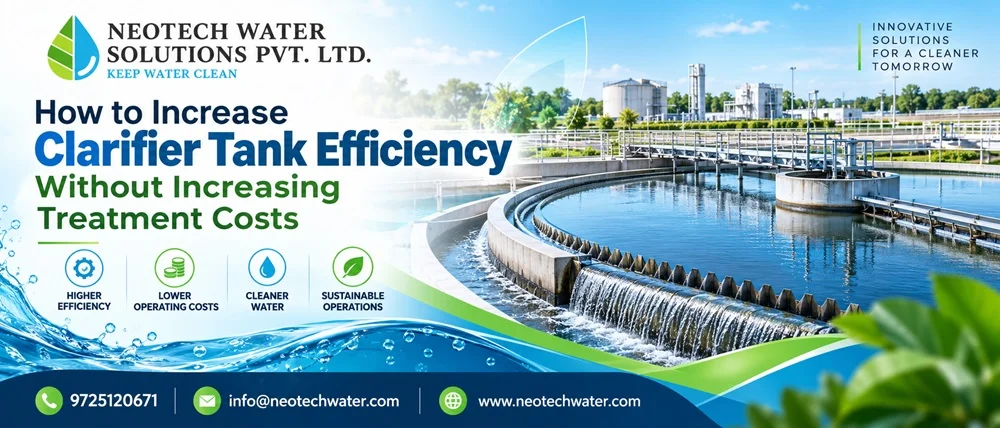
A Clarifier Tank is one of the most important components in water and wastewater treatment systems because it separates suspended solids from water through gravity settling. However, poor flow distribution, excessive sludge accumulation, incorrect chemical dosing, equipment wear, and inadequate monitoring can reduce clarifier efficiency and increase operational costs.
The good news is that improving clarifier performance does not always require expensive equipment replacement or major plant modifications. Many facilities can achieve better clarification by optimizing existing operating conditions, maintaining equipment correctly, improving sludge withdrawal, and monitoring key performance indicators.
For industries, municipal treatment facilities, sewage treatment plants, and effluent treatment plants across India, understanding how to improve clarifier efficiency can help maintain consistent treated-water quality while controlling operating expenses.
Neotech Water Solutions provides clarification and water treatment solutions designed to support efficient solid-liquid separation and dependable plant operation.
How Can You Improve Clarifier Tank Efficiency Without Increasing Costs?
You can improve Clarifier Tank efficiency by:
- Maintaining uniform inlet flow
- Controlling hydraulic loading
- Removing accumulated sludge regularly
- Optimizing coagulant and flocculant dosage
- Inspecting scraper mechanisms
- Preventing short-circuiting
- Monitoring sludge blanket depth
- Keeping overflow weirs clean and level
- Controlling solids loading
- Training operators to identify performance changes early
Most of these improvements involve better operation and maintenance rather than major capital investment.
What Is a Clarifier Tank?
A Clarifier Tank is a settling unit used in water and wastewater treatment processes to separate suspended solids from liquid.
Water enters the clarifier at a controlled rate. As velocity decreases inside the tank, heavier suspended particles settle toward the bottom due to gravity. The settled solids form sludge, which is collected and removed through a scraper or sludge withdrawal system.
Clarified water then flows over outlet weirs for additional treatment or discharge.
Clarifiers may be installed in:
- Water treatment plants
- Sewage treatment plants
- Effluent treatment plants
- Industrial wastewater systems
- Chemical processing facilities
- Food and beverage plants
- Textile industries
- Pharmaceutical facilities
- Power plants
- Municipal wastewater treatment facilities
A properly designed and maintained Clarifier In Water Treatment Plant operations can significantly improve downstream filtration and overall treatment reliability.
Why Does Clarifier Tank Efficiency Matter?
The performance of a clarifier influences several downstream processes.
When clarification is inefficient, suspended solids can escape with the clarified water. This condition is often called solids carryover.
Excessive solids can increase the load on filters, biological treatment units, membranes, disinfection systems, and other downstream equipment.
Efficient clarification can therefore help:
- Improve treated-water quality
- Reduce suspended solids
- Reduce downstream filtration load
- Improve chemical utilization
- Maintain stable plant operation
- Reduce unnecessary maintenance
- Minimize process interruptions
- Improve sludge handling
- Control energy and treatment expenses
For these reasons, plants should focus on operational optimization before considering expensive equipment upgrades.
1. Maintain Uniform Flow Into the Clarifier
One of the simplest ways to improve a Clarifier Tank is to maintain stable inlet flow.
Rapid changes in flow can disturb settled solids and reduce settling efficiency. When too much water enters the tank suddenly, the upward water velocity may increase enough to carry suspended particles toward the outlet.
Operators should therefore monitor flow patterns and avoid unnecessary hydraulic surges whenever possible.
Useful practices include:
- Maintaining consistent pumping rates
- Using equalization tanks where available
- Avoiding sudden pump starts and stops
- Checking inlet control valves
- Monitoring peak flow periods
Stable flow gives particles sufficient time to settle.
2. Improve Inlet Flow Distribution
Water should enter the clarifier evenly.
Poor inlet distribution can create turbulence or short-circuiting. Instead of moving gradually through the tank, water may travel rapidly from the inlet toward the outlet.
This reduces effective settling time.
Check the condition of:
- Feed wells
- Inlet pipes
- Baffles
- Energy-dissipation arrangements
- Distribution channels
Removing deposits or obstructions from these components may improve hydraulic conditions without requiring major modifications.
3. Control Hydraulic Loading
Every clarifier has a practical hydraulic capacity.
Operating significantly above this capacity can reduce settling performance even when other equipment is working properly.
Plant operators should compare incoming flow with the design capacity of the clarifier.
During unusually high flows, consider operational adjustments such as:
- Diverting flow between parallel clarifiers
- Using available equalization capacity
- Balancing pumps
- Adjusting process timing
A qualified Clarifier Manufacturer or treatment system specialist can also evaluate whether hydraulic conditions match the original clarifier design.
4. Monitor the Sludge Blanket
The settled solids at the bottom of the clarifier form a sludge blanket.
If the sludge blanket becomes too deep, solids can rise and escape with the clarified water.
Regular sludge blanket monitoring can help operators determine whether sludge withdrawal needs adjustment.
Signs of excessive sludge accumulation may include:
- Increased turbidity
- Floating solids
- Rising sludge
- Poor outlet clarity
- Uneven scraper loading
- Strong odour in biological applications
Routine monitoring is inexpensive but can prevent significant process problems.
5. Optimize Sludge Withdrawal Frequency
Sludge should not remain inside the clarifier longer than necessary.
However, withdrawing sludge too aggressively can also create operational instability.
The goal is to establish a withdrawal schedule based on actual plant conditions.
Important factors include:
- Incoming solids concentration
- Tank size
- Sludge characteristics
- Treatment process
- Daily flow
- Seasonal changes
- Chemical usage
Instead of relying only on a fixed schedule, operators should combine routine timing with sludge blanket observations.
6. Optimize Coagulant and Flocculant Dosing
Many water and wastewater systems use coagulation and flocculation before clarification.
These chemicals help small suspended particles combine into larger flocs that settle more easily.
However, excessive chemical addition does not automatically improve settling.
Overdosing can increase chemical costs and may create unnecessary sludge.
Underdosing may produce weak flocs that remain suspended.
Plants should optimize dosage using:
- Jar testing
- Turbidity observations
- Incoming water quality
- pH monitoring
- Historical performance
- Operator records
The objective should be the lowest practical chemical dose that consistently achieves the required treatment performance.
7. Check the Clarifier Scraper Mechanism
Most clarifiers use a rotating scraper mechanism to move settled sludge toward the collection hopper.
If the scraper is damaged, misaligned, overloaded, or moving incorrectly, sludge may accumulate unevenly.
Routine inspections should include:
- Scraper blades
- Drive unit
- Gearbox
- Torque indication
- Bearings
- Central shaft
- Supporting structure
Early maintenance usually costs less than repairing equipment after a mechanical failure.
A reputable Clarifier Manufacturer India can provide guidance on equipment inspection, replacement parts, or clarifier upgrades when required.
8. Keep Overflow Weirs Clean and Level
Overflow weirs play an important role in distributing clarified water leaving the tank.
If some sections are blocked or uneven, more water may pass through one part of the clarifier than another.
This creates uneven hydraulic loading.
Operators should regularly inspect and clean:
- Weir plates
- Launders
- Outlet channels
- V-notches
- Scum accumulation areas
Simple cleaning can restore uniform overflow distribution and improve clarification.
9. Prevent Short-Circuiting
Short-circuiting occurs when water travels through part of the clarifier much faster than intended.
Instead of using the full settling area, the flow follows a shorter path between the inlet and outlet.
Common causes include:
- Poor inlet design
- Damaged baffles
- Excessive flow
- Uneven weirs
- Accumulated sludge
- Obstructions inside the tank
Identifying hydraulic short-circuiting may help improve performance without increasing chemical consumption.
10. Reduce Turbulence Inside the Clarifier
Clarification depends heavily on calm hydraulic conditions.
Excessive turbulence can break flocs and prevent solids from settling.
Potential sources of turbulence include:
- High inlet velocity
- Incorrect pump operation
- Damaged feed wells
- Sudden flow changes
- Improper sludge withdrawal
- Mechanical disturbances
Operators should inspect the water surface for unusual movement and identify areas where excessive turbulence occurs.
Common Signs That a Clarifier Is Not Working Efficiently
Watch for the following warning signs:
Cloudy Clarified Water
This may indicate poor settling, inadequate chemical dosing, excessive flow, or hydraulic disturbance.
Floating Sludge
Floating sludge may be associated with gas formation, excessive sludge retention, or biological activity.
High Sludge Blanket
A rising sludge blanket can indicate inadequate withdrawal or excessive solids loading.
Uneven Overflow
Uneven flow over the outlet weirs may indicate blockage, poor leveling, or hydraulic imbalance.
Excessive Chemical Consumption
Increasing chemical dosage without improving water quality may indicate that the underlying issue is hydraulic or mechanical rather than chemical.
Frequent Scraper Problems
Repeated torque or mechanical issues can indicate excessive sludge accumulation or equipment wear.
Clarifier Tank Efficiency Checklist
For quick reference, plant operators should regularly check:
- Is inlet flow stable?
- Is the feed well clean?
- Is flow distributed evenly?
- Is the sludge blanket within an acceptable range?
- Is sludge being removed regularly?
- Are chemicals being dosed correctly?
- Are the overflow weirs clean?
- Is the scraper mechanism operating normally?
- Is there visible turbulence?
- Are solids escaping over the outlet?
- Are operating records being maintained?
- Has preventive maintenance been completed?
A simple checklist can improve consistency without significantly increasing operating expenses.
When Should You Contact a Clarifier Manufacturer?
Operational optimization can solve many problems, but some situations require professional evaluation.
Consider contacting a Clarifier Manufacturer when:
- Clarifier performance remains poor despite operational adjustments
- Existing equipment is undersized
- Scraper components require replacement
- Hydraulic distribution requires modification
- Corrosion has damaged structural components
- Plant capacity is being increased
- Treatment requirements have changed
- A new clarification system is required
Working with an experienced Clarifier Manufacturer India can help determine whether adjustment, repair, retrofitting, or equipment replacement is the most economical solution.
Clarifier In Water Treatment Plant: Why Correct Design Matters
The efficiency of a Clarifier In Water Treatment Plant depends on both design and operation.
Important design considerations can include:
- Tank diameter
- Water depth
- Surface loading rate
- Solids loading
- Feed arrangement
- Outlet weir configuration
- Sludge collection system
- Scraper speed
- Hydraulic retention
- Construction material
An incorrectly sized or poorly configured clarifier may remain difficult to optimize regardless of operator effort.
For new plants or capacity expansion, correct design is therefore important from the beginning.
How Neotech Water Solutions Can Help
Neotech Water Solutions supports water and wastewater treatment requirements with clarification equipment and treatment solutions for industrial and infrastructure applications.
Businesses looking for a reliable Clarifier Manufacturer in India should consider more than equipment price alone.
The right solution should consider:
- Required treatment capacity
- Wastewater characteristics
- Suspended solids concentration
- Available installation space
- Sludge handling requirements
- Operating conditions
- Maintenance accessibility
- Long-term plant requirements
A properly selected clarifier can provide stable operation while helping control maintenance and treatment costs.
Frequently Asked Questions
1. What is a Clarifier Tank?
A Clarifier Tank is a settling unit used in water and wastewater treatment to separate suspended solids from water. Solids settle at the bottom while clarified water flows from the upper section of the tank.
2. How can I improve clarifier efficiency without spending more money?
Start by optimizing flow distribution, sludge withdrawal, chemical dosage, sludge blanket monitoring, scraper maintenance, and overflow weir cleaning. These operational improvements may significantly improve performance without major equipment investment.
3. What causes poor clarification?
Poor clarification can result from excessive hydraulic loading, high solids concentration, inadequate chemical dosing, sludge accumulation, hydraulic short-circuiting, turbulence, damaged equipment, or uneven overflow distribution.
4. How often should sludge be removed from a clarifier?
There is no universal withdrawal frequency. The schedule should depend on sludge blanket depth, incoming solids, tank design, flow, and process conditions. Regular monitoring helps determine the appropriate frequency.
5. What is the role of a clarifier in a water treatment plant?
A Clarifier In Water Treatment Plant applications removes suspended particles after coagulation and flocculation or other treatment stages. This reduces solids before filtration or subsequent treatment.
6. How do I know whether my clarifier is overloaded?
Common indicators include cloudy outlet water, solids carryover, a rising sludge blanket, uneven overflow, increasing turbidity, and declining performance during high-flow periods.
7. Can excessive chemical dosing reduce clarifier performance?
Yes. Excessive coagulant or flocculant may increase operating costs and sludge generation without improving settling. Chemical dosage should be optimized according to water quality and treatment conditions.
8. What should I look for when choosing a Clarifier Manufacturer?
Evaluate engineering capability, equipment quality, customization options, treatment experience, after-sales support, maintenance requirements, material selection, and the manufacturer's understanding of your wastewater characteristics.
9. Who is a Clarifier Manufacturer in India?
Several engineering companies manufacture clarification systems in India. Neotech Water Solutions provides water and wastewater treatment solutions and can support customers looking for clarification equipment based on their project requirements.
10. Can an existing clarifier be upgraded?
Yes. Depending on its condition, an existing clarifier may be improved through scraper replacement, hydraulic modifications, feed-well improvements, outlet adjustments, mechanical repairs, or process optimization.
Final Thoughts
Increasing Clarifier Tank efficiency does not necessarily mean increasing treatment costs.
In many treatment plants, the biggest improvements can come from better flow management, regular sludge removal, optimized chemical dosage, clean overflow weirs, proper scraper maintenance, preventive inspections, and consistent operator monitoring.
Before investing in expensive equipment modifications, plant managers should first evaluate whether the existing clarifier is being operated close to its intended conditions.
When operational improvement is not enough, working with an experienced Clarifier Manufacturer can help identify whether repair, modification, capacity enhancement, or replacement is required.
For industries seeking clarification and water treatment solutions in India, Neotech Water Solutions can support the selection of suitable equipment based on plant capacity, wastewater characteristics, and treatment objectives.