Sign up with Google
 Sign in with Zoho
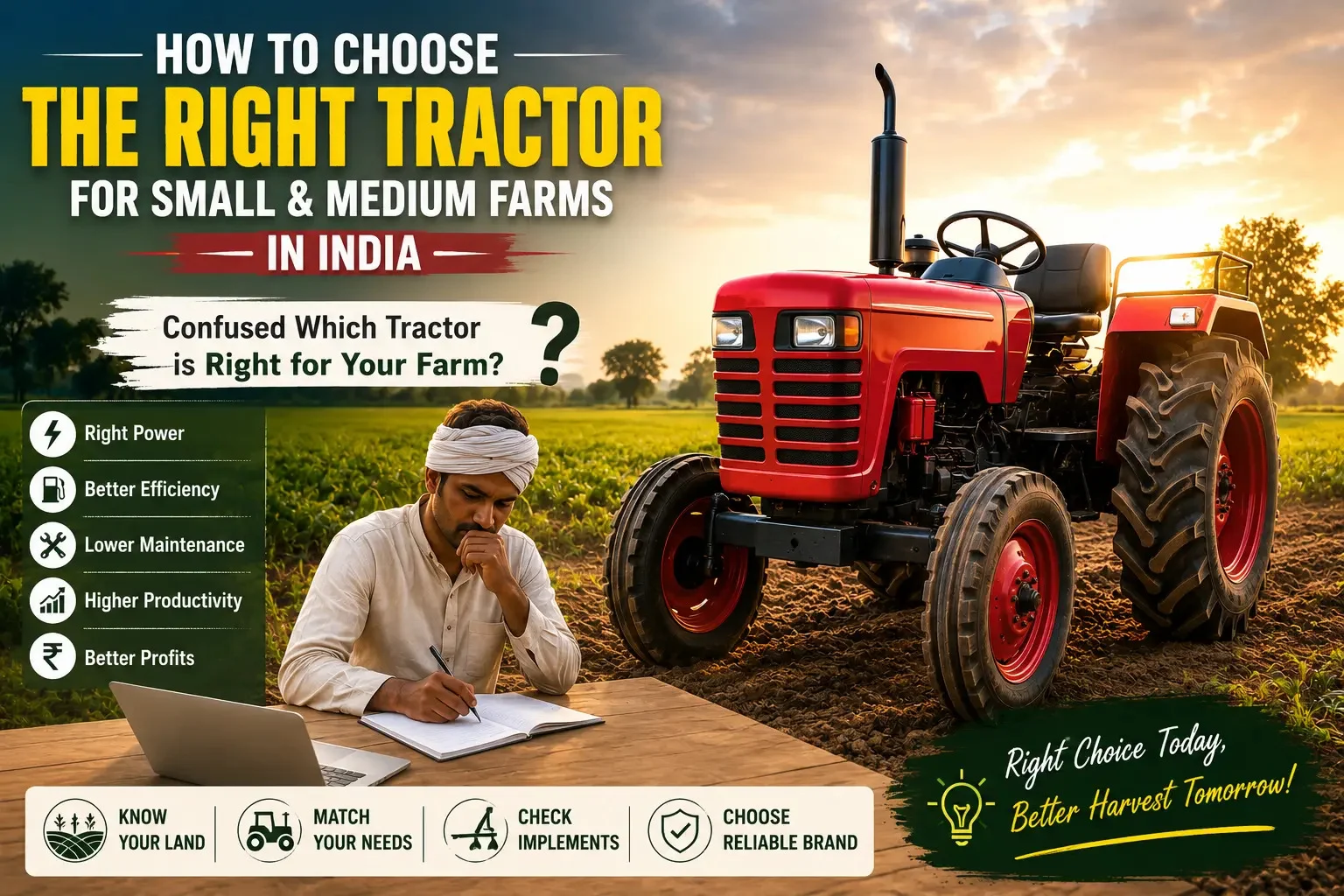
Buying a tractor is one of the biggest decisions a farmer makes. It isn't just a machine — it becomes the backbone of daily farm operations for the next 10 to 15 years. Yet many first-time buyers, and even experienced farmers replacing an old unit, end up choosing a tractor based on horsepower numbers or the lowest quoted price alone.
That approach often backfires. A tractor that's too powerful for your landholding adds unnecessary fuel and maintenance costs. One that's underpowered struggles with your implements and slows down every operation. The right choice depends on a combination of factors — farm size, soil type, crops grown, implements used, and long-term running costs. This guide walks through each of these factors so you can make a decision that actually fits your farm, not just your budget on paper.
1. Understand Your Farm Size
Farm size is the starting point for every other decision.
- Small farms (under 5 acres): These operations usually don't need very high horsepower. A compact, fuel-efficient tractor for small farms is often enough to handle tilling, sowing, and light haulage without overspending on capacity you'll rarely use.
- Medium-sized farms (5–15 acres): Farmers in this bracket often run a mix of implements — rotavators, seed drills, sometimes a trolley for local transport. A slightly higher HP range gives room to handle this variety.
- Larger farms (15 acres and above): Here, higher horsepower and stronger hydraulics start to matter more, especially if multiple implements are used across different crop cycles.
Buying a tractor with far more power than your land requires isn't just a bigger upfront cost. It also means higher fuel burn, costlier servicing, and a machine that's harder to manoeuvre in smaller or oddly shaped fields.
2. Choose Horsepower According to Farm Work
Horsepower is the most talked-about spec, but it should be matched to actual field work, not chosen in isolation.
- 20–30 HP: Suited to small landholdings, orchards, and light-duty tasks like inter-cultivation or operating small implements.
- 30–40 HP: A popular middle ground for many Indian farms — capable of handling rotavators, seed drills, and moderate trolley loads while still staying fuel-efficient.
- 40–50 HP: Useful where soil is heavier, fields are larger, or implements like bigger cultivators and threshers are in regular use.
- 50+ HP: Typically needed for large landholdings, sugarcane operations, or farms that rely heavily on haulage and multiple heavy-duty implements.
These ranges are only a starting reference. Two farmers with the same acreage can need different horsepower simply because of soil texture, implement choice, or cropping pattern.
3. Consider the Type of Farming
The crops you grow shape your tractor requirements as much as your land size does.
- Wheat and paddy: Generally need reliable mid-range HP tractors for puddling, tilling, and harvesting-related transport.
- Sugarcane: Often demands higher horsepower and stronger hydraulics due to intensive tillage and haulage needs.
- Vegetables: Usually favour compact, manoeuvrable tractors that can work efficiently in smaller plots and raised beds.
- Pulses and oilseeds: Typically need moderate power with good PTO performance for sowing and threshing implements.
- Horticulture: Orchard-friendly, narrower tractors are often preferred here over standard field tractors.
- Transport and trolley work: If your tractor will double as transport for produce or inputs, factor in load-carrying capacity and road-worthy gearing.
4. Check Engine and PTO Performance
Engine capacity and rated RPM determine how consistently a tractor can perform under load, but for most implement-based work, PTO (Power Take-Off) performance is just as important.
PTO output directly affects how well a tractor runs equipment such as:
- Rotavators
- Seed drills
- Sprayers
- Threshers
- Reapers
- Other PTO-driven implements
A tractor with a strong engine but weak PTO output can still struggle with implement-heavy operations. It's worth checking PTO HP specifically, not just engine HP, especially if your farming involves regular implement use.
5. Transmission and Gearbox
The gearbox affects how smoothly you can shift between field work and road transport.
Things worth checking:
- Number of forward and reverse gears
- Ease of gear selection under load
- Clutch type (single or dual)
- Suitability for the field speeds your operations need
- Comfort and control during road transportation
A tractor with well-spaced gears can noticeably improve productivity, letting you match speed to the task — slower for precision sowing, faster for transport.
6. Hydraulics and Lifting Capacity
Hydraulic lifting capacity determines how well a tractor can raise and control mounted implements. This is where many buyers get it wrong — they focus on horsepower and overlook whether the hydraulics can actually handle the implement they plan to use.
Before buying, list out the implements you'll regularly attach, and check the tractor's lifting capacity against their weight. A mismatch here leads to strain on the machine and inconsistent implement performance in the field.
7. Fuel Efficiency and Operating Cost
Purchase price is only one part of tractor ownership cost. Over several years, these factors matter just as much:
- Fuel consumption per hour of operation
- Overall engine efficiency
- Routine maintenance costs
- Recommended service intervals
- Local availability of spare parts
- How well the tractor's capacity matches your actual utilization
A fuel efficient tractor that's slightly costlier upfront can often work out cheaper over its lifetime than a low-cost option with high fuel consumption and frequent repairs. It helps to think in terms of cost per acre over the tractor's working life, not just the showroom price.
8. Example: 30 HP Tractor Category
To put these factors into perspective, it helps to look at how a real tractor in a popular category is specified. The 30 HP segment is a practical example, since it's widely used for routine operations on small and medium farms — tilling, sowing, and moderate trolley work.
Farmers considering a 30 HP tractor can compare models such as the Mahindra 265 DI by reviewing its engine specifications, transmission, PTO output, hydraulics and overall operating requirements. In this category, the Mahindra 265 DI comes with a 3-cylinder, 2048 cc engine, delivers around 25.5 PTO HP, and runs on an 8 Forward + 2 Reverse gearbox. It also includes power steering, oil-immersed brakes, and a 45-litre fuel tank — specifications typical of tractors built for everyday farm use in this HP range.
This isn't to say it's the best choice for every farmer. Whether a 30 HP tractor — this one or any other — suits your operation depends entirely on your landholding size, the implements you run, and your typical workload. Use specifications like these as a reference point for comparison, not a final answer.
9. Tractor and Implement Compatibility
Decide on your implements before you decide on your tractor, not after. If you already know you'll be running a rotavator, seed drill, or thresher regularly, match the tractor's PTO output and hydraulic capacity to those specific implements.
As a general guide, lighter implements like cultivators and seed drills pair well with lower-to-mid HP tractors, while heavier implements such as large rotavators or multi-bottom ploughs need higher HP and stronger hydraulics. Still, actual requirements vary with implement size, soil hardness, and field conditions, so it's worth checking implement compatibility with a dealer rather than assuming based on HP alone.
10. After-Sales Service and Spare Parts
A tractor is only as reliable as the support behind it. Before buying, check:
- How close the nearest authorized dealer or service centre is
- Whether spare parts are easily available locally
- What the warranty covers and for how long
- The quality of ongoing maintenance support
- Whether local mechanics are familiar with the brand and model
A well-specified tractor with poor local service backup can mean long downtimes during critical farming windows — which often costs more than any spec difference between brands.
11. New vs Used Tractor
Buying new gives you full warranty coverage, the latest engine and emission compliance, and no unknown usage history — but at a higher upfront cost.
Buying used can significantly lower the initial investment and may suit farmers with tighter budgets or smaller landholdings. However, it comes with risks: unclear maintenance history, shorter or no warranty, and a higher chance of unexpected repair costs.
Financing terms also differ between the two — new tractors typically have more accessible loan options, while used tractor financing can involve stricter conditions. Weigh the total cost of ownership, not just the purchase price, before deciding.
12. Tractor Buying Checklist
Before finalizing your purchase, run through this checklist:
- Farm size and field layout
- Main crops grown
- Soil type and terrain
- Required horsepower range
- Implements you plan to use
- PTO requirement for those implements
- Hydraulic lifting capacity needed
- Fuel efficiency and expected running cost
- Dealer and service network nearby
- Total budget, including implements
- Financing and loan options
- Expected resale value after a few years
Conclusion
There's no single "best" tractor for Indian farms — only the tractor that's best suited to your specific land, crops, and implements. Instead of chasing the highest horsepower or the lowest price tag, evaluate your farm's real requirements: acreage, soil, cropping pattern, implement needs, and long-term operating costs.
Take time to compare specifications across models in your relevant HP category, ask about after-sales support in your area, and factor in fuel efficiency alongside purchase price. A tractor bought with this kind of planning tends to serve a farm well for many seasons, rather than becoming a source of recurring cost and frustration.