
 Sign up with Google
 Sign in with Zoho
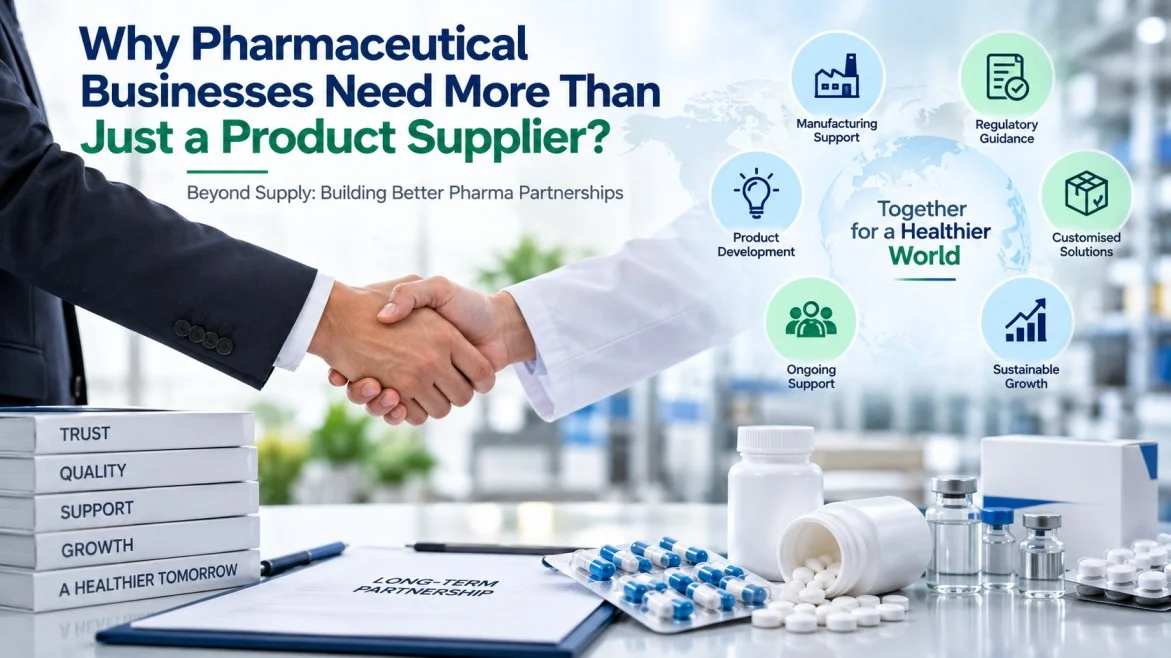
For a pharmaceutical business, finding a reliable pharmaceutical product supplier is only one part of building a successful business. A supplier may provide medicines on time, but long-term growth often requires much more — from product selection and regulatory documentation to packaging, market support and technical guidance.
This is why many businesses today look for a pharmaceutical manufacturing and export partner rather than simply a company that can supply products.
The difference may seem small at first. However, when a business enters a new country, launches a new medicine or expands its product portfolio, having the right support can make day-to-day operations much easier.
What Does a Pharmaceutical Business Really Need?
A pharmaceutical company or distributor may start with a simple requirement: “We need this medicine at the right price.”
But once the project moves forward, several other questions usually come up.
- Which formulation is suitable for the target market?
- What dosage strength should be selected?
- What packaging will work best?
- What documents are required for registration?
- Can the product be made under our own brand?
- Who can support product development?
- How should the product be positioned in the market?
- What happens after the first shipment?
These questions show why a pharma business partner can be more valuable than a conventional supplier.
A good partnership is not only about selling a product. It is about understanding the business behind that product.
Product Selection Is Only the Beginning
Choosing the right pharmaceutical product is not always as simple as looking through a catalogue.
A product that sells well in one market may not have the same potential in another. Patient needs, prescribing patterns, local competition, pricing and regulatory requirements can all be different.
A useful pharmaceutical partner can help a business look at its product portfolio from a wider commercial and technical perspective.
For example, a distributor may already sell antibiotics but notice increasing demand for products in another therapeutic category. Discussions with an experienced pharma partner can help identify possible additions to the portfolio.
Medwise Overseas provides product marketing support that includes guidance related to new product launches, formulation, dosing, packaging, product suggestions and marketing strategies.
Customised Manufacturing Can Give Businesses More Control
Sometimes an existing product is not enough.
A business may want its own brand name, a specific formulation, a particular pack size or customised packaging. This is where customised pharmaceutical manufacturing can become useful.
Instead of simply purchasing an available product, the business can discuss its requirements with a manufacturing partner.
For instance, an overseas distributor may want:
- A particular tablet strength
- Its own brand name
- A specific blister configuration
- Country-specific packaging
- A selected pack size
- Product information suited to its market
Medwise Overseas states that it provides customised manufacturing based on the client's preferred brand name and packaging, while also considering regulatory requirements.
This type of service can be particularly useful for companies that want to build a distinctive pharmaceutical portfolio rather than compete only on the basis of price.
Regulatory Documentation Can Become a Major Part of the Process
Pharmaceutical businesses operating internationally know that supplying a product is only one part of market entry.
Registration requirements can vary from country to country. Technical documents, product information and manufacturing details may need to be prepared according to the requirements of the relevant authority.
For a business without regulatory experience in a particular market, this can become a time-consuming part of the project.
A pharmaceutical partner with dossier preparation experience can provide valuable support.
Medwise Overseas states that its technical team prepares dossiers according to the requirements of different regulatory authorities, including CTD, ACTD and customised formats.
This kind of support can be especially useful when a company is expanding into several international markets and needs to manage different registration requirements.
Technology Transfer Supports Product Development
Another area where a pharmaceutical partner can provide value is technology transfer.
Technology transfer connects product development with commercial manufacturing. It can involve areas such as API sourcing, equipment requirements, formulation development, scale-up and packaging.
Imagine a company has a product concept but does not have the manufacturing infrastructure to develop it commercially.
Rather than starting from scratch, it may work with a technical partner that understands the product development process.
According to Medwise Overseas, its technology transfer service covers product development from API sourcing and equipment requirements through formulation development, laboratory-scale work, commercial development and packaging, with on-site support when required.
For businesses planning new products, this type of technical connection can be valuable.
Packaging Is Part of the Product
Pharmaceutical packaging is not simply about making a box look attractive.
The packaging protects the medicine, communicates important product information and affects how the product is stored, transported and presented to customers.
For an international pharmaceutical business, packaging may also need to reflect local regulatory requirements.
A partner who understands both pharmaceutical manufacturing and packaging can help bring these areas together.
For example, a company launching a new tablet brand may need to decide between different blister formats, carton sizes and labelling requirements. These decisions are easier when discussed early rather than after production has already been planned.
Post-Sale Support Matters More Than Many Businesses Expect
The relationship between a pharmaceutical company and its supplier should not necessarily end when an order is delivered.
Questions can arise after a shipment:
- Is another product suitable for the portfolio?
- Can packaging be changed for the next batch?
- Are there new product opportunities?
- Has a relevant guideline changed?
- Is additional technical information required?
- Can the business expand into another therapeutic segment?
Having someone available to discuss these matters can make a major difference.
Medwise Overseas highlights its Med-Advise concept, which includes client support such as data, suggestions for new products, updated disease guidelines, journal and research information, weekly updates and packaging ideas.
That approach reflects an important point: a pharmaceutical relationship should be about more than completing individual orders.
Why Long-Term Relationships Matter in Pharma
Pharmaceutical businesses often work with products for years rather than weeks.
A distributor may spend considerable time registering a product, building a sales network and developing relationships with healthcare professionals. Changing suppliers repeatedly can create additional work.
A stable pharmaceutical partnership can help businesses build familiarity around:
- Product specifications
- Manufacturing processes
- Packaging requirements
- Documentation
- Ordering patterns
- Market plans
- Future product additions
Over time, this can create a more practical working relationship between the buyer and manufacturer.
Medwise Overseas says it currently services more than 30 countries through 11 associated loan licence manufacturing facilities and has been operating since 2013.
What Should Businesses Look for in a Pharma Partner?
Choosing a pharmaceutical business partner requires more thought than comparing product prices.
1. Manufacturing Capability
Check whether the company has access to manufacturing facilities suitable for the products you need.
Medwise Overseas states that its products are manufactured at accredited sites and refers to WHO GMP norms and ISO 9001:2015 certification within its quality and accreditation information.
2. Product Range
A broad product range can make future portfolio expansion easier.
Medwise lists tablets, capsules, injections, syrups and dry syrups, eye and ear preparations, external preparations, Ayurvedic and nutraceutical products, and unique products.
3. Regulatory Support
Ask whether the company has experience with the documentation required in your target market.
4. Customisation
If you want your own brand or packaging, check whether customised manufacturing is available.
5. Technical Support
Product development, formulation and technology transfer can become important as your business grows.
6. Communication After the Sale
A supplier that remains available after delivery can be much more useful than one that only responds when a purchase order arrives.
A Simple Example
Consider a pharmaceutical distributor planning to enter a new African market.
At first, the requirement may simply be for a few commonly used medicines. But after reviewing the market, the company decides to build a larger portfolio.
It now needs additional products, suitable packaging, registration documents and advice on new formulations.
A basic supplier may only provide the requested products.
A broader pharmaceutical partner could potentially support product selection, customised manufacturing, dossier preparation, packaging and product development.
The second relationship may therefore be more useful as the business grows.
The Real Value Is in the Partnership
Price will always matter in pharmaceutical procurement. However, choosing a partner based only on the lowest quotation can overlook other costs.
Delays, documentation problems, packaging changes, communication gaps and difficulty finding new products can all affect a business later.
A pharmaceutical business partner should bring more to the table than a product catalogue.
The right relationship can connect manufacturing, product development, regulatory documentation, packaging and market support in a practical way.
Conclusion
Pharmaceutical businesses need more than just a product supplier because the pharmaceutical industry involves many connected stages. Product selection, manufacturing, documentation, packaging, market planning and after-sales support can all influence long-term business performance.
For companies looking to expand internationally, a partner with manufacturing, technical, regulatory and product support can provide a stronger foundation than a relationship based only on individual orders.
Medwise Overseas combines pharmaceutical product supply with services including customised manufacturing, product marketing, dossier preparation and technology transfer. Its approach also includes post-sale support through its Med-Advise concept.
Ultimately, the best pharmaceutical partnership is one that grows with the business — helping turn today's product requirement into tomorrow's wider market opportunity.










.webp)