Sign up with Google
 Sign in with Zoho

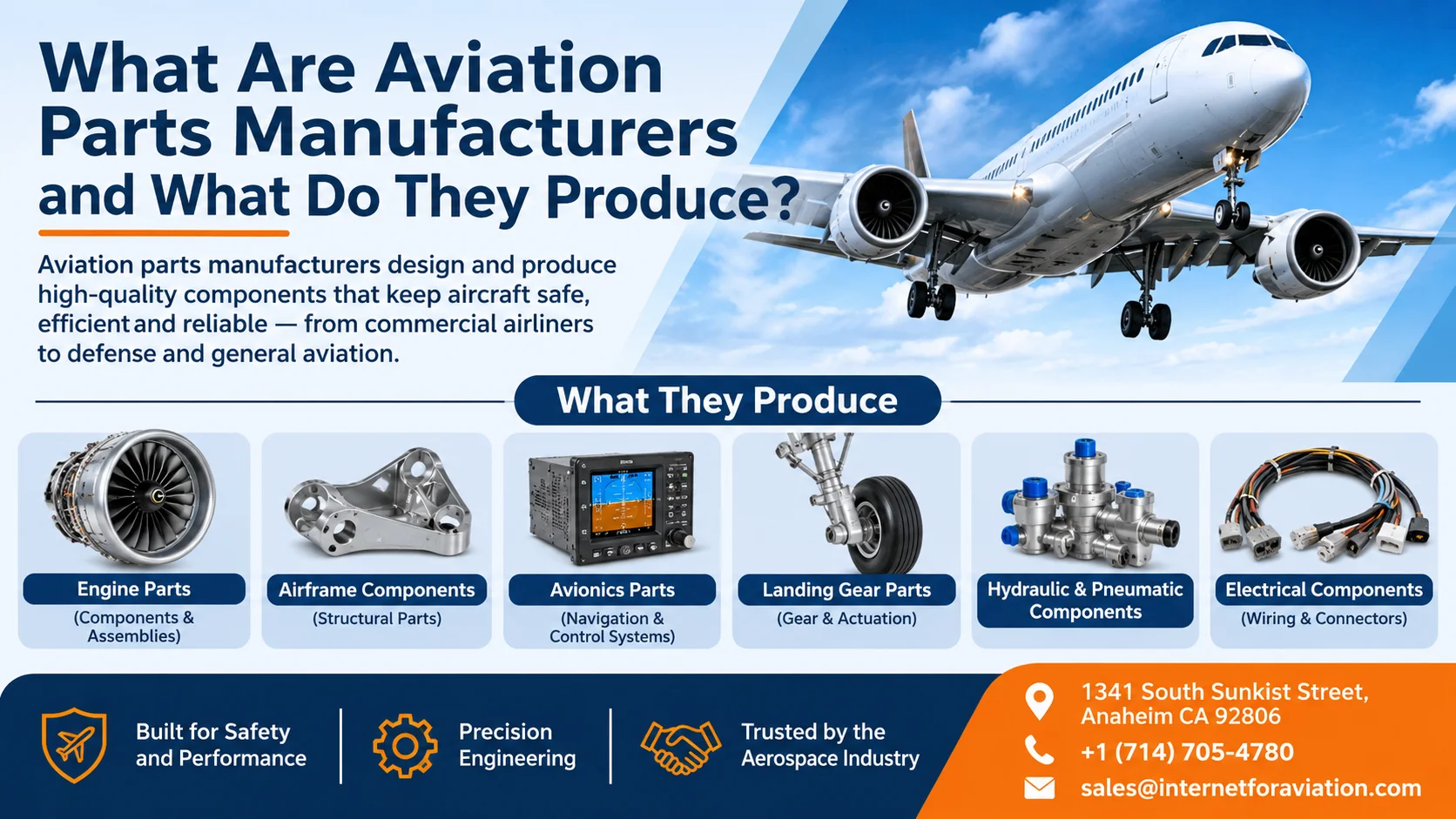
The aviation industry depends on thousands of specialized components to keep aircraft operating safely, efficiently, and reliably. From engines and landing gear to electrical systems and hydraulic assemblies, every aircraft requires high-quality parts that meet strict industry standards. Aviation parts manufacturers play an essential role in designing, developing, and producing these components for commercial airlines, military aircraft, and general aviation.
Understanding what these manufacturers produce and how their products support aircraft operations can help maintenance teams, procurement professionals, and aviation businesses make informed sourcing decisions.
What Are Aviation Parts Manufacturers?
Aviation parts manufacturers design, engineer, and produce components used in aircraft manufacturing, maintenance, repair, and overhaul (MRO). They supply parts for different aircraft systems, ensuring that each component meets applicable engineering specifications, safety requirements, and quality standards.
These manufacturers may specialize in specific components, such as engine assemblies, electrical equipment, fasteners, bearings, or structural parts. Others produce a broader range of aerospace components for commercial, private, and defense aviation applications.
Original Equipment Manufacturers (OEMs) develop and produce components according to aircraft design requirements. Their products are often identified through manufacturer names, part numbers, and CAGE codes, which help procurement teams verify component information.
What Do Aviation Parts Manufacturers Produce?
Aviation parts manufacturers produce a wide variety of components required for aircraft construction, operation, and maintenance. Some of the major product categories include:
1. Engine and Propulsion Parts
There are a great number of precision-engineered parts used in aircraft engines that serve to generate power and propel aircraft. Manufacturers provide turbine blades, compressors, fuel system parts, engine mounts, seals, and other engine-related assemblies. These components have to be able to withstand heat, pressure, and mechanical loads.
2. Aircraft Structural Parts
Structural parts are responsible for the strength, stability, and durability of an aircraft. These include brackets, panels, fuselage sections, wing parts, supports, and various types of fasteners. Manufacturers manufacture structural components out of materials such as aluminum alloys, titanium, and composites that ensure aircraft performance.
3. Aviation Bearings Parts
Bearings are mechanical components that serve to minimize friction in aircrafts and enable linear or rotational movement. Aviation Bearings Parts are widely used in aircraft engines, landing gear assemblies, control systems, and auxiliary systems.
Various bearings are designed for operation under different conditions. Thus, selecting bearings that comply with their specifications is crucial for the performance and reliability of equipment.
4. Electrical and Avionics Parts
Modern aircraft feature complex electric and electronic systems. Manufacturers offer wiring harnesses, connectors, switches, sensors, circuit breakers, navigation and communication equipment, and many other components.
Why Are Aviation Parts Manufacturers Important?
Aviation parts manufacturers contribute directly to aircraft safety, reliability, and maintenance efficiency. Their importance extends across several areas:
- Product Quality: They manufacture components according to technical specifications and applicable quality requirements.
- Aircraft Safety: Reliable components help maintain the performance of critical aircraft systems.
- Maintenance Support: Manufacturers provide replacement parts required for scheduled maintenance and unexpected repairs.
- Supply Chain Reliability: Consistent component availability helps airlines and MRO providers manage maintenance schedules.
- Technical Documentation: Manufacturer details, part numbers, and product specifications support accurate component identification.
Working with verified manufacturer information also helps procurement professionals reduce sourcing errors and identify suitable replacement components.
How to Find the Right Aviation Parts Manufacturer
Selecting the right manufacturer requires careful evaluation of product specifications and sourcing requirements. Start by identifying the required part number, manufacturer, and relevant technical details. Check whether the component matches the aircraft system and relevant documentation requirements.
An organized Aviation Part Type Catalog can simplify this process by helping users explore component categories and find relevant product information. Manufacturer directories can also help procurement teams research OEMs, compare available manufacturer details, and identify potential sourcing options.
Additionally, verifying CAGE codes, manufacturer references, and part descriptions can improve the accuracy of identification and support more informed purchasing decisions.
Find Aviation Manufacturer Information on the Internet for Aviation
Finding accurate manufacturer information is an important part of procuring aviation parts. Internet for Aviation helps users explore aviation manufacturer listings and access useful information for identifying manufacturers across different aerospace product categories.
Whether you are researching engine components, structural assemblies, electrical equipment, or Aviation Bearings Parts, having access to organized manufacturer information can simplify your search process.
Conclusion
Aviation parts manufacturers are essential to the aerospace supply chain, producing the specialized components that support aircraft construction, operation, and maintenance. Their products range from engine assemblies and structural components to bearings, avionics, and hydraulic equipment.
Understanding manufacturer capabilities, verifying component specifications, and using organized manufacturer directories can make identifying and procuring aviation parts more efficient. With Internet for Aviation, users can explore manufacturer information and take a more informed approach to locating aviation component sources.