Sign up with Google
 Sign in with Zoho

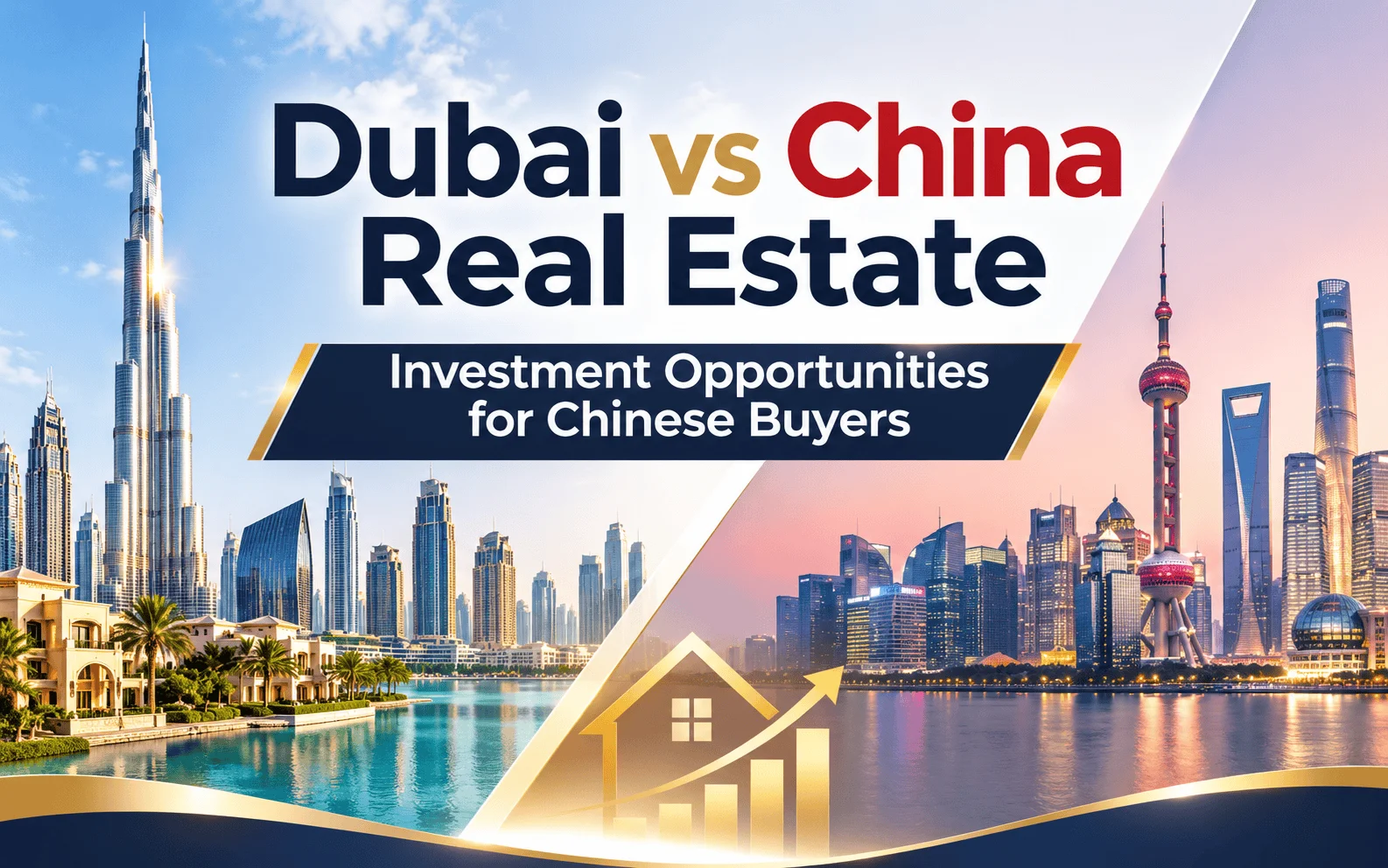
For investors comparing international real estate opportunities in 2027, Dubai and Shanghai represent two distinct residential property markets.
Shanghai is one of China's major financial and commercial centres, supported by an extensive transport network, established business districts and a large urban population.
Dubai offers international business connectivity, residential developments across different price categories and foreign ownership opportunities in designated freehold areas.
Both cities have attractive characteristics, but neither market guarantees stronger investment performance.
A useful comparison should focus on apartment prices, rental returns, ownership regulations, currency exposure and future housing supply.
1. Understanding the Two Property Markets
Shanghai's residential market is closely connected to China's domestic economy, employment conditions, housing policies and mortgage environment.
Dubai's residential market is influenced by international migration, business activity, employment, tourism and development supply.
Recent market reports illustrate why investors must examine local conditions.
According to Global Property Guide's September 2026 research, the average price of newly built homes in Shanghai was approximately RMB 65,058 per square metre in August 2026, based on CREIS data.
In Dubai, Savills reported approximately 34,500 residential transactions during Q3 2026, with transaction activity moderating as buyers became more selective.
These figures describe different aspects of the markets and should not be used as a direct price comparison.
For 2027 planning, investors should evaluate actual apartments rather than relying on broad citywide statistics.
2. Comparing Apartment Prices
A property's advertised price rarely provides enough information to determine value.
Buyers should examine the neighbourhood, building quality, apartment configuration and usable floor area.
A Shanghai apartment in a central commercial district may have different characteristics from a residential unit in an outer neighbourhood.
The same principle applies in Dubai, where areas such as Downtown Dubai, Dubai Marina and Jumeirah Village Circle serve different residential markets.
A proper price comparison should consider:
- Price per square metre or square foot
- Actual usable living space
- Building age and construction quality
- Neighbourhood connectivity
- Parking and residential amenities
- Maintenance and transaction expenses
Investors must also account for differences in how apartment areas are measured.
An apparently lower price per square foot may be misleading if the quoted area includes different spaces.
3. Rental Yields and Net Investment Returns
Rental yield is frequently used to compare international property markets.
However, investors should distinguish between gross rental yield and actual income after expenses.
The basic formula is:
Gross Rental Yield = Annual Rent ÷ Purchase Price × 100
Consider a hypothetical Dubai apartment purchased for AED 1.2 million and rented for AED 84,000 annually.
Its gross rental yield would be 7%.
Now consider a hypothetical Shanghai apartment purchased for RMB 4 million and generating RMB 120,000 in annual rent.
Its gross yield would be 3%.
These examples are illustrative and do not represent actual market averages.
Higher gross income relative to purchase price can be attractive, but the comparison is incomplete.
Investors must also consider maintenance, vacancies, financing, taxes, insurance and property management.
A market offering stronger advertised yields does not necessarily produce higher after-tax returns.
4. Foreign Property Ownership Rules
Ownership regulations are an important difference between Dubai and Shanghai.
Dubai Land Department confirms that eligible foreign nationals can own freehold property in designated areas.
Shanghai has a different framework for foreign individuals.
According to official Shanghai government guidance, qualifying foreign buyers generally need Chinese permanent residency or an eligible employment and residence history. Additional conditions apply.
For many foreign purchasers, a Shanghai residential property must be intended for personal occupation rather than investment rental use.
This means foreign ownership opportunities in Shanghai are not directly comparable with Dubai's designated freehold market.
Rules may differ for Chinese nationals, permanent residents and foreign buyers.
Investors should confirm the legal position applicable to their nationality and residence status before comparing purchases.
5. Currency Exchange and International Funding
Shanghai properties are generally priced in Chinese renminbi, while Dubai real estate is priced in UAE dirhams.
The UAE dirham is pegged to the US dollar.
An investor holding Chinese yuan therefore faces currency exposure when purchasing a Dubai apartment.
Changes in exchange rates can affect the cost of purchase instalments, rental income and eventual sale proceeds.
Chinese residents considering overseas property must also examine applicable foreign exchange and capital-account regulations.
Permission to own real estate in Dubai does not automatically establish permission to transfer funds overseas for that purchase.
Buyers should obtain confirmation from authorised financial institutions and appropriate legal advisers before making payment commitments.
Investors should never assume that ordinary foreign-exchange conversion allowances can automatically be used for overseas real estate investment.
6. Transaction Costs and Property Maintenance
Dubai property purchases generally involve Dubai Land Department registration charges and other applicable transaction fees.
The standard sale-registration fee is commonly expressed as 4% of the transaction value, with the applicable fee allocation requiring verification.
Apartment owners also pay service charges for the maintenance of shared facilities.
In Shanghai, buyers must consider applicable deed taxes, registration expenses, building maintenance responsibilities and relevant local charges.
Both markets may involve financing expenses, insurance and rental management costs.
Investors should request a full acquisition-cost estimate and calculate realistic annual ownership expenses before making a decision.
7. Future Housing Supply and Market Risks
Residential investment performance depends partly on the relationship between housing demand and supply.
China's property market has experienced a prolonged adjustment, although conditions vary considerably between major cities.
A September 2026 Global Property Guide review noted that Shanghai was performing differently from several other Chinese cities in the new-home market.
Dubai is also experiencing changes in its residential cycle.
Savills' Q3 2026 report highlighted a more selective environment and a significant pipeline of future residential completions.
For investors planning for 2027, this reinforces the importance of researching individual neighbourhoods and projects.
Future supply can create more housing choice, but it can also increase competition among landlords and sellers.
8. Why International Investors Consider Dubai
Dubai's international connectivity, foreign ownership framework and variety of residential developments make it a market worth examining.
However, investment decisions should not depend solely on the belief that Dubai properties are cheaper or more profitable than Shanghai apartments.
Location, liquidity, financing, legal requirements and currency exposure must all be assessed.
MAK Developers provides additional discussion of these differences in its article on Dubai vs China real estate investment opportunities for Chinese buyers.
International investors should use market comparisons as a starting point for research, not as a substitute for independent due diligence.
Final Thoughts
Dubai and Shanghai offer different property ownership environments and financial characteristics.
Shanghai may appeal to buyers seeking exposure to an established Chinese metropolitan market, subject to their eligibility and objectives.
Dubai may interest investors exploring international diversification and residential ownership in designated freehold communities.
For 2027, the stronger decision is the one supported by realistic costs, current local market information and an appropriate investment strategy.
Explore Residential Property Opportunities in Dubai
Interested in researching contemporary residential developments in Dubai?
Visit MAK Developers – Real Estate Developer in Dubai to explore residential projects, locations, apartment configurations and development information.
Confirm ownership eligibility, funding arrangements and project documentation before making an investment commitment.