Sign up with Google
 Sign in with Zoho
Farmers spend heavily on fertilizer, yet much of what goes into the soil never reaches the plant. Phosphorus, for example, binds to soil particles and becomes hard for roots to absorb. A mycorrhiza fertilizer takes a different approach. Instead of only adding nutrients, it helps the plant take up more of what is already in the soil.
This guide explains what mycorrhiza is, how it works with plant roots, its benefits, and how ECOMAX-G (Vesicular Arbuscular Mycorrhiza) from JU Agri Sciences is used in the field.
What is mycorrhiza?
Mycorrhiza is a natural partnership between a beneficial fungus and the roots of a plant. The word means “fungus-root”. Most crop plants form this partnership in healthy soil. The fungus lives on and inside the root and sends fine thread-like filaments (hyphae) out into the soil.
The most common type in agriculture is Vesicular Arbuscular Mycorrhiza (VAM), which is the type in ECOMAX-G. The fungus enters root cells and forms tiny tree-like structures called arbuscules, where nutrients and sugars are exchanged between fungus and plant.
How the partnership works
The relationship benefits both sides:
- The fungus gives the plant extra reach into the soil. Its filaments are far thinner than root hairs and can explore soil pores that roots cannot enter. They bring back water and nutrients, especially phosphorus.
- The plant gives the fungus sugars made by photosynthesis, which the fungus needs to live.
In practice, the plant gets a much larger root-zone network without having to grow all of it itself.
Why phosphorus matters
Phosphorus is vital for root development, flowering, grain and fruit set, and energy transfer in the plant. But it moves very slowly in soil, and a large share of applied phosphate becomes fixed and unavailable. According to the ECOMAX-G product page, mycorrhiza helps mobilise macronutrients, especially phosphorus, along with certain micronutrients such as zinc, calcium, iron and magnesium.
Because the fungal network reaches nutrients that roots alone cannot, a mycorrhizal biofertilizer can help improve nutrient uptake from the same soil.
Key benefits of a mycorrhiza biofertilizer
- Better nutrient uptake. An expanded feeder-root and fungal network helps the plant reach phosphorus and micronutrients.
- Better water absorption and drought tolerance. Stronger root systems help crops cope with dry spells.
- Improved soil health. Mycorrhiza supports soil structure, beneficial microbial activity and organic matter over the long term.
- Stress tolerance. Crops with well-developed root systems generally cope better with abiotic and biotic stresses.
- Lower input cost over time. Because uptake improves, mycorrhiza can help reduce the amount of chemical fertilizer needed. It works alongside fertilizer, and the right balance depends on the soil, crop and soil test.
- Better yield and produce quality, which supports farmer income.
Results vary with soil, crop, weather and management. A biological product supports good practice and does not replace it.
ECOMAX-G: Vesicular Arbuscular Mycorrhiza
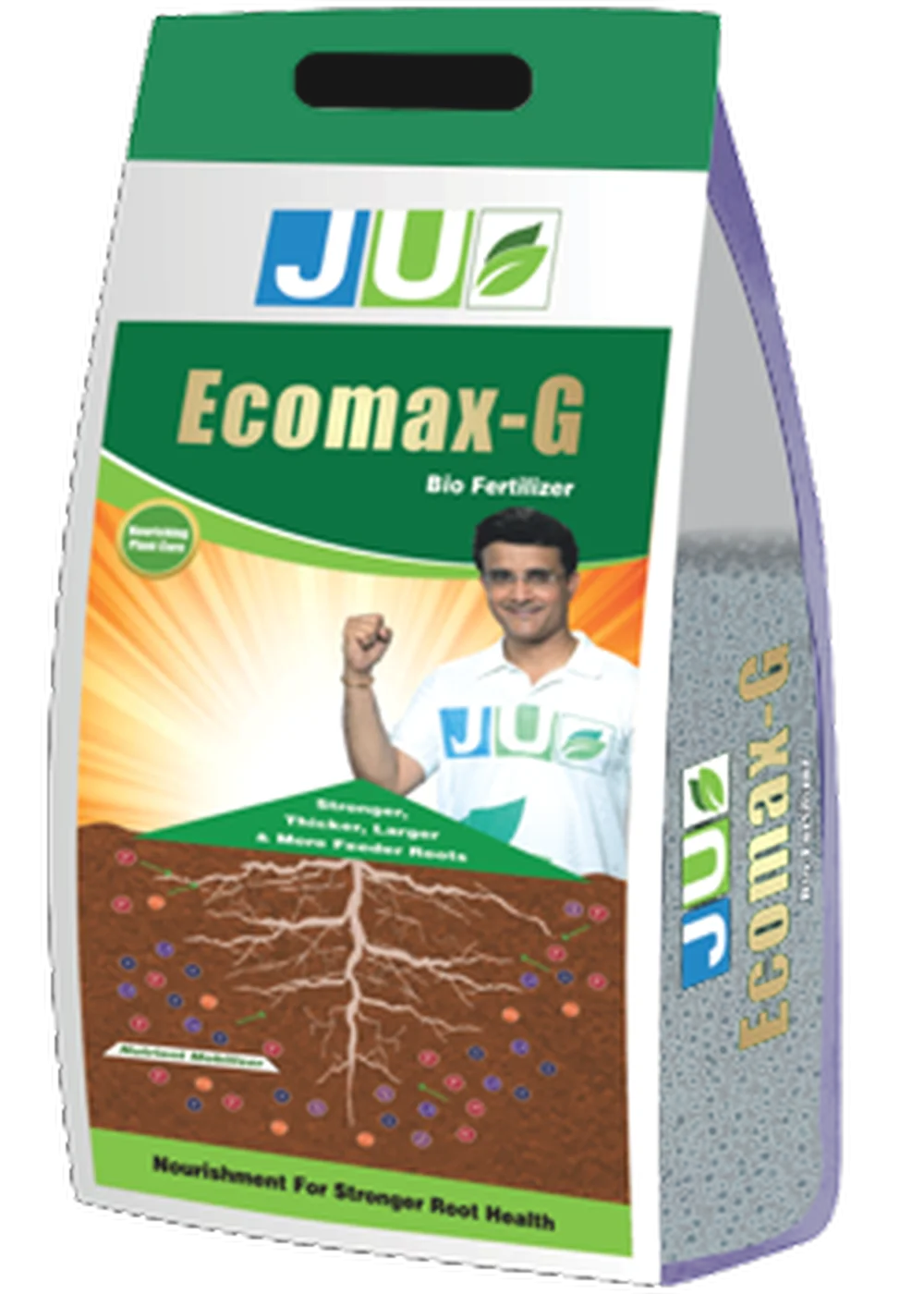
ECOMAX-G is a mycorrhiza-based biofertilizer from JU Agri Sciences. The product page describes it as a premium mycorrhizal biofertilizer that promotes strong root development and better nutrient uptake. It also reports that it enhances soil structure, encourages beneficial microbial activity and supports long-term soil fertility.
Key features
- Mycorrhiza-based biofertilizer containing Vesicular Arbuscular Mycorrhiza
- Supports mobilisation of phosphorus and certain micronutrients, including zinc, calcium, iron and magnesium
- Promotes feeder-root expansion for better nutrient and water uptake
- Helps crops tolerate drought and other stresses
- Supports soil health by improving structure and organic matter over time
- Can help reduce chemical fertilizer use, which lowers cost
Dose and timing
The 2 kg pack matches the per-acre dose, so one pack covers one acre. For the method of application, soil conditions and crop-specific instructions, follow the label or contact the JU Agri Sciences team.
Why apply at sowing or transplanting
Mycorrhizal fungi need to meet the root early. The fungus colonises new roots as they grow, so putting the product in the root zone at sowing or transplanting gives it the best chance to establish. Applying it late, when roots are already large and the crop is well advanced, is less effective.
Getting the best results
Mycorrhiza is a living product, so a few practices help it perform:
- Place it near the roots. The fungus has to contact young roots to form the partnership.
- Do not over-apply phosphorus. Very high levels of soluble phosphorus can reduce the plant’s need for the fungus. Follow soil test recommendations.
- Be careful with chemical fungicides. Some fungicides can harm beneficial fungi. The product page gives no compatibility data, so check the label or ask our team before using fungicides at the same time in the root zone.
- Avoid heat and direct sun. Store the pack in a cool, dry, shaded place and use fresh stock.
- Keep the soil reasonably moist so the fungus can establish.
- Reduce unnecessary tillage and soil disturbance, which can break the fungal network.
- Combine with organic matter. Compost or well-decomposed manure supports soil life.
Mycorrhiza and Trichoderma: different jobs
Farmers often hear about mycorrhiza and Trichoderma together. They are different organisms.
In simple terms, mycorrhiza is about nutrition, and Trichoderma is about protection. Many biological programmes use both. Check labels or ask our team about timing and compatibility.
Mycorrhiza is not a fungicide or an insecticide
Because mycorrhiza is a fungus, some farmers assume it works against crop diseases. It does not replace crop protection products. It improves how the plant feeds and drinks. For leaf diseases and insects, you still need targeted products:
- For rice blast and sheath blight, read our guide to the fungicide JU-ART. It covers fungicide for rice, fungicides for rice blast and sheath blight control fungicide options and when to spray.
- For stem borer and leaf folder, read our guide to LAMBDA CS, a lambda insecticide (lambda cyhalothrin 4.9% CS), and our guide to CARTAP GR.
- For soil-borne diseases, read our guide to ECOLIFE (Trichoderma).
Safety and handling
Biological products are generally gentler than chemical ones, but handle them with care. Wear gloves and a mask when handling powders, wash your hands afterwards, and keep the product away from children, animals and food. Store in the original pack and follow the label for storage and disposal.
About JU Agri Sciences
JU Agri Sciences is among the mycorrhiza manufacturers in India, according to its product information. The company has played a role in establishing the biological fertilizer industry in the country. It offers more than 130 products across biological fertilizers, biological pesticides, insecticides, fungicides, herbicides and bio-stimulants. With more than 5,500 trade partners, 25,000 retailers and over 1,000 trained people supporting farmers, its solutions reach growers across India. Dealers and buyers looking for mycorrhizal manufacturers can contact our team directly.
Frequently asked questions
What is a mycorrhiza fertilizer? It is a biological product that contains mycorrhizal fungi. The fungus forms a partnership with plant roots and helps them absorb nutrients and water.
What does ECOMAX-G contain? Vesicular Arbuscular Mycorrhiza (VAM), as per the product page.
What is the dose of ECOMAX-G? 2 kg per acre, preferably at sowing or transplanting.
Does mycorrhiza replace chemical fertilizer? It can help reduce the amount needed by improving uptake, but it does not replace a balanced fertilizer plan. Follow soil test advice.
Which nutrients does it help with? The product page lists phosphorus especially, plus zinc, calcium, iron and magnesium.
When should I apply it? Preferably at sowing or transplanting, when new roots are forming.
Is mycorrhiza a fungicide? No. It supports nutrient and water uptake. For disease control, use a suitable fungicide or a biocontrol product such as Trichoderma.
What pack sizes are available? 1 kg and 2 kg.
Get in touch
For product availability, dealer enquiries or guidance on mycorrhizal biofertilizer, call 0120 – 4328671 or use the form on our Contact Us page.