Sign up with Google
 Sign in with Zoho

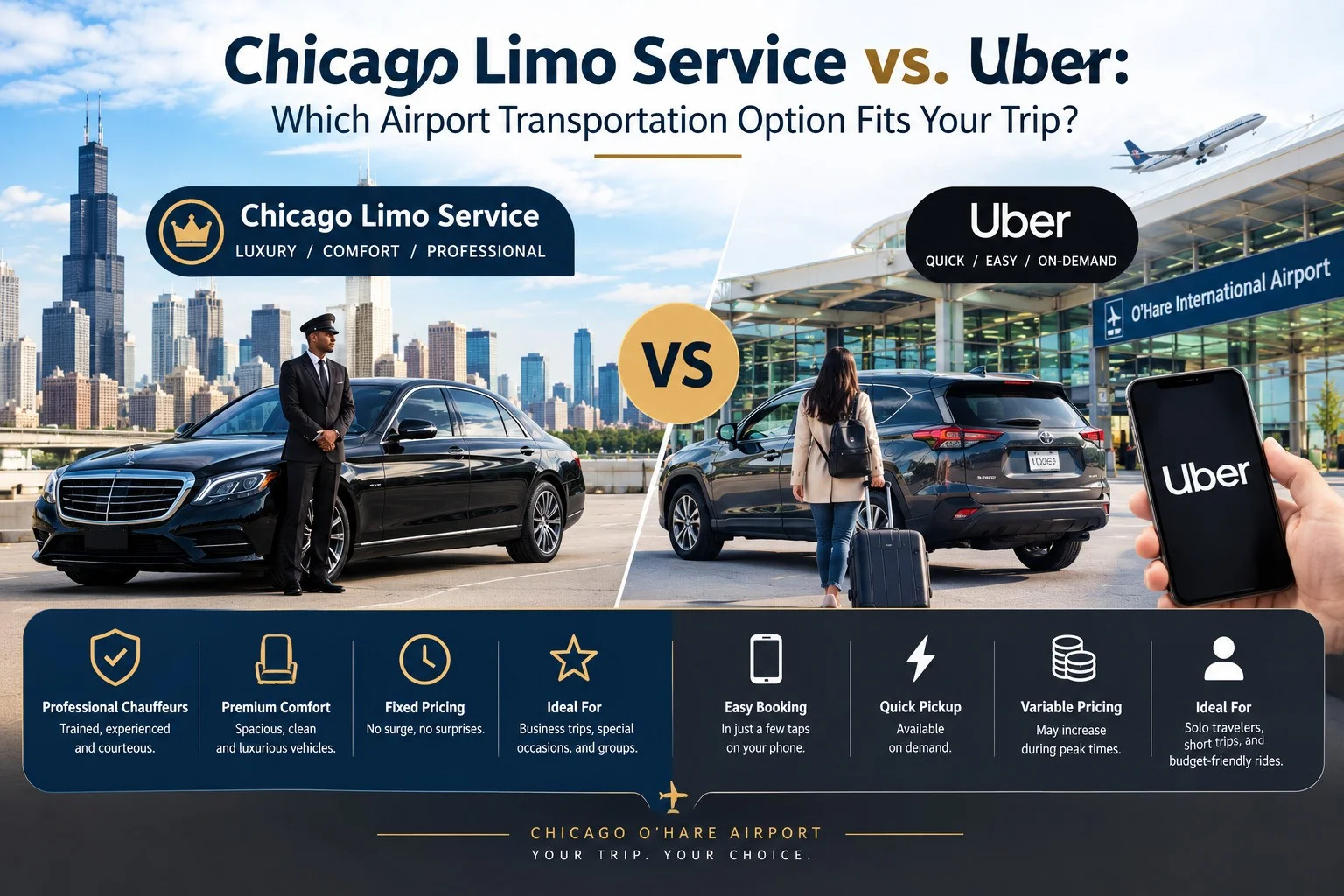
If you are flying into Chicago, transportation is probably not the first thing on your mind when the plane lands.
You are more likely thinking about getting your bags, finding your way out of the terminal, checking your phone, and getting on with the day.
Then comes the practical question: how are you getting to your destination?
For many travelers, the choice comes down to Uber or a prearranged car service. Both are familiar options, and both can work perfectly well depending on the situation. The difference is mostly in how the ride is arranged and what you expect from it.
I don't think this is one of those comparisons where you can simply say, "Choose this one."
A person traveling alone with a backpack has a very different transportation problem from a family arriving with three suitcases and a tired child. Someone going straight to a hotel has different priorities from an executive who has a meeting shortly after landing.
So instead of trying to pick one universal winner, it makes more sense to look at the parts of the trip that actually matter.
Start With What Happens After You Land
This is where the difference between the two options becomes noticeable.
With Uber, the basic idea is familiar. You arrive, collect your luggage, open the app, enter your destination, and request a ride.
It sounds easy, and often it is.
But airport rides have one extra complication: you aren't picking up the car on an ordinary city street.
Airports have their own rules and designated pickup areas. At Chicago Midway, for example, rideshare vehicles use designated zones on the lower level, while limousines have separate pickup locations. The airport currently lists rideshare pickup in specific zones and limousines in the lower-level center lane.
That may not sound like a big deal if you have used Midway many times.
For someone who has never been there, it can mean another few minutes of figuring out where to go.
O'Hare has its own ground transportation arrangements as well. Airport transportation services are directed through designated facilities and pickup areas, so it is worth checking the current instructions before you travel rather than assuming every vehicle picks up in the same place.
That's a small detail, but airport trips are full of small details.
Uber Has One Obvious Advantage: Flexibility
There is something appealing about being able to decide when you need the car.
Maybe your flight lands early. Maybe it is delayed. Maybe you want to grab something to eat before leaving the airport. With an on-demand service, you don't necessarily have to make every decision days in advance.
For a traveler who likes that flexibility, Uber can be a natural choice.
It can also be convenient for a straightforward trip. One passenger, one suitcase, hotel downtown, no special schedule. There may not be much reason to make the transportation more complicated than it needs to be.
The app also gives you information about the ride as you request it, which many travelers find useful.
There is a trade-off, though.
You are still dealing with whatever is happening at the airport at that moment. If it is crowded, if the pickup area is busy, or if you are unfamiliar with the terminal, the experience may require a little more attention.
For some people, that is no problem at all.
For others, especially after a long flight, it is one more thing they would rather not deal with.
A Prearranged Car Changes the Timing
A prearranged ride takes the opposite approach.
Instead of waiting until you land to figure out transportation, you arrange it before the trip.
You provide the date, pickup location, destination, number of passengers, and other details. Depending on the provider, you may also provide your flight information.
That doesn't magically eliminate airport delays or traffic. Chicago traffic is still Chicago traffic.
What it does is move some of the planning from the airport to your preparation stage.
This can be useful if you are someone who prefers knowing what happens next.
For example, imagine landing at O'Hare after an overnight flight. You have two checked bags, a carry-on, and a meeting across town later that afternoon.
At that point, "I'll figure it out when I land" may not be your favorite plan.
Having transportation arranged in advance can make the first part of the day more predictable.
The Price Question Is More Complicated Than It Looks
Price is where many comparisons start, but it probably shouldn't be the only thing you look at.
An Uber fare can change based on demand and other conditions at the time you request the ride. A limousine or private car service generally quotes the trip based on factors such as the vehicle, route, timing, and service requirements.
So you are not always comparing identical pricing models.
There is also the question of what you actually need.
Suppose two people are traveling with two small bags. A basic rideshare may be perfectly adequate.
Now change the example.
There are five passengers, everyone has luggage, and the group needs to stop at two locations before reaching the final destination.
The cheapest-looking option on a screen may not tell you much until you know whether the vehicle and service actually fit the trip.
This is why I would compare the total arrangement rather than just the first number you see.
Ask what vehicle is being provided. Ask how many passengers it comfortably accommodates. Check whether additional stops affect the price. If the ride is scheduled around a flight, find out how delays are handled.
A few questions at the beginning can prevent surprises later.
Where Chicago Limo Service Fits Into the Picture
For travelers who want the transportation arranged before they arrive, Chicago Limo Service is another option to consider alongside rideshare.
The main difference is not simply the type of car.
It is the way the transportation is planned.
A prearranged service may be more appealing when the pickup time, destination, luggage, passenger count, or overall itinerary is important. Instead of making the transportation decision while standing near baggage claim, you have already made most of the arrangements.
That doesn't make it automatically better.
If you are traveling alone and your only goal is getting downtown without spending much time planning, an app-based ride may be exactly what you want.
But if the transportation itself is an important part of the schedule, advance planning starts to have more value.
Think About Your Luggage Before You Choose the Car
Luggage is one of those things people remember too late.
A vehicle can have enough seats for four people and still feel cramped when four people bring large suitcases.
This matters especially after a long trip.
Imagine arriving with:
- Two large checked bags
- Four carry-ons
- A stroller
- A laptop bag
- Three or four passengers
Suddenly, the question isn't just "How much is the ride?"
It becomes "Will everything actually fit?"
If you are booking a private vehicle, give the provider an honest idea of how many people and bags you have. If you're using rideshare, pay attention to the vehicle category you select rather than assuming every option has the same amount of space.
It is a simple step, but it can save you from an uncomfortable ride.
Traveling Alone Is Different From Traveling With a Family
I would not use the same transportation criteria for a solo traveler and a family.
Someone traveling alone can move quickly through the airport. They may have one bag, know exactly where they are going, and be comfortable using a phone to arrange a ride.
A family has more moving pieces.
There may be children who are tired after the flight. There may be a stroller, multiple bags, or a need for more space. Getting everyone from the baggage area to the correct pickup location can take longer than expected.
Neither option automatically solves all of those problems.
The point is simply that convenience means something different depending on who is traveling.
For a family, having the transportation details settled before arrival may be worth more than it would be for a solo traveler.
Business Trips Are Another Story
Airport transportation becomes a little more serious when you are traveling for work.
Imagine landing at 9:00 a.m. and having a meeting at 11:00.
You have enough time on paper, but you don't really want to spend that time wondering where your ride is or trying to solve transportation problems after landing.
Business travelers may also have equipment, presentation materials, or other luggage that isn't particularly easy to manage.
In this situation, the question becomes less about luxury and more about organization.
Would you rather make the transportation decision after landing, or have that part of the itinerary handled beforehand?
That's a personal preference, but it is worth thinking about before the trip.
What If the Flight Is Delayed?
This is one question I would ask any transportation provider before booking.
Flights get delayed. It happens.
If you arrange a car in advance, find out what the provider does when the arrival time changes. Some services monitor flight information, while others may require the passenger to contact them after landing.
The important thing is to know the procedure.
You don't want to discover the policy while standing at baggage claim with your phone in one hand and your suitcase in the other.
The same idea applies to rideshare, although the situation works differently. With an app-based ride, you generally request the vehicle when you are ready, so the transportation isn't waiting for you in the same way a prearranged reservation might be.
Again, there isn't necessarily a right or wrong answer.
It is simply a different way of handling the uncertainty that comes with air travel.
Don't Ignore the Time You Are Traveling
A ride that works well at 2 p.m. may feel very different at 1 a.m.
Late-night arrivals, early-morning departures, holiday travel, and busy event periods are all worth considering when you make transportation plans.
If you have plenty of flexibility, waiting a little longer may not bother you.
If you have somewhere you need to be, it can matter a lot more.
This is also why I would avoid making the decision based only on what worked during your last trip. Chicago airport conditions can vary depending on the day, time, weather, traffic, and number of travelers.
Your next trip may have completely different requirements.
What About Multiple Stops?
Airport transportation isn't always point A to point B.
Maybe you need to stop at your office before checking into the hotel.
Maybe you're picking up another passenger.
Maybe your family wants to drop luggage at one location and then head somewhere else.
If your trip includes multiple stops, think about that before booking.
With an app-based service, you may be able to add stops through the application. With a prearranged service, you can discuss the itinerary ahead of time.
Either way, make sure the transportation provider understands the plan.
The more complicated the itinerary, the more useful it becomes to have the details written down rather than trying to explain everything after landing.
A Simple Example: Two Travelers, Two Completely Different Choices
Consider two hypothetical Chicago trips.
The first traveler is flying into O'Hare for a weekend. She has a backpack and one carry-on. Her hotel is downtown, and she doesn't have anything scheduled until dinner.
For her, flexibility may be more important than advance planning. Requesting a rideshare after collecting her bag could be perfectly reasonable.
Now consider another traveler.
He is arriving with two coworkers. They have several pieces of luggage and are going directly from O'Hare to a conference. They have a scheduled meeting shortly after arrival.
The transportation decision looks different.
A prearranged vehicle may make more sense for that particular itinerary because the group can organize the pickup, vehicle size, destination, and timing before the flight.
Notice that neither example requires saying one service is always better.
The trips are different.
That's really the point of the comparison.
So, What Should You Actually Look At?
Before you book airport transportation in Chicago, I'd make a short checklist.
How many people are traveling?
One passenger and a group of six have very different needs.
How much luggage do you have?
Count the large bags, not just the people.
How fixed is your schedule?
A flexible vacation and a business meeting are not the same situation.
Are you comfortable navigating airport pickup areas?
If you've never used the airport before, check the current instructions in advance.
Do you need more than one stop?
Make sure the provider knows the itinerary.
What happens if the flight changes?
Understand the cancellation, delay, and flight-monitoring policies before you pay.
What exactly is included in the price?
Don't compare numbers until you know what those numbers represent.
Do you want to arrange the ride before you fly?
This may be the simplest question of all.
The Better Choice Depends on the Trip, Not the Label
I think airport transportation is one of those decisions where people sometimes make it more complicated than necessary.
Uber can be convenient. That's the reason so many travelers use it.
A prearranged limousine or private car can also be convenient, particularly when the trip requires more planning.
The important thing is to look at your own situation.
If you're traveling light, have a flexible schedule, and don't mind arranging your ride after landing, an on-demand service may fit naturally into your plans.
If you're traveling with several people, carrying a lot of luggage, heading straight to a meeting, or simply prefer to have transportation organized before the flight, a prearranged service may be worth considering.
And if you're still unsure, don't start with the question, "Which one is better?"
Start with a more useful question:
What do I need this ride to do?
Once you answer that, the choice usually becomes much easier.







.webp)