Sign up with Google
 Sign in with Zoho


Building a house is exciting. It’s also where budgets quietly fall apart.
Most people searching this topic aren’t just curious about “how to save money.” They’re usually planning a build, talking to a contrctor, or trying to avoid going 20–30% over budget. Some already got a rough estimate and it feels… high. Others are worried about hidden costs that nobody mentioned.
I’ve worked on residential cosntruction projects where the initial budget looked solid on paper, but small oversight snowballed into six-figure overruns. Not because the owner was careless. Because construction budgeting isn’t intuitive.
So this guide focuses on real-world budgeting decisions. Not theory. Not generic advice.
Start With a Realistic Cost Baseline (Not Pinterest Numbers)
Here’s the first mistake I see: people budget based on inspiration photos.
A 2,500 sq. ft. home doesn’t cost the same in Texas as it does in California. Labor rates, permit fees, material availability — they all varies depending on region. According to the U.S. Census Bureau’s Construction Spending data, residential costs have steadily increased over the last few years due to material volatility and labor shortages. That trend hasn’t magically reversed.
Before you even speak to a builder, you need three reference points:
- Local cost per square foot (recent builds only)
- Land development costs (grading, utilities, soil testing)
- Soft costs (design, permits, engineering, inspections)
And here’s what most people miss: site conditions can distort your budget fast. A flat lot with existing utilities is cheap to develop. A sloped lot with poor soil? That foundation cost doubles sometimes.
In one project we handled, the client underestimated soil stabilization by nearly $18,000 because no one ordered a proper geotechnical report early. Small oversight. Expensive lesson
Scheduling a professional post-construction cleaning service ensures the property is truly move-in ready and protects your newly installed finishes from long-term damage.
Break the Budget Into Phases — Don’t Treat It as One Lump Sum
When people say, “My house will cost $400,000,” it sounds clear. It isn’t.
A smarter way to budget is by dividing the project into major cost categories:
- Land acquisition
- Site preparation
- Foundation and structure
- Roofing and exterior envelope
- Mechanical systems (HVAC, plumbing, electrical)
- Interior finishes
- Landscaping and external works
- Contingency
This structure does two things. First, it shows where your money actually goes. Second, it lets you adjust intelligently.
For example, structural components aren’t flexible. You shouldn’t downgrade foundation concrete or framing lumber to save 5%. But interior finishes? That’s adjustable without compromising safety.
I always tell clients: prioritize what’s expensive to change later. You can upgrade countertops in 3 years. You cannot easily redo structural beams.
And while most homeowners focus heavily on structural and aesthetic costs, they often overlook the long-term health impact of the indoor environment. Proper budgeting should also account for maintaining a clean, healthy space after construction. As explained in The Hidden Health Benefits of Having Your Home Professionally Cleaned, professional cleaning plays a significant role in improving indoor air quality and reducing allergens — something especially important after renovation or new builds when dust and construction residue linger.
Set a Contingency Fund (And Actually Protect It)
If you only take one tip from this article, let it be this: always add 10–15% contingency.
Not for luxury upgrades. For unknowns.
Even in well-managed builds, surprises happens:
- Hidden rock during excavation
- Material price increases mid-project
- Code upgrades
- Design revisions
The National Association of Home Builders (NAHB) often reports material price swings — lumber volatility alone has caused thousands in unexpected adjustments over the past few years.
What usually happens? Owners dip into contingency for aesthetic upgrades early. Then a real issue appears and there’s no buffer left.
That contingency is not optional. It’s protection.

Understand Fixed-Price vs Cost-Plus Contracts
Budget control heavily depends on contract type.
Fixed-Price Contract: You agree on total project cost upfront. Risk shifts more toward contractor. Predictable for you — but only if scope is clear.
Cost-Plus Contract: You pay actual cost of labor and materail plus contractor’s fee (often 10–20%). More transparency. More flexibility. But if you don’t monitor, costs creep.
I’ve seen homeowners choose cost-plus thinking it’ll be cheaper. It can be. But only if there’s strong project management and disciplined decision-making.
If you’re not experienced reviewing invoices or tracking change orders, fixed-price may provide better financial clarity.
Don’t Underestimate Soft Costs
When budgeting, most attention goes to bricks and cement. But soft costs quietly stack up:
- Architectural design fees (5–15% of project cost)
- Structural engineering
- Permit fees
- Impact fees (in some municipalities)
- Utility connection charges
- Surveying
On certain builds, soft costs account for 15–25% of total project cost. And many people forget them entirely during early planning.
I once had a client shocked by permit and impact fees exceeding $22,000. It was listed clearly in municipal documentation — just not factored into their initial plan.
It happens more than you’d think.
Value Engineering: Where to Save Without Regret
“Value engineering” gets misunderstood. It doesn’t mean cutting quality. It means aligning cost with long-term benefit.
Here’s where I usually recommend optimization:
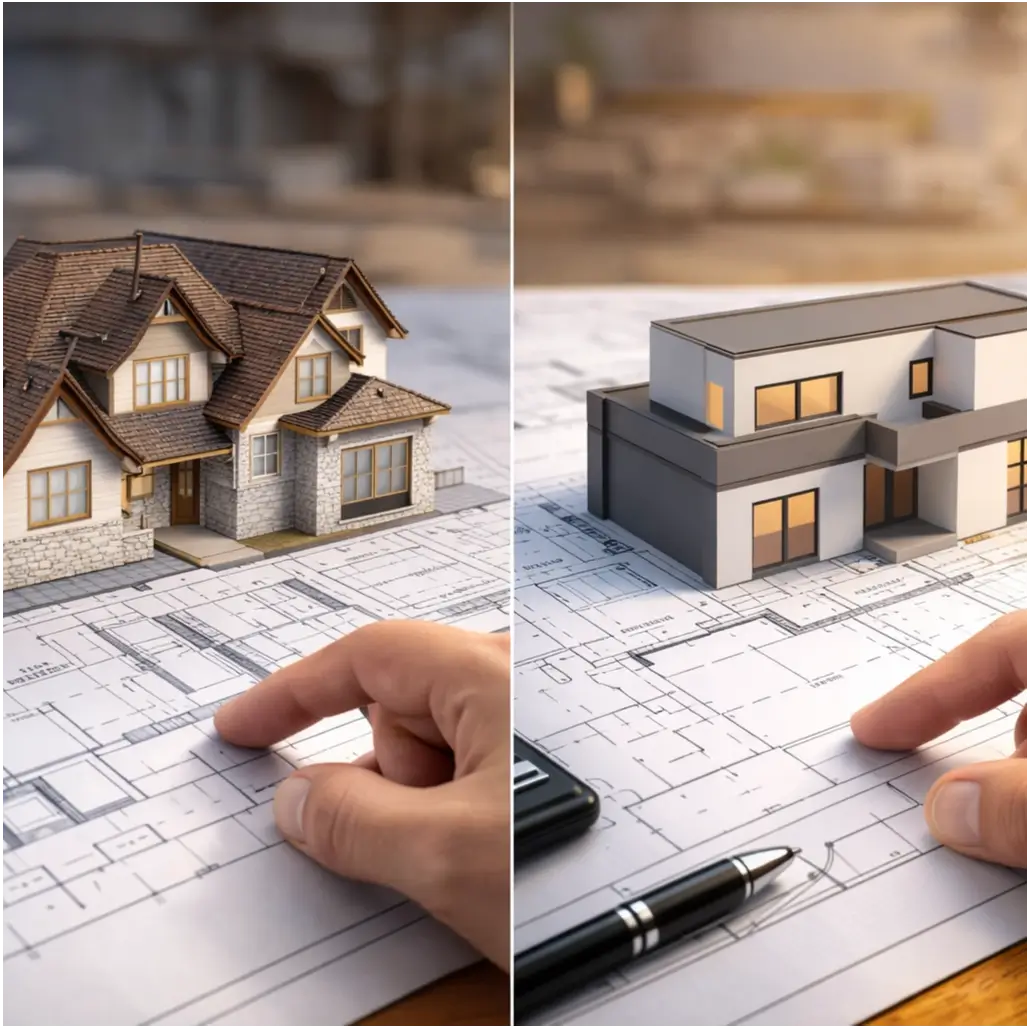
1. Simplify the Building Shape
Complex rooflines and multiple corners increase framing and roofing costs significantly. A rectangular layout is cheaper to build than a highly segmented design. It’s not glamorous advice. But it works.
2. Standardize Window Sizes
Custom-sized windows cost more and delay schedules. Standard dimensions reduce both cost and lead times.
3. Plan Mechanical Systems Early
Late changes in HVAC duct routing or plumbing layout leads to rework. Rework is expensive. Coordination saves money.
4. Avoid Over-Specifying Hidden Materials
Not every wall needs premium tile backing if it’s never exposed to moisture. A good contractor will guide this — if they are honest.
Track Change Orders Ruthlessly
Here’s where budgets quietly explode.
Every time you say, “Let’s just add this,” it costs money. Even small changes affects:
- Labor schedule
- Material orders
- Rework
- Inspections
A $1,000 change rarely stays $1,000 once labor adjustments are included.
My rule on-site was simple: no verbal approvals. Everything written. Every change priced before execution.
It sounds strict, but it saves relationships. Budget clarity prevents disputes.
Consider Long-Term Operating Costs (Not Just Build Cost)
Short-term savings can create long-term expenses.
For example:
- Poor insulation increases utility bills
- Low-grade roofing reduces lifespan
- Cheap windows compromise energy efficiency
The U.S. Department of Energy provides guidelines on high-performance insulation and window efficiency standards. Spending slightly more upfront on building envelope components often reduces lifetime cost.
What’s worth paying attention to is total cost of ownership. A $5,000 upgrade that saves $800 annually pays for itself fairly quick.
But splurging on purely aesthetic upgrades rarely provides return.
Timing and Market Cycles Matter
Construction pricing fluctuates with demand. During high housing demand periods, labor shortages push rates up. In slower markets, contractors may be more flexible.
Material costs also respond to global supply chains. Cement, steel, lumber — they don’t operate in isolation.
If your timeline allows flexibility, monitor local permit activity and housing starts. When volume drops, pricing often becomes more negotiable.
That said, delaying purely to “time the market” is risky. Build when financially ready, not when rumors suggest prices might drop.
Budget for Professional Project Management (If You Need It)
Many homeowners think hiring a project manager adds cost. Sometimes it saves more than it costs.
On complex custom builds, coordination errors are expensive. A dedicated project manager monitors:
- Schedule
- Contractor billing
- Procurement
- Quality control
- Cost forecasting
In projects exceeding $500,000, professional oversight often pays for itself by preventing errors and rework.
But if your builder already includes structured project management, adding another layer may be redundant. Context matters.
Cash Flow Planning Is Different From Total Budget
Even if total budget is $450,000, that money isn’t spent evenly.
Construction spending typically follows this curve:
- Early phase: moderate (design, permits, foundation)
- Mid phase: heavy (structure, mechanical systems)
- Final phase: steady but detail-heavy (finishes, landscaping)
If you’re financing through a construction loan, understand draw schedules. Banks release funds in stages after inspections. Delays in approvals can disrupt contractor payments.
And when payments delay, contractors slow down. It’s a chain reaction.
Cash flow clarity keeps momentum steady.
Avoid Emotional Upgrades Late in the Project
Late-stage decisions are the most expensive.
You’re tired. You want the house done. You see showroom finishes and suddenly granite turns into imported marble. I’ve seen clients overspend 8–10% in final 60 days just from emotional decisions.
It’s normal. But if you defined your finish standards early and stick to them, you’ll protect your budget.
Make key selections — flooring, cabinetry, fixtures — before construction begins. Late upgrades cause both cost increase and scheduling issues.
Get Multiple Detailed Estimates — But Compare Correctly
Three bids is a common recommendation. It’s useful, but only if you compare apples to apples.
One contractor might exclude landscaping. Another might include only basic electrical fixtures. A third might assume mid-grade finishes.
Low bid doesn’t always mean cheaper. Sometimes it just means incomplete.
Ask each contractor for:
- Scope breakdown
- Material specifications
- Payment schedule
- Allowances
Allowances are particularly tricky. If the budget allocates $5 per sq. ft. for tile but you choose $9 tile, you pay the difference.
And most clients choose higher.
Don’t Ignore Inflation and Price Escalation Clauses
In longer builds (9–18 months), some contracts include price escalation clauses tied to material indexes. Read them carefully.
It’s not about distrust. It’s about clarity.
Global commodity markets impact steel, copper, petroleum-based products. If the contract allows adjustments, understand how they’re calculated.
Transparent formulas are better than vague wording.
The Real Takeaway
Smart budgeting for home construction isn’t about cutting corners. It’s about foresight.
- Define scope clearly
- Separate structural essentials from aesthetic preferences
- Protect contingency
- Track changes
- Understand contracts
- Think long-term
I’ve seen modestly sized homes built beautifully under budget because decisions were disciplined. I’ve also seen large budgets collapse due to constant scope creep.
The difference isn’t income level. It’s planning behavior.
Build with clarity. Question estimates. Ask uncomfortable questions early. And don’t rush financial decisions because you’re excited.
A house is emotional. But budgeting it should be methodical — even if the process feels messy at times.