Sign up with Google
 Sign in with Zoho

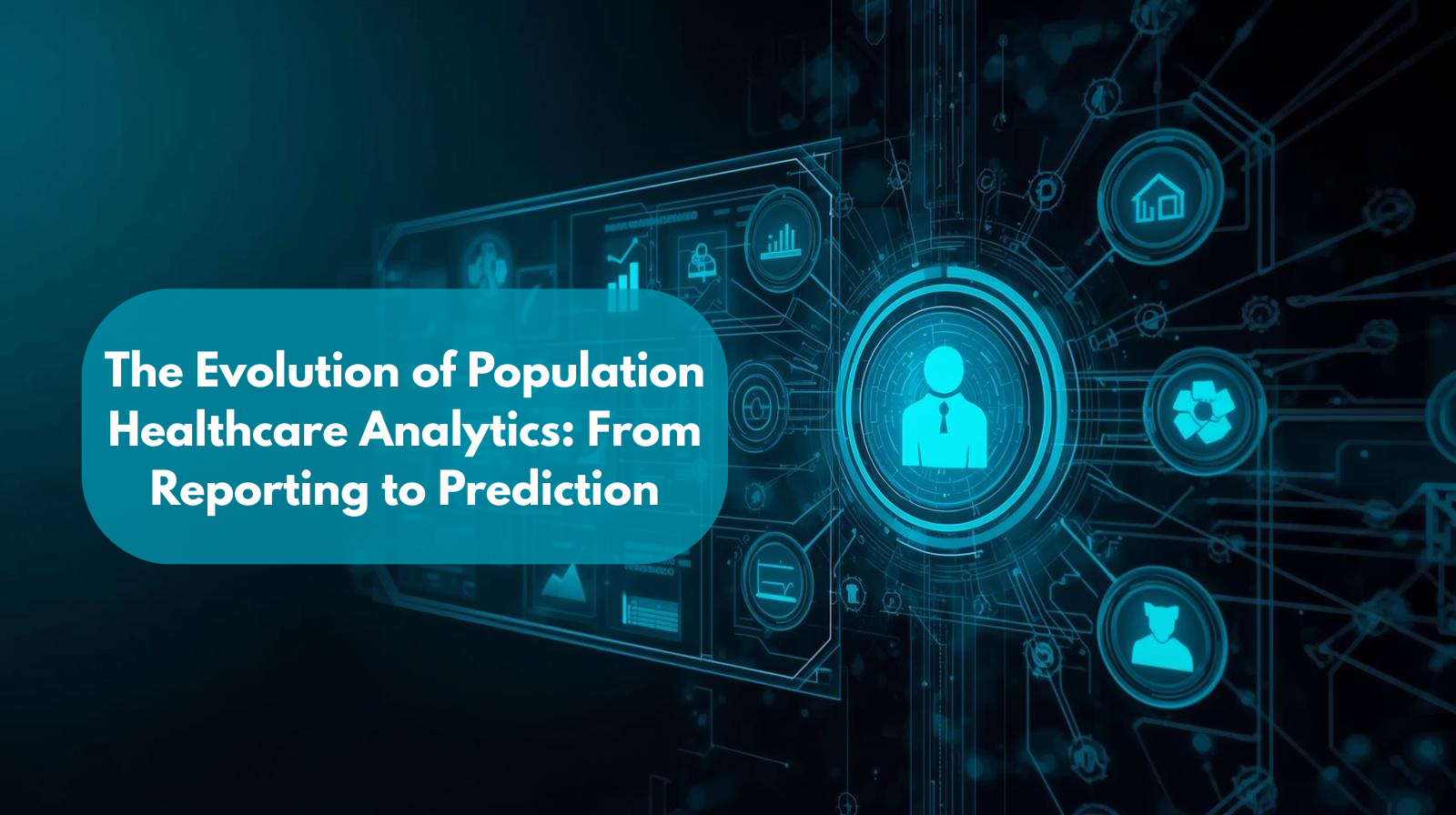
Healthcare data has never been scarce. The real challenge has always been how that data is used once collected. Clinical and operational teams often received reports weeks later summarizing events that had already occurred and costs that had already been incurred. Population healthcare analytics has significantly changed this model. It shifted analytics from retrospective reporting to proactive risk identification, resulting in the possibility of forecasting risk, gaps in care, and helping care teams prevent costly events rather than documenting them afterward.
This shift is already happening in real healthcare environments. It is quantifiable, functional, and is already being implemented in health systems that rely on continuous analytics instead of static dashboards. Understanding how analytics has evolved helps organizations evaluate their current capabilities and future direction.
The Problem With Traditional Reporting And Why It Was Never Enough
Healthcare reporting originally developed as a compliance and performance tracking function. Data was collected, formatted into charts and summaries, and distributed to administrators on a quarterly cycle. It answered one question well: what happened?
This retrospective model created challenges for health systems managing attributed populations under value-based care contracts. Knowing that readmission rates increased last quarter does not help clinicians identify which patients may be readmitted next week. Similarly, rising costs alone do not reveal which patient groups drove those expenses or what interventions could have changed the outcome.
The Core Limitations of Reporting-Only Analytics
- No real-time visibility into patient-level risk
- No ability to identify care gaps before they become costly events
- No connection between claims spend and clinical data in a single view
- Fragmented data across systems, with no longitudinal patient record
- Quality metrics are often evaluated after the performance period rather than monitored continuously
The Shift to Predictive and Prescriptive Analytics
Moving beyond reporting required systems capable of analyzing clinical data, claims, pharmacy records, lab results, and SDOH data in real time and surfacing actionable insights.
Predictive population healthcare analytics works very differently from traditional reporting. Instead of summarizing past population behavior, it estimates the likelihood of future outcomes for individual patients and flags risk before an event occurs.
What Predictive Analytics Delivers in Practice
- Individual 30/60/90-day readmission risk scores updated in real time
- High-cost cohort identification models that help target care management resources more effectively
- Chronic disease progression signals for diabetes, CHF, and COPD populations
- Episodic cost forecasting across bundled payment models, including BPCI-A and CMS TEAM
- Rising-risk patient flags that surface weeks before a patient reaches high-cost status
The next stage beyond prediction is prescriptive analytics. The system doesn't just identify a high-risk patient; it recommends the appropriate care pathway, identifies relevant care gaps, and delivers that information directly into the provider's workflow before the appointment begins.
Cost and Utilisation Analytics: The Financial Layer That Completes the Picture
Clinical prediction alone is not sufficient for health systems managing value-based contracts. Cost/utilization analytics adds the financial dimension, connecting claims spend to care patterns to show exactly where resources are being used efficiently and where they are not.
This is where mature population healthcare analytics capabilities create measurable financial value. By consolidating clinical and claims data into a single environment, healthcare organizations can analyze cost drivers, identify inefficiencies, and design targeted cost reduction initiatives without compromising care quality.
What Cost and Utilization Analytics Tracks
Reported outcomes from Persivia implementations illustrate this shift. HCA Florida Oak Hill Hospital reduced 30-day all-cause readmissions by 65%. McLaren realized $34 million in shared savings. These outcomes come from pairing predictive risk intelligence with cost/utilization analytics, not from reporting alone.
What a Mature Analytics Platform Looks Like Today
Modern population healthcare analytics platforms are integrated into daily clinical workflows rather than existing as separate reporting tools. It is embedded into the daily clinical workflow, delivering real-time signals where decisions are actually being made.
The key capabilities that define a mature platform include:
- A curated longitudinal patient record aggregating clinical, claims, SDOH, lab, and device data
- Predictive modelling and risk stratification that updates continuously, not annually
- Explainable AI that surfaces insights with enough context for clinicians to act on them
- Real-time care gap identification with automated closure workflows
- Quality tracking across HEDIS, STAR, and custom measures with AI-suggested actions
- Point-of-care delivery through EHR-embedded tools that put insights inside the visit
Persivia's CareSpace® platform achieves 91% care gap closure rate, 91.64% efficiency improvement, and a 0.5 STAR rating increase in a single year, outcomes that are only possible when analytics moves from a reporting function into an operational one.
Takeaway
Population healthcare analytics evolved not only to improve reporting but to improve patient outcomes. The transition from retrospective dashboards to real-time predictive and prescriptive analytics has changed how health systems manage risk, quality, and cost. Organizations that rely only on quarterly reports often make decisions using delayed data, whereas companies that use continuous and AI-driven analytics are able to close care gaps earlier, detect high-risk patients earlier, and maintain performance when using value-based contracts.
About Persivia
Persivia offers CareSpace®, a unified digital health platform designed to support population health analytics and value-based care initiatives. With 90% accuracy in predicting high-cost cohorts, 65% reduction in readmissions, $34M in documented shared savings, and full support for attributed and episodic risk models in a single platform, CareSpace® is where reporting ends and real population health management begins.